
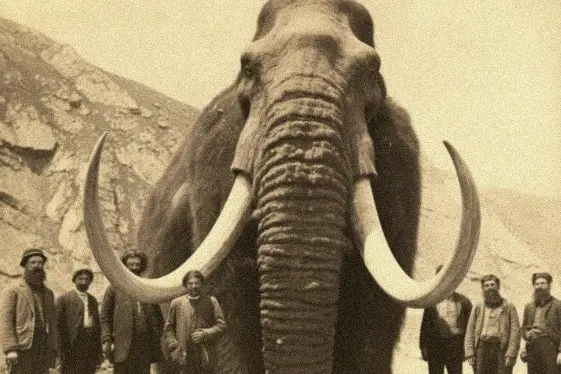
Paris: A surge of touching images claiming to capture significant moments in history has captivated amateur historians online. However, these images are not real and may distort our understanding of the past.
Shared widely on social media, these atmospheric black-and-white photos - such as a mother and child suffering during the Great Depression or a weary soldier from the Vietnam War - may initially appear to be genuine historical records. In reality, they were created by artificial intelligence, raising concerns among researchers about their impact on historical accuracy.
"AI has caused a tsunami of fake history, especially images," said Jo Hedwig Teeuwisse, a Dutch historian who debunks false claims online. "In some cases, they even make an AI version of a real old photo. It is really weird, especially when the original is very famous."
For example, one widely circulated photo shows two young men in front of an old biplane, allegedly depicting Orville and Wilbur Wright during their first powered flight. However, these men do not resemble the Wright Brothers at all. Authentic historical images reveal them as moustachioed figures in flat caps, looking nothing like the blond duo in the AI-generated image.
Using Midjourney, a popular AI image generator, various misleading images have emerged, including fictional recreations of the moment when Lee Harvey Oswald, the suspected assassin of President John F. Kennedy, was shot by Jack Ruby in 1963. Other fabricated images claim to depict the atomic bomb explosion over Hiroshima in 1945, the Soviet invasion of Prague in 1968, and even scenes of the Roman Coliseum in ancient times.
"They often focus on events from too long ago to have been photographed or on moments that are poorly documented," said Marina Amaral, an artist who specialises in adding colour to black and white photographs. "This creates a risk of false visuals being accepted as fact, which could, over time, distort our understanding of history and weaken public trust in visual evidence as a reliable source for learning about the past."
For now, Amaral and Teeuwissen believe they can still tell fake historical images from real ones just by looking at them. AI-generated photos often exhibit recognizable glitches, such as having too many fingers on a hand or missing crucial details—like the absence of a propeller on the Wright brothers' aircraft. These imperfections, along with overly perfect compositions, serve as warnings about the authenticity of these images.
"AI-generated pictures can recreate the look, but they miss the human element, the intent, the reason behind the photographer's choices," said Amaral. "They may be visually convincing, but they're ultimately hollow."
For Teeuwissen, "real photos are made by real people and there's usually something that's out of focus, or someone looks silly by accident, the makeup looks bad, et cetera." But she judges it is "only a matter of time" before the quality of the AI image makes fakes hard to detect with the naked eye -- a "dangerous" prospect, she says, which would amplify disinformation.
Agency
Published: 16 Oct 2024, 01:29 pm IST
Related Topics
Disclaimer: Kindly avoid objectionable, derogatory, unlawful and lewd comments, while responding to reports. Such comments are punishable under cyber laws. Please keep away from personal attacks. The opinions expressed here are the personal opinions of readers and not that of Mathrubhumi.
