
War clouds are looming large over the West Asia after the assassination of Hamas political chief Ismail Haniyeh in Tehran on July 31. While Tehran has blamed Israel for the airstrike on its soil, the latter has not yet owned up to assassination.
Amidst the ongoing sabre-rattling between Iran and Israel, let us examine the firepower that both nations pack.
Also Read

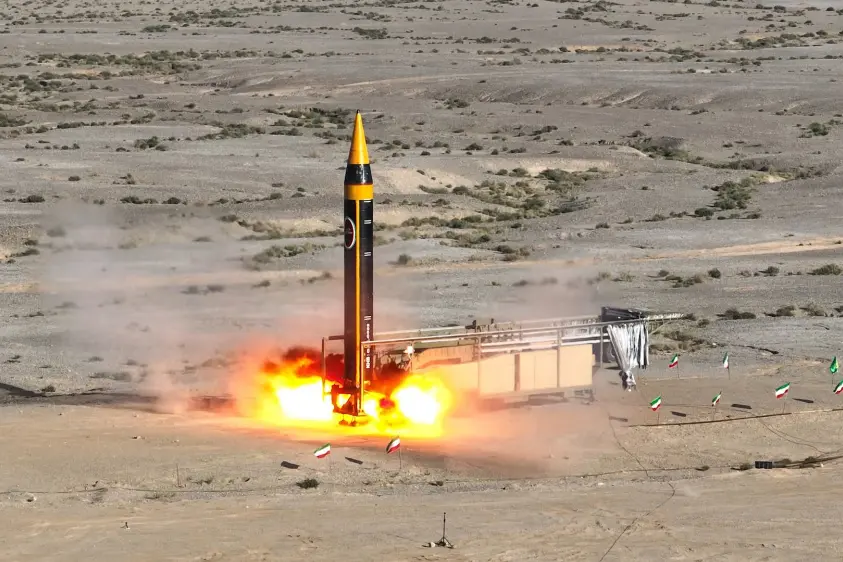
Iranian Ballistic Missiles
* Kheiber (Khorramshahr-4): The fourth generation of the Khorramshahr missile. It can travel up to 2,000 km and carry a warhead weighing about 1,500 kg
* Kheiber-Shekan: This missile can hit targets as far as 1,450 km and has a payload capacity of 600 kg
* Emad: A medium-range missile with a range of 1,700 km, capable of carrying a 750 kg payload
* Fattah-2: Unveiled in November 2023, this hypersonic missile can travel 1,500 km and has a 450 kg warhead, designed to bypass enemy defences
* Haj Qassem: Named after General Qassem Soleimani, this ballistic missile can reach targets up to 1,400 km away and carries a 500 kg warhead, featuring radar evasion technology
* Sejjil: With a range of about 4,000 km, this missile can deliver a payload of 700 kg
* Shahab-3: Adopted in 2003, it has a reach of 1,300 km and can carry a payload of up to 1,200 kg
* Ghadr-110: This intermediate-range missile can travel nearly 2,000 km and carry an 800 kg payload
* Dezful: With a range of about 1,000 km, this missile can carry a warhead weighing between 600 kg and 700 kg
Israel's Ballistic Missiles
Israel's ballistic missile programme is very secretive, so most of the information available is based on estimates.
* Jericho-2: The Jericho-2 is an intermediate-range, nuclear-capable missile that can carry a payload of 1,000 kg and has a range of about 1,500 km. It has an estimated range of between 4,800 km and 6,500 km, capable of carrying up to 1,300 kg.
* Lora: Lora is a quasi-ballistic missile with a range of up to 430 km and can carry a payload of up to 570 kg.
Comparing the Air Capabilities
Israel is preparing for potential retaliation from Iran following the assassination of Haniyeh, a close ally of Tehran.
Iran Air Force Capabilities
Iran's Air Force has about 37,000 personnel, but years of international sanctions have limited access to modern military equipment, according to the International Institute for Strategic Studies (IISS) in London.
They operate only a few dozen strike aircraft, which include some ageing US models from before the 1979 revolution and Russian jets.
Iran has a small fleet of fighter jets, including nine F-4 and F-5 planes, a squadron of Sukhoi-24 jets from Russia and a few MiG-29s, F-7s and F-14s.
Additionally, Iran has drones designed to carry out attacks. Estimates suggest they have a few thousand drones in total. Iran also possesses over 3,500 surface-to-surface missiles, some of which can carry warheads weighing up to half a ton. However, the number of missiles that can reach Israel may be fewer.
In April, Iran’s air force commander stated that their Sukhoi-24 jets were in top condition to respond to any potential Israeli attack, according to Reuters. However, relying on these jets, which were first created in the 1960s, highlights the weaknesses in Iran’s air force. For defence, Iran uses a combination of Russian-made, and locally produced, surface-to-air missiles and air defence systems.
In 2016, Tehran received the S-300 anti-aircraft system from Russia. This system can target multiple threats at once—including aircraft and ballistic missiles. Iran also has its own Bavar-373 surface-to-air missile system, along with the Sayyad and Raad defence systems.
Israel's Air Force Capabilities
Israel has a highly-advanced air force equipped with hundreds of US-made F-15, F-16 and F-35 jet fighters.
These aircraft were crucial in intercepting Iranian drones in April when Iran launched explosive drones and missiles in its first direct attack on Israel.
Published: 10 Aug 2024, 04:53 pm IST
Related Topics
Disclaimer: Kindly avoid objectionable, derogatory, unlawful and lewd comments, while responding to reports. Such comments are punishable under cyber laws. Please keep away from personal attacks. The opinions expressed here are the personal opinions of readers and not that of Mathrubhumi.