
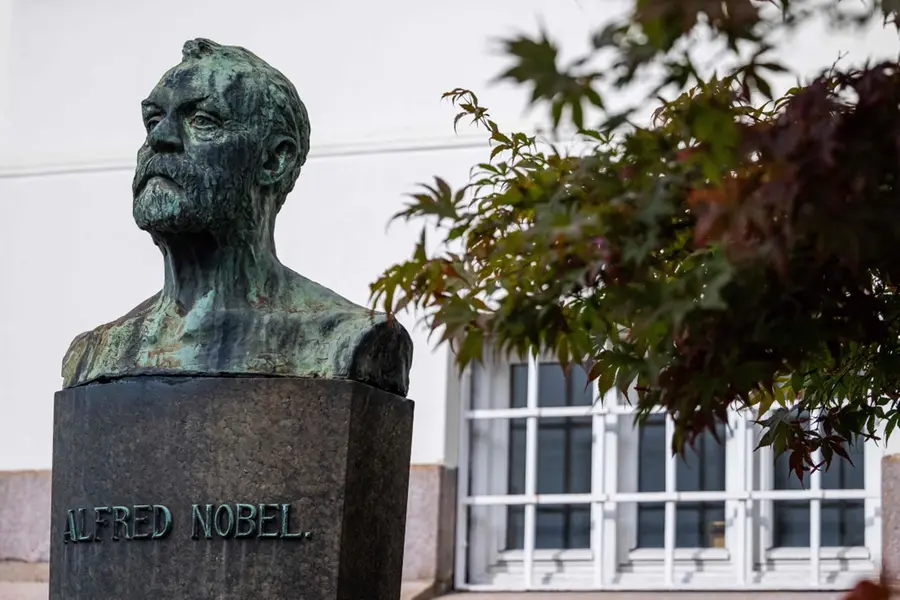
Stockholm: Since 1901, the Nobel Prizes have honoured individuals and organisations for their contributions to humanity, fulfilling the vision of inventor Alfred Nobel. With the 2024 Nobel winners set to be announced between October 7 and 14, here are five important points to know about the prizes and their founder.
Notable absences
Also Read

Over the years, five Nobel Peace Prize winners have been prevented from attending the ceremony in Oslo. In 1936, German journalist Carl von Ossietzky was imprisoned in a Nazi concentration camp. Myanmar's Aung San Suu Kyi, awarded in 1991, was under house arrest and declined to attend, fearing she wouldn't be allowed back into her country. In 2010, Chinese dissident Liu Xiaobo was in prison, leaving an empty chair at the ceremony. Belarusian activist Ales Bialiatski was jailed in 2022, represented by his wife, and last year, Iranian activist Narges Mohammadi celebrated her win from Evin prison.
Youngest laureates
The youngest-ever Nobel laureate, Pakistani activist Malala Yousafzai, won the Peace Prize at just 17 in 2014. Australian physicist Lawrence Bragg was also young, winning the Nobel Prize in Physics at 25 in 1915 for work done at age 21. Iraqi Nadia Murad won the Peace Prize at 25 in 2018 for her advocacy for the Yazidi community.
Oldest laureates
On the other end of the spectrum, John Goodenough became the oldest laureate when he won the Nobel Prize in Chemistry in 2019 at age 97 for his work on lithium-ion batteries. The previous year, Arthur Ashkin won the Nobel Prize in Physics at 96.
Posthumous awards
Since 1974, Nobel regulations state that the prize cannot be awarded posthumously, although individuals who die between the announcement and the award ceremony in December can still be honoured. Before this rule, only two people received posthumous awards: Dag Hammarskjöld, who died in a plane crash in 1961, and poet Erik Axel Karlfeldt in 1931. In 2011, the Nobel committee awarded Ralph Steinman the Prize in Physiology or Medicine, unaware he had passed away just three days earlier.
Alfred Nobel
Alfred Nobel is famously known for inventing dynamite, but he also had a passion for poetry, particularly the works of Percy Bysshe Shelley and Lord Byron. He wrote poetry his entire life, sometimes in his native Swedish but mostly in the language of Shakespeare.
In a letter to a friend, he wrote: "I have not the slightest pretension to call my verses poetry; I write now and then for no other purpose than to relieve depression, or to improve my English." In 1862, at the age of 29 and questioning his literary talent, he sent a letter in French to a young woman that said: "Physics is my field, not writing." In 1896, the year he died, he wrote a provocative play titled "Nemesis," inspired by Shelley’s "The Cenci."
Each year, the Swedish Academy, which awards the Nobel Prize in Literature, receives about 300 nominations from previous winners, academics, and literary experts. Nominators highlight the strengths of their candidates, sometimes including gifts for the jury, although this practice is frowned upon. Self-nominations are not allowed, and nominations must be renewed annually, with candidates needing to be alive at the time of nomination.
Agency
Published: 03 Oct 2024, 02:46 pm IST
Related Topics
Disclaimer: Kindly avoid objectionable, derogatory, unlawful and lewd comments, while responding to reports. Such comments are punishable under cyber laws. Please keep away from personal attacks. The opinions expressed here are the personal opinions of readers and not that of Mathrubhumi.