
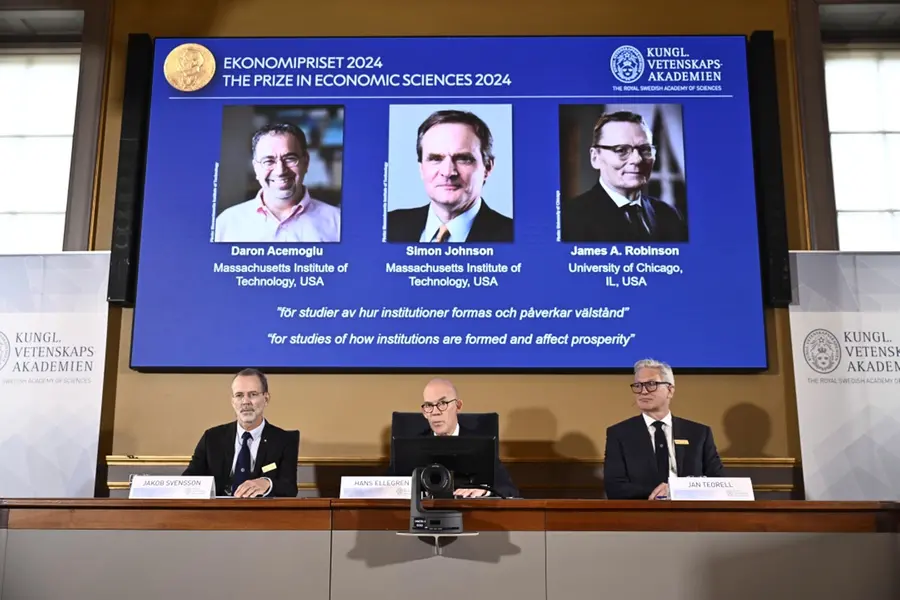
Stockholm: The Nobel Prize in Economics was awarded on Monday to Turkish-American Daron Acemoglu, British-American Simon Johnson, and British-American James Robinson. They were honored for their research on the reasons behind wealth inequality between nations.
The trio's work focuses on how political and economic systems, introduced by European colonizers, have impacted the prosperity of countries. According to the Nobel committee, their research highlights the importance of societal institutions in explaining why some nations prosper while others struggle.
"Reducing the vast differences in income between countries is one of the greatest challenges of our time," said Jakob Svensson, chair of the Committee for the Prize in Economic Sciences. "The laureates have shown the critical role of institutions in achieving this."
Acemoglu, 57, and Johnson, 61, are professors at the Massachusetts Institute of Technology (MIT), while Robinson, 64, is a professor at the University of Chicago.
The committee emphasized that the laureates' work demonstrates how political and economic institutions affect the income gap between countries. They noted that while poorer countries are becoming wealthier, they are not closing the gap with richer nations.
The prize committee gave the example of Nogales, a city divided by the US-Mexico border, to illustrate the role institutions play in economic outcomes. Residents on the US side of the city tend to be better off because of greater opportunities and political rights, while those on the Mexican side face different economic conditions and have fewer political rights.
The research also sheds light on why some countries experience slow economic growth. The committee explained that in some colonies, European powers exploited the local population and resources, creating systems that only benefited the colonizers. This led to short-term gains for those in power but did not promote long-term growth. In contrast, colonies where inclusive political and economic systems were built saw long-term benefits for everyone.
Acemoglu, speaking from Athens after learning about the award, said their research supports the idea that democracies tend to grow faster than non-democratic regimes. However, he cautioned that democracy is not a quick fix, and establishing democratic systems is difficult.
Acemoglu is well-known for his book Why Nations Fail: The Origins of Power, Prosperity, and Poverty, which explores similar themes and made him a strong contender for this year's prize.
The Nobel Prize in Economics wraps up the Nobel season, which saw awards in physics and chemistry focus on artificial intelligence. The Nobel Peace Prize was awarded to Nihon Hidankyo, a Japanese group dedicated to fighting nuclear weapons.
The Nobel Prizes include a diploma, a gold medal, and a $1 million cash prize. The winners will receive their awards on December 10, the anniversary of Alfred Nobel’s death.
AP
Published: 14 Oct 2024, 06:14 pm IST
Related Topics
Disclaimer: Kindly avoid objectionable, derogatory, unlawful and lewd comments, while responding to reports. Such comments are punishable under cyber laws. Please keep away from personal attacks. The opinions expressed here are the personal opinions of readers and not that of Mathrubhumi.
