
A bright fireball streaked across the Southeast US, causing a sonic boom and possibly impacting a Georgia home.
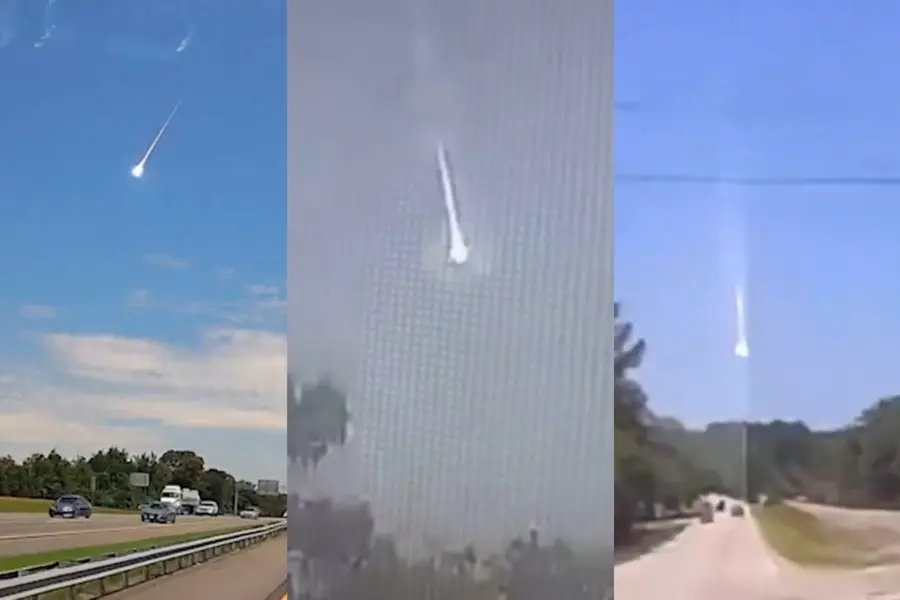
McDonough: A blazing fireball streaked across the midday sky over parts of the southeastern United States on Thursday, startling residents and leaving behind what may be physical evidence of a meteor strike.
The dramatic event, witnessed in broad daylight, was likely caused by a meteor or space debris burning through Earth’s atmosphere, officials said. Reports of a brilliant streak of light, accompanied by a loud sonic boom, were received from across Georgia and South Carolina shortly after 12:30 pm.
Possible meteorite pierces Georgia home
In Henry County, just southeast of Atlanta, emergency officials confirmed a homeowner reported that a “rock” had punctured their roof, left a hole in the ceiling the size of a golf ball, and cracked the laminate floor beneath. Ryan Morrison, director of emergency management for Henry County, said, “it pierced through the roof all the way through and cracked through the laminate flooring to the concrete. That’s why we think it’s part of this meteor storm,” as reported by Guardian.
The homeowner, who has a young child, has asked not to be identified publicly. Authorities are currently investigating the object and have not ruled out it being a meteorite fragment.
Fireball spotted across multiple states
Doorbell and dashcam footage captured the fireball falling rapidly through the sky, with sightings reported in at least six states: Georgia, South Carolina, Alabama, North Carolina, Tennessee, and Florida. More than 140 reports were submitted to the American Meteor Society (AMS), which noted the event coincided with the ongoing June Bootids meteor shower.
Mike Hankey, operations manager for the AMS, told CNN, “it looks to be a ‘daytime fireball’ that caused a sonic boom. This is usually indicative of a (meteor) dropping a fireball, but not always.”
According to the AMS, Thursday’s fireball was classified as a bolide — an exceptionally bright meteor that explodes in a terminal flash. The organisation estimated the meteor reached a magnitude of -14, making it brighter than the full moon and far more luminous than Venus, which marks the typical brightness threshold for a fireball.
Shockwaves and sightings rattle the region
Witnesses from metro Atlanta to North Carolina described hearing a loud explosion, with some believing it to be an earthquake or lightning strike. Brenda Eckard, a 64-year-old from Gilbert, South Carolina, said that she saw a big flash in the sky come down and disappear and that it almost looked like a firework.
Eckard said she immediately phoned her husband to make sure their home hadn’t been hit.
The National Weather Service in Peachtree City, Georgia, initially didn’t detect the object on radar, but later analysis using satellite-based lightning detection showed an atmospheric disturbance over the NC/VA border and over Georgia between 11:51 a.m. and 11:56 a.m. Eastern Time. “We did not catch it on radar,” said meteorologist Dylan Lusk. “It looks like the fireball was a little bit too high up.” However, a smoke trail was captured by satellite.
In Rockdale County, Georgia, residents reported homes shaking from the shockwave, with some mistaking the impact for an earthquake. The US Geological Survey quickly ruled out any seismic activity.
Meteor or space junk?
While NASA has yet to comment publicly on the incident, officials are leaning toward the object being a meteor — particularly given the sonic boom, brightness, and apparent impact. Though meteors enter Earth’s atmosphere frequently, few are bright enough to be visible during daylight hours, and it is extremely rare for them to cause damage on the ground.
Meteoroids — typically ranging from 1 to 20 metres in size — enter the atmosphere at speeds of 11 to 72 km/s (25,000–160,000 mph). As they collide with atmospheric particles, the resulting friction heats the object to thousands of degrees Celsius, causing it to glow and often disintegrate into dust. But in rare cases, like Thursday’s, a fragment can survive the descent.
Emergency management officials in Georgia are analysing the suspected meteorite fragment. The North American Aerospace Defense Command has referred all inquiries to NASA. Meanwhile, local agencies across the Southeast are monitoring for potential additional fragments, as the AMS has suggested the fireball likely broke apart into dozens, if not hundreds, of pieces.
(With inputs from AP)
Published: 27 Jun 2025, 10:58 am IST
Related Topics
Disclaimer: Kindly avoid objectionable, derogatory, unlawful and lewd comments, while responding to reports. Such comments are punishable under cyber laws. Please keep away from personal attacks. The opinions expressed here are the personal opinions of readers and not that of Mathrubhumi.
