
Bangladesh’s landmark 2026 general election is underway, with nearly 128 million voters casting ballots under an unprecedented nationwide security deployment.
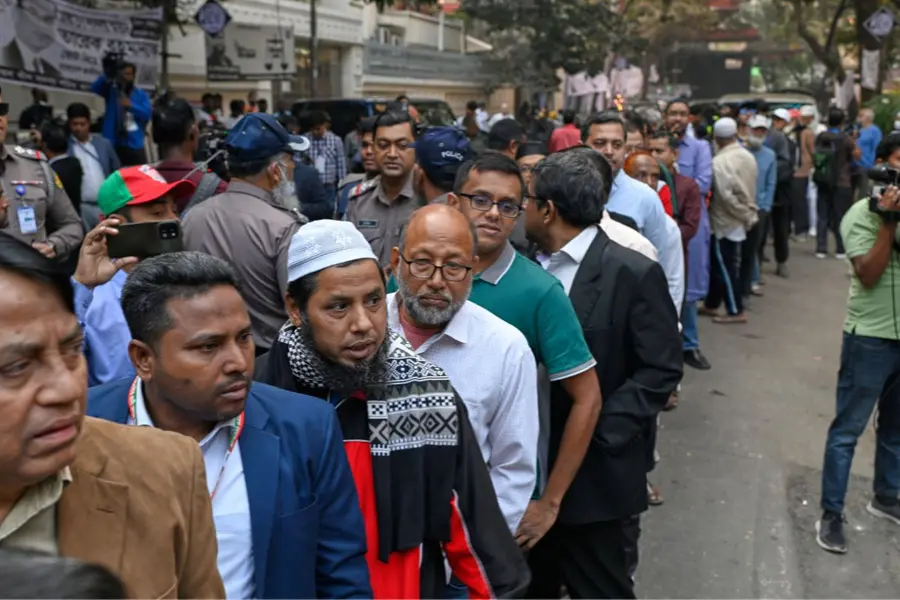
Voting has begun across Bangladesh in a landmark parliamentary election that marks the nation’s first major nationwide ballot since the 2024 uprising that toppled former Prime Minister Sheikh Hasina.
Voters started casting their ballots from 7.30 am local time across 299 of 300 constituencies under the watch of a record security deployment aimed at preventing violence and ensuring order.
Also Read

Nearly 127.7 million eligible voters, including over 5 million first-time voters, are participating in what is widely described as a defining moment for Bangladesh’s democracy. Polling continues until late afternoon, and preliminary results are expected as early as Friday, February 13.
Security: Largest ever deployment in electoral history
Authorities have mobilised close to one million security personnel, backed by army units, drones and rapid response teams, making this the most intensely guarded election in the country’s history. Strategic high-risk districts such as Dhaka, Chittagong and Rajshahi have seen paramilitary and police patrols reinforced, with CCTV monitoring and body cameras deployed at many polling stations.
Officials have identified around 24,000 polling centres as “high” or “moderate” risk, prompting stricter presence of law enforcement and quick-reaction forces in sensitive areas.
A ballot shaped by political upheaval
This election comes 18 months after street protests and political upheaval ended the long dominance of the Awami League, led by Sheikh Hasina. She fled to India in 2024, and her party remains banned from contesting this poll.
The main contest has crystallised around the Bangladesh Nationalist Party (BNP), led by Tarique Rahman, son of former Prime Minister Khaleda Zia, and a broad 11-party coalition spearheaded by the Islamist party Jamaat-e-Islami. The BNP is viewed in many quarters as the frontrunner, with Rahman vowing to restore stability and “clean governance”.
However, the rise of Jamaat-e-Islami has prompted deep concern among civil society groups, particularly women’s rights activists, who warn that a stronger Islamist presence in Parliament could imperil hard-won social freedoms.
Referendum, observers and international stakes
In addition to the parliamentary vote, Bangladeshis are also weighing in on an 84-point constitutional reform referendum designed to strengthen electoral institutions, balance powers and set term limits for the executive.
The election is monitored by foreign observers, including missions from the European Union and the Commonwealth, with tens of thousands of domestic and international monitors in place.
Economic and social implications
Economic sectors such as the garment industry, which account for the bulk of exports, are looking to the ballot for political stability and policy clarity after months of tariff pressures and domestic instability.
Despite long queues and heavy security, early images from polling centres suggest a large turnout and determined participation. Authorities say they aim for a peaceful and credible vote as Bangladesh’s future democratic trajectory hangs in the balance.
Published: 12 Feb 2026, 07:36 am IST
Disclaimer: Kindly avoid objectionable, derogatory, unlawful and lewd comments, while responding to reports. Such comments are punishable under cyber laws. Please keep away from personal attacks. The opinions expressed here are the personal opinions of readers and not that of Mathrubhumi.