
The army said in an earlier briefing that it had identified only two polling centres in Dhaka as “risky”
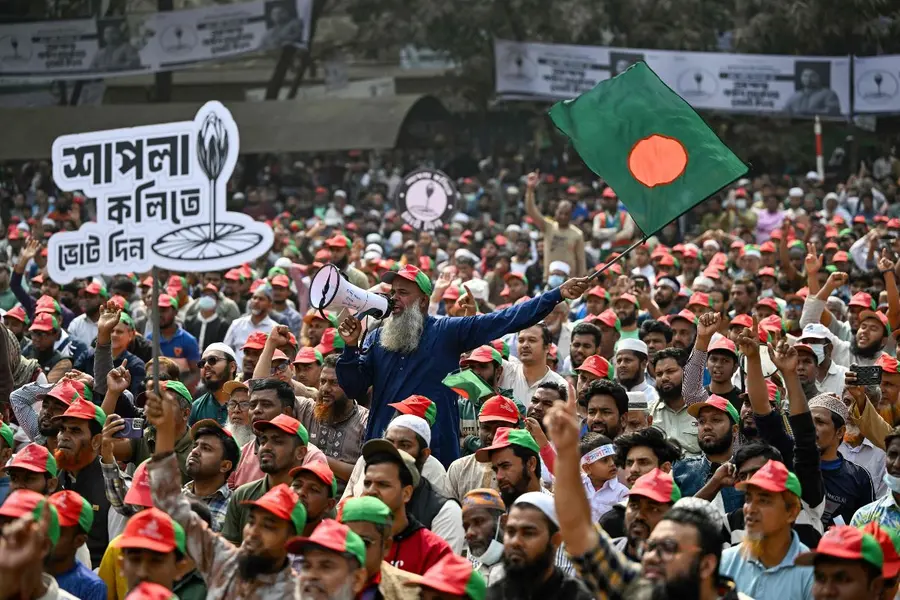
Dhaka: More than half of Bangladesh’s polling centres have been classified as “risk-prone” ahead of the general election, officials said, as authorities prepare for the largest deployment of law enforcement and the most extensive use of technology in the country’s electoral history.
The Election Commission (EC) said around 90 per cent of polling stations will be monitored by CCTV, and many police officers deployed in the capital, Dhaka, will wear body cameras.
The security arrangements are being guided by a risk assessment, Election Commissioner Abul Fazal Mohammad Sanaullah told a media briefing on Tuesday. “Security deployment is being made based on local sensitivity assessments,” he said.
Officials said the EC expects law enforcement agencies to maintain a peaceful environment for voters both during polling and afterwards. Sanaullah added that the commission was broadly satisfied with the current law-and-order situation and believed it was better than at any time in the past.
His remarks followed a statement by Police Inspector General Baharul Alam, who said that 24,000 of nearly 43,000 polling centres nationwide had been identified as either high or moderate risk. The police provided a list of risk-prone stations to the EC, noting that 1,614 of Dhaka’s 2,131 polling centres were deemed risk-prone.
In contrast, the army said in an earlier briefing that it had identified only two polling centres in Dhaka as “risky”.
Officials also said that police would wear body-worn cameras for the first time at selected locations.
EC data showed that first-time voters accounted for about 3.58 per cent of the total 127.7 million registered voters.
ALSO READ | US, Bangladesh sign reciprocal trade deal; tariffs cut to 19%, ‘first in South Asia’
The general election is being held alongside a referendum on an 84-point reform package. The main contest is between the Bangladesh Nationalist Party (BNP) and its former ally, Jamaat-e-Islami.
Last year, the interim government led by Chief Adviser Muhammad Yunus disbanded the Awami League, the party of deposed prime minister Sheikh Hasina, and barred it from participating in the election.
Pre-poll surveys conducted over the past two months by various research organisations and think tanks have suggested that the BNP is the frontrunner, with its new chairman, Tarique Rahman, seen as the likely next prime minister.
The Awami League government was toppled following the violent student-led protests known as the July Uprising on 5 August 2024.
Published: 11 Feb 2026, 07:32 am IST
Related Topics
Disclaimer: Kindly avoid objectionable, derogatory, unlawful and lewd comments, while responding to reports. Such comments are punishable under cyber laws. Please keep away from personal attacks. The opinions expressed here are the personal opinions of readers and not that of Mathrubhumi.
