
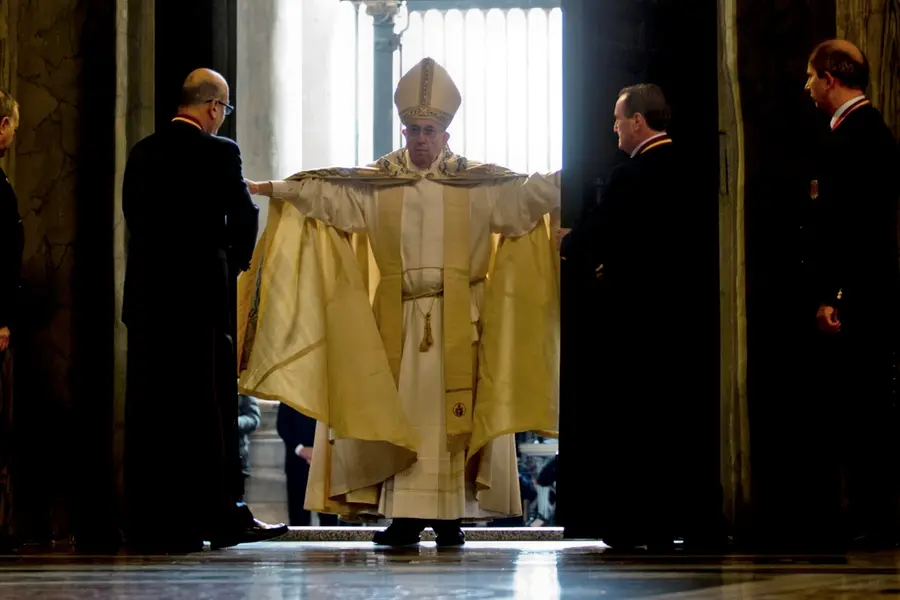
Vatican City: Pope Francis will officially inaugurate the 2025 Holy Year on Tuesday, reviving an ancient Church tradition that encourages the faithful to make pilgrimages to Rome, despite heightened security concerns following a recent Christmas market attack in Germany.
At the start of Christmas Eve Mass, the Pope will open the Holy Door of St. Peter's Basilica, which will remain open throughout the year, welcoming an estimated 32 million pilgrims who are expected to visit Rome.
Also Read

History and significance of the Holy Year
The first Holy Year was proclaimed in 1300, and they are typically celebrated every 25 to 50 years. Pilgrims who participate in the Holy Year can receive "indulgences" -- a long-standing practice within the Catholic Church associated with the forgiveness of sins, offering a form of release from Purgatory.
The last regular Jubilee was held in 2000, when Pope St. John Paul II marked the beginning of the third millennium. A special Jubilee focused on mercy was held in 2015-2016, and the next one is scheduled for 2033 to commemorate the anniversary of Christ’s crucifixion.
Indulgences and their meaning
According to Catholic doctrine, when Catholics confess their sins, they are forgiven and spared from eternal damnation. An indulgence is intended to eliminate the "temporal" punishment of sin -- the lingering consequences that affect relationships with others.
The sale of indulgences, which sparked Martin Luther's protest and led to the Protestant Reformation in the 1500s, was condemned by the Church after Luther's excommunication. Since the 1562 Council of Trent, the buying and selling of indulgences has been forbidden. However, the granting of indulgences continues to play a significant role in Holy Year pilgrimages.
Conditions for gaining indulgences in 2025
According to the norms issued for the 2025 Jubilee, Catholics can obtain an indulgence if they:
- Undertake a pious pilgrimage, participating in Masses and other sacraments, at any of the four papal basilicas in Rome or the Holy Land, or other sacred Jubilee sites “so as to manifest the great need for conversion and reconciliation.”
- Participate in works of charity, mercy or penance, such as visiting prisoners, sick people or elderly people or undertaking corporal works of mercy “to feed the hungry, give drink to the thirsty, clothe the naked, welcome the stranger, heal the sick, visit the imprisoned, and bury the dead.”
- Abstain, in a spirit of penance, for at least one day of the week from “futile distractions,” such as social media, or from “superfluous consumption," such as fasting; or donating the proportionate sum to the poor or to help migrants.
Pope Francis's focus on prisoners
Pope Francis has consistently made outreach to prisoners a central focus of his priestly ministry, and this Holy Year, centered on a message of hope, is no different.
In fact, the only other Holy Door that Francis will personally open this year is at the chapel of Rome’s Rebibbia prison, emphasizing the importance of offering prisoners a sense of hope for a brighter future.
The last major event of the Holy Year, before its closure on January 6, 2026, will be the Jubilee of Prisoners on December 14, 2025.
The busy jubilee schedule
The Jubilee schedule is a packed list of both official and unofficial events, which will put Pope Francis’s endurance to the test. At 88 years old, he entered the Christmas season struggling with a cold that made breathing difficult.
Each month features multiple official Jubilee events, sometimes two, three, or even four, tailored to specific groups such as the armed forces, artists, clergy, the poor, volunteers, and educators. Additionally, there are unofficial Jubilee events, including pilgrimages to Rome organized by various dioceses and groups.
One such unofficial event that has garnered attention is scheduled for September 6, hosted by the Italian association “La Tenda di Gionata” (Jonathan’s Tent). This group works to make LGBTQ+ Catholics feel more accepted within the Church.
Enhanced security measures in Rome
Rome's Mayor, Roberto Gualtieri, has announced that the security strategy will combine traditional policing with advanced technology. This includes the deployment of an additional 700 officers, along with high-tech surveillance systems such as drones and closed-circuit cameras. These cameras are equipped with algorithms powered by artificial intelligence, enabling real-time monitoring of crowd sizes and congestion hotspots. “There will be more vehicles, more men, and very, very shall we say robust and important security devices,” Gualtieri told reporters last week.
The Vatican has taken steps to reduce congestion for pilgrims by allowing them to reserve their visits to St. Peter's Basilica in advance.
Increased security following German attack
In light of the recent attack in Magdeburg, Germany, where a driver crashed into a Christmas market, killing five, Italian authorities issued a directive to police stations nationwide, urging them to increase security efforts. This includes ramping up surveillance and police presence around Christmas markets, tourist attractions, and public displays.
Given its life-sized nativity scene, massive Christmas tree in St. Peter’s Square, and outdoor nativity exhibit along the Bernini colonnade, the Vatican is undoubtedly considered a high-risk target.
Ongoing preparations for the Holy year
Rome has been under the strain of two years of intense preparations for the Holy Year, with major public works and artistic renovations, many of which were funded by the European Union’s COVID-19 recovery program.
However, fewer than a third of the 323 Jubilee projects are completed or nearing completion, meaning the city's traffic disruptions and unsightly constructions will persist through 2025 and into 2026. Nevertheless, locals and visitors are starting to see some of the finished results.
Bernini’s fountains in Piazza Navona have been restored to their gleaming white appearance after extensive cleaning, and the Trevi Fountain recently reopened after renovation. This Monday, the main Jubilee project was unveiled: a pedestrian plaza connecting Castel St. Angelo to the Via della Conciliazione, the main avenue leading to St. Peter’s Square.
Agency
Published: 23 Dec 2024, 12:23 pm IST
Related Topics
Disclaimer: Kindly avoid objectionable, derogatory, unlawful and lewd comments, while responding to reports. Such comments are punishable under cyber laws. Please keep away from personal attacks. The opinions expressed here are the personal opinions of readers and not that of Mathrubhumi.