
The announcement of an 18% tariff on Indian goods by US President Donald Trump and Prime Minister Narendra Modi has marked a major shift in bilateral trade ties
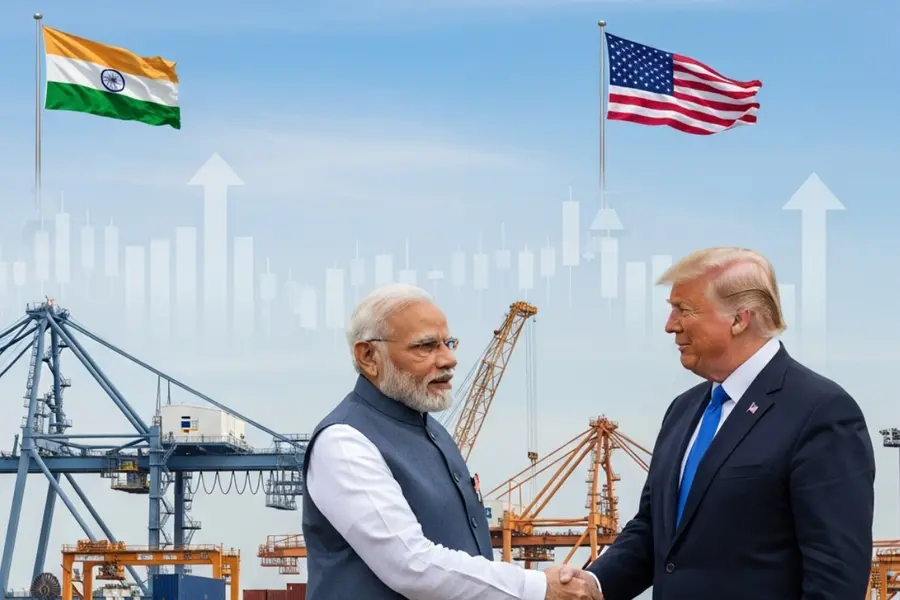
India and the United States this week announced a significant easing of trade tensions, with tariffs on Indian goods reduced from 50% to 18%. While the formal agreement is yet to be signed and detailed provisions are awaited, the move signals the end of a prolonged stalemate between the two economies.
Tariff reset restores competitiveness
Also Read

The US is India’s single largest trading partner, accounting for around 21% of India’s total goods exports in the first eleven months of 2025. The earlier 50% tariff had eroded the competitiveness of Indian products in the American market.
With the revised 18% tariff, India now enjoys a lower rate than several competing economies. Vietnam and Bangladesh face tariffs of around 20%, Malaysia 19%, Cambodia and Thailand 19%, and China 34%. Pakistan is subject to 19%. This places Indian exporters in a relatively stronger position in labour-intensive sectors such as garments, leather, footwear, carpets, shrimps, and gems and jewellery.
Commerce Minister Piyush Goyal described the arrangement as a “very good” deal, stressing that India secured better terms than competitors while protecting sensitive sectors.
Agneshwar Sen, Trade Policy Leader at EY India, said the immediate impact would be to “arrest the export erosion” India had been facing. He noted that the lower tariffs restore predictability and allow exporters to plan pricing and retain market share rather than absorb losses.
The agreement reportedly cuts tariffs on nearly 60% of Indian exports to the US.
Growth and market impact
Global financial institutions have estimated that the tariff rollback could add to India’s economic growth. Goldman Sachs projected an incremental boost of around 0.2 percentage points to annual GDP if the lower tariffs are fully implemented. Barclays estimated that reversing the 50% tariff threat could add 30 basis points to headline GDP growth.
The announcement triggered a strong market reaction. The Sensex recorded one of its biggest single-day gains, adding Rs 12 lakh crore in investor wealth. Foreign portfolio investors turned net buyers, investing Rs 5,236 crore in equities on the day of the rally.
The rupee also appreciated sharply, rising 124 paise to 90.27 against the dollar, marking its strongest single-day gain in seven years.
Russian oil question
In a post on Truth Social, President Trump claimed that India had agreed to stop buying Russian oil and increase purchases from the US and potentially Venezuela.
However, Russia said it had received no official communication from New Delhi. Kremlin spokesman Dmitry Peskov stated that there had been no formal statement from India on the issue.
Data from Kpler show that Russia’s share in India’s crude imports declined from 37.9% to 33.7% between April and November 2025. In absolute terms, imports fell from about 1.8 million barrels per day in November to around 1.16 million barrels per day in January 2026. Over the same period, US crude imports rose to 8.1% from 4.6%.
Analysts suggest that any immediate sharp reduction in Russian supplies is unlikely, given India’s refining requirements and existing contractual commitments. A report by SBI Research indicated that shifting part of imports to Venezuelan crude could potentially save India up to $3 billion annually, depending on pricing and logistics.
Agriculture and dairy safeguarded
Concerns emerged after Trump’s statement that India would “BUY AMERICAN” at higher levels, particularly regarding agriculture.
Piyush Goyal clarified in the Lok Sabha that India had successfully protected its “sensitive sectors, particularly agriculture and dairy” during negotiations. US Trade Representative Jamieson Greer also indicated that while India agreed to cut tariffs on industrial goods to zero from 13.5%, agriculture remains safeguarded.
Agriculture and allied sectors support the livelihoods of over 700 million people in India. Policymakers have consistently maintained that opening the sector to heavily subsidised foreign farm products could undermine domestic farmers’ incomes.
Strategic timing
The agreement comes shortly after India concluded a major free trade agreement with the European Union. Analysts suggest that this may have accelerated US efforts to finalise negotiations.
Trade talks between India and the US had continued despite the imposition of 50% tariffs. Engagement at the leadership and ministerial levels, along with diplomatic efforts, appears to have paved the way for the breakthrough.
Caution over fine print
While the headline tariff cut has been welcomed by exporters and markets, experts have advised caution. Past trade agreements have seen later reinterpretations and safeguards alter initial expectations.
A joint statement detailing the full contours of the agreement is expected soon. Until the final provisions are released, the long-term sectoral impact and strategic commitments — including energy sourcing — remain subject to clarification.
For now, the 18% tariff signals a reset in India-US trade relations, restoring competitiveness for Indian exporters and reducing uncertainty, but the durability and depth of the deal will depend on its detailed implementation.
Published: 07 Feb 2026, 05:57 pm IST
Related Topics
Disclaimer: Kindly avoid objectionable, derogatory, unlawful and lewd comments, while responding to reports. Such comments are punishable under cyber laws. Please keep away from personal attacks. The opinions expressed here are the personal opinions of readers and not that of Mathrubhumi.