
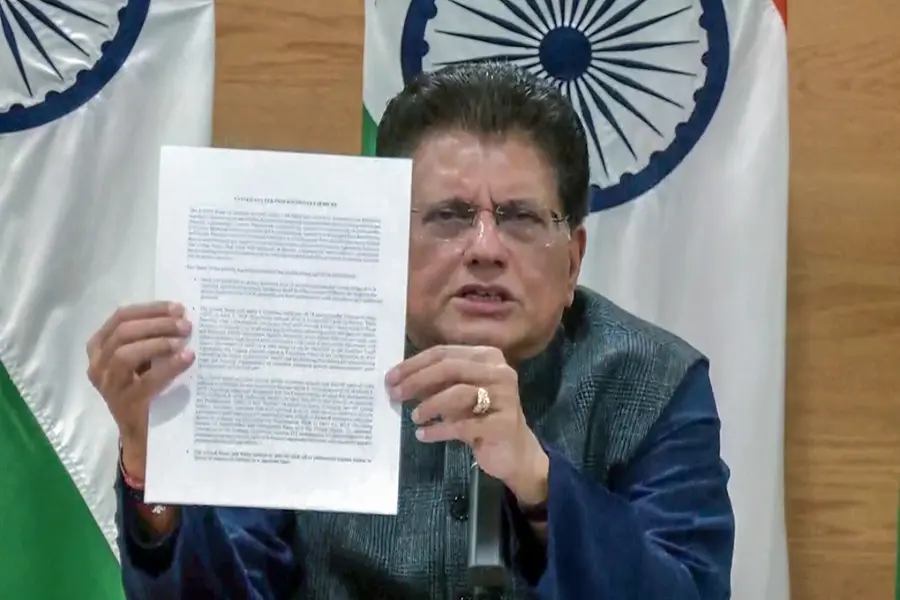
Union Commerce and Industry Minister Piyush Goyal on Saturday asserted that the interim trade agreement with the United States fully safeguards farmers
New Delhi: A political row intensified on Saturday after India and the United States announced a framework for an interim trade agreement under which US tariffs on Indian goods will be reduced to 18 per cent. While the Opposition criticised the pact, the government maintained that the deal protects sensitive domestic sectors.
Commerce and Industry Minister Piyush Goyal said the agreement has been carefully designed to safeguard farmers and the dairy sector. Responding to criticism, he said no step has been taken in the trade framework that goes against farmers’ interests. He accused certain political groups of misleading the public and being surprised that the agreement does not harm the agricultural sector.
Also Read

Goyal stated that under the agreement, the reciprocal tariff of 50 per cent levied on Indian exports to the US will be reduced to 18 per cent. He said this rate is lower than tariffs imposed on several competing countries, which would provide Indian exporters with a competitive advantage in the US market.
He highlighted that zero duty will apply to several major Indian exports to the United States. These include gems and diamonds, pharmaceutical products and smartphones. According to the minister, the reduction in duties will open opportunities for exporters and generate employment.
Prime Minister Narendra Modi welcomed the interim trade framework, saying it would strengthen the ‘Make in India’ initiative by creating opportunities for farmers, entrepreneurs, MSMEs and start-ups, and generate jobs for women and young people. He also thanked US President Donald Trump for his personal commitment to strong bilateral ties.
Under the framework, India will eliminate or reduce tariffs on all US industrial goods and a wide range of American food and agricultural products. These include dried distillers’ grains, red sorghum for animal feed, tree nuts, fresh and processed fruit, soybean oil, wine and spirits, among others.
The Opposition, including the Congress, has criticised the deal and indicated that it will raise the matter in Parliament during the ongoing Budget Session. Critics have alleged that the agreement could favour the United States and affect sensitive domestic sectors, though the government has rejected these claims.
Industry bodies have responded positively to the announcement. The Indian Pharmaceutical Alliance said the agreement strengthens the India–US medicines partnership and noted that generics are exempted from tariffs. FICCI President Anant Goenka described the pact as a strategic step to enhance competitiveness and technology access, while India’s chief negotiator Rajesh Agrawal said the interim agreement would unlock the potential of bilateral goods trade while protecting domestic sensitivities through exclusions and phased commitments.
The joint statement said both countries will promptly implement the framework and continue negotiations towards a broader Bilateral Trade Agreement, which is expected to include further market access commitments and supply chain cooperation.
Published: 07 Feb 2026, 02:40 pm IST
Related Topics
Disclaimer: Kindly avoid objectionable, derogatory, unlawful and lewd comments, while responding to reports. Such comments are punishable under cyber laws. Please keep away from personal attacks. The opinions expressed here are the personal opinions of readers and not that of Mathrubhumi.