
A debate over the future role of ISRO has intensified after nine employee associations sought written clarification on reported plans to shift some manufacturing and operational activities to private entities, prompting IN-SPACe Chairman Pawan Goenka to state that ISRO’s role is “by no means diminishing”.
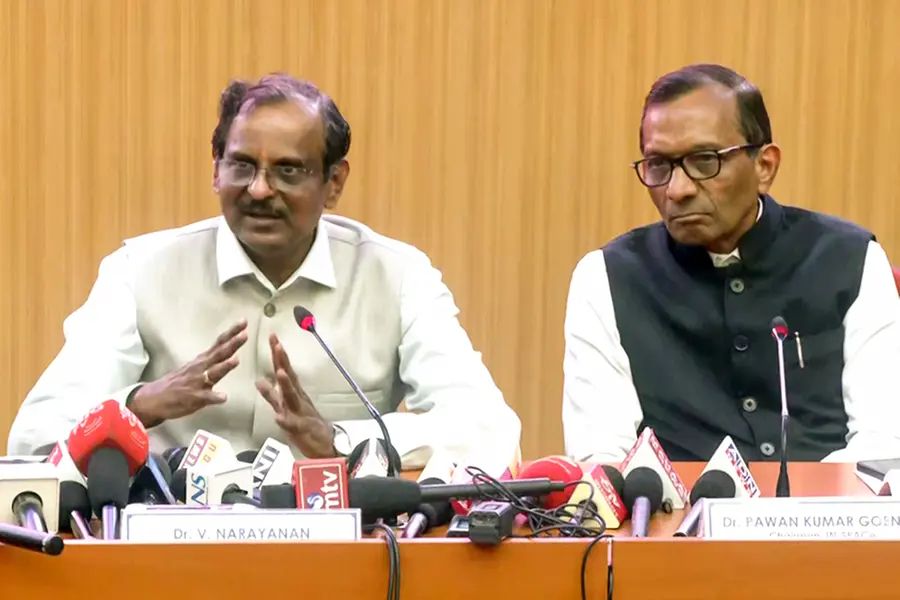
The future role of the Indian Space Research Organisation (ISRO) has come under scrutiny after nine employee associations sought official clarification on the government’s space-sector reforms and reports that some manufacturing and operational activities could increasingly move to private entities.
In a joint representation dated September 4 and reported on Sunday, September 6, the associations wrote to ISRO Chairman and Department of Space Secretary V Narayanan, seeking clarity on the policy, its implementation and its implications for ISRO’s workforce and future recruitment.
Also Read

The employee bodies raised questions over the future of launch-vehicle production, particularly the SSLV, PSLV and LVM3 programmes. They also flagged concerns about routine satellite manufacturing and the operation of new launch infrastructure, including the proposed Space Launch Complex at Kulasekarapattinam.
The associations referred to remarks attributed to IN-SPACe Chairman Pawan Kumar Goenka at an August 21 summit, according to which ISRO would eventually stop manufacturing launch vehicles, with such work being carried out by private companies or public sector undertakings. The employee groups argued that launch-vehicle design, realisation, integration, testing and launch operations represent core strategic capabilities and should not be treated merely as manufacturing activities.
The associations said they were not opposed to private-sector participation or legitimate commercialisation through NewSpace India Limited (NSIL). Their concern, they said, was the absence of an official policy clearly defining which capabilities would remain within ISRO and which would be transferred to private companies or PSUs.
They also sought clarity on the impact of the proposed changes on sanctioned posts, recruitment, career progression and existing employees. The associations asked whether Goenka’s remarks represented an approved government decision or an IN-SPACe position, and requested a written clarification from the Department of Space before any irreversible changes are made.
Goenka says ISRO’s role is not diminishing
Amid the concerns, Pawan Goenka said on September 6 that ISRO’s role was “by no means diminishing” and that the organisation would remain the “bedrock” of India’s space sector.
Goenka said the reforms introduced since 2020 are aimed at expanding India’s overall space ecosystem rather than reducing ISRO’s importance. Under the reform framework, IN-SPACe is intended to facilitate and authorise greater non-government participation, while NSIL is responsible for commercialising mature capabilities.
The approach, according to Goenka, would allow industry to increasingly manufacture and scale mature launch vehicles, satellites and other systems, while ISRO concentrates on advanced research and development, scientific and strategic missions, new technologies and complex infrastructure.
He also pointed to major future programmes, including the Bharatiya Antariksh Station, an Indian crewed lunar mission, next-generation launch systems and continued lunar and planetary exploration, as areas in which ISRO would retain a central role.
Why are ISRO employees seeking clarity?
The issue is not simply whether private companies should participate in India’s space programme. The employee associations have said they support private participation and commercialisation, but want a clear distinction between expanding the private space industry and reducing ISRO’s in-house capabilities.
The associations are particularly concerned about what could happen if production, testing and operational responsibilities progressively move outside ISRO. They have sought assurances regarding the organisation’s future workforce, recruitment and promotion opportunities, as well as the continued public ownership of strategically important capabilities.
The debate comes six years after India opened its space sector to greater private participation. The reforms created a framework in which IN-SPACe facilitates private-sector participation and NSIL commercialises space technologies and capabilities, while ISRO continues to focus on research, advanced technology and national missions.
Analysis and explainer
At the heart of the debate is the question of where India draws the line between ISRO’s core technological role and the private sector’s role in scaling mature technologies.
The employee associations fear that transferring too much of ISRO’s manufacturing and operational work could eventually reduce the organisation’s ability to independently design, build, test and launch major space systems. They have therefore asked for a formal policy explaining the future responsibilities of ISRO, private companies, PSUs, IN-SPACe and NSIL.
Goenka’s clarification offers a different interpretation of the reforms. His position is that moving mature production towards industry would not mean dismantling ISRO, but would allow the organisation to concentrate more heavily on frontier technologies and missions that require capabilities not yet available commercially.
The immediate issue is therefore not a confirmed decision to privatise ISRO itself. Rather, it is a dispute over how far the transfer of mature manufacturing and operational activities should go and what capabilities ISRO must continue to retain.
The employee associations have asked V Narayanan for a formal, time-bound clarification on these questions, making the Department of Space’s response an important next step in determining how India’s space-sector reforms will evolve.
Published: 06 Sept 2026, 09:07 pm IST
ABOUT THE AUTHOR
Related Topics
Disclaimer: Kindly avoid objectionable, derogatory, unlawful and lewd comments, while responding to reports. Such comments are punishable under cyber laws. Please keep away from personal attacks. The opinions expressed here are the personal opinions of readers and not that of Mathrubhumi.