
Russia’s Cosmos 2612 military satellite came within 500 metres of a US commercial radar satellite, sparking fears of on-orbit weapons operations.
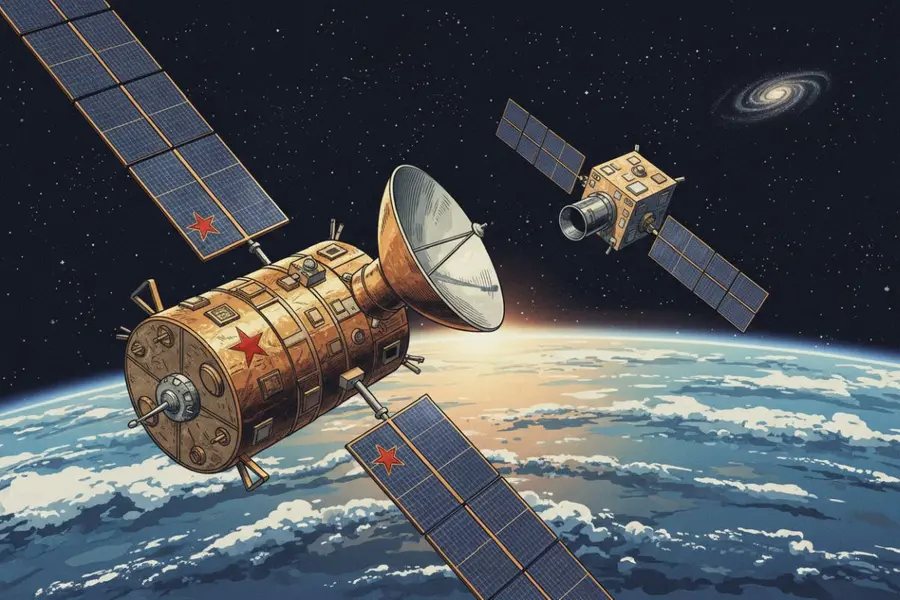
The United States has called out Russia over its military satellite, Cosmos 2612, reportedly carrying out a series of deliberate manoeuvres that brought it dangerously close to a US-operated commercial radar satellite, ICEYE-X36. The move prompted Washington to describe the activity as consistent with on-orbit weapons operations. The encounter has intensified concerns about Russia’s counterspace capabilities and the vulnerability of commercial satellites supporting Ukraine.
Space-tracking firm LeoLabs said Cosmos 2612 conducted a “deliberate series of maneuvers” toward ICEYE-X36 between October 15 and 19. Rather than making a routine flyby, the Russian spacecraft matched the commercial satellite’s orbital plane, adjusted its speed and altitude, and repeatedly repositioned itself ahead of and behind ICEYE-X36.
The two spacecraft came within about 500 metres of each other, according to LeoLabs and reporting by Breaking Defense. Some public tracking models suggested an even closer pass, but analysts cautioned that freely available orbital data cannot precisely confirm distances of tens of metres.
The manoeuvres began earlier: Cosmos 2612 started changing its orbit on September 30, gradually aligning its altitude, inclination and orbital period with ICEYE-X36, which operates at an altitude of roughly 550–560 km.
Thomas DiNanno, US Under Secretary of State for Arms Control and International Security, said at the UN First Committee that Cosmos 2612 had been “exhibiting threatening behavior by intentionally maneuvering dangerously close to a commercial satellite, behaviors consistent with on-orbit weapons operations.”
US officials and space-security analysts have not confirmed that the Russian satellite carried a weapon. CSIS aerospace-security expert Clayton Swope said close-proximity operations can have benign purposes, such as servicing or debris removal, but could also precede a kinetic or non-kinetic counterspace action or a hostile grappling operation.
ICEYE-X36 is a synthetic-aperture-radar imaging satellite built by Finland-headquartered ICEYE and owned by its US subsidiary. It is US-registered and has been used to provide imagery to the Ukrainian military.
SAR satellites can image Earth’s surface through cloud cover and darkness, making them valuable for tracking military movements, logistics and infrastructure. Russian military analyst Vasily Stepanov told TASS that the ICEYE constellation effectively functions as a microsatellite reconnaissance group supporting Ukrainian forces’ targeting, logistics and intelligence requirements.
The encounter is being described by trackers as highly unusual because Cosmos 2612 did not simply pass nearby. It spent roughly two days within less than 5 km of ICEYE-X36 before moving away to about 100 km, according to astrophysicist Jonathan McDowell.
At orbital speeds of about 27,000 km/h, even a small navigation error during such proximity operations can create collision risk. Estonian lawmaker and physicist Mario Kadastik called the Russian satellite’s shadowing a “deliberate provocation” that could have caused a major accident.
Experts say the behaviour could support several objectives: inspection, intelligence collection, electronic interference, communications disruption or a demonstration of Russia’s ability to hold commercial space assets at risk. No hostile action against ICEYE-X36 has been confirmed.
Meanwhile, Russian coverage has not disputed that Cosmos 2612 approached ICEYE-X36, but has framed the US satellite as part of Ukraine’s military-intelligence infrastructure.
TASS quoted Stepanov saying ICEYE satellites help form a “bank of targets” for Kyiv, including for long-range drone operations against Russia.
Russian outlet Vzglyad reported the encounter as an “extremely small distance” between ICEYE-X36 and Cosmos 2612, citing foreign coverage of what it called an unprecedented non-cooperative rendezvous in low Earth orbit.
Moscow has not publicly confirmed that Cosmos 2612 was conducting a weapons test or hostile operation. The available Russian reporting instead emphasises ICEYE’s alleged role in supporting Ukrainian military operations.
CSIS had flagged Cosmos 2612’s movements before the closest approach, warning that its trajectory could bring it into very close proximity with the US-registered commercial SAR satellite. The think-tank noted Russia’s history of testing on-orbit weapons and urged policymakers to treat the satellite as a potential threat.
Space.com reported that Cosmos 2612 was among four satellites in its fleet that manoeuvred into a co-planar orbit with ICEYE-X36 as early as May. The latest episode, however, involved a far more sustained and precise close-approach sequence.
LeoLabs said the close-approach sequence had ended by October 20 and that the two spacecraft were moving apart. But the incident is likely to sharpen calls in Washington and Europe for stronger space-domain awareness, commercial-satellite protection and clearer norms against irresponsible rendezvous operations.
The key unresolved question is intent. The US says the manoeuvres fit a counterspace-weapons pattern; Russia’s public commentary frames ICEYE as a military-relevant target. Neither side has produced public evidence proving that Cosmos 2612 carried or used a weapon.
Published: 22 Oct 2026, 02:07 pm IST
Related Topics
Disclaimer: Kindly avoid objectionable, derogatory, unlawful and lewd comments, while responding to reports. Such comments are punishable under cyber laws. Please keep away from personal attacks. The opinions expressed here are the personal opinions of readers and not that of Mathrubhumi.
