
The satellite features a third indigenous atomic clock alongside procured ones and introduces the L1 signal to enhance positioning accuracy over India and a 1,500 km radius.
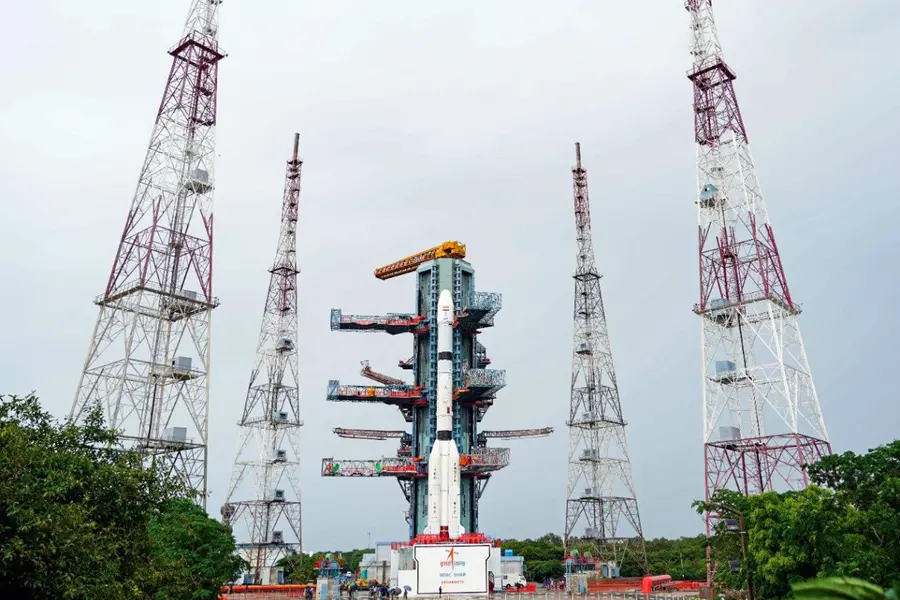
Sriharikota: The Indian Space Research Organisation (ISRO) has scheduled the launch of its NVS-03 satellite for Friday at 11:51 p.m., placing a third indigenous atomic clock into orbit to bolster national time sovereignty and enhance regional satellite navigation capabilities under the Navigation with Indian Constellation (NavIC) framework.
The NVS-03 spacecraft will be carried aboard the GSLV-F18 launch vehicle, marking the 20th flight of India’s Geosynchronous Satellite Launch Vehicle (GSLV). The liftoff is slated to take place from the Second Launch Pad at the Satish Dhawan Space Centre (SDSC SHAR) in Sriharikota.
NVS-03 represents the third satellite in the next-generation series designed to ensure continuous operational service for the Indian Regional Navigation Satellite System (IRNSS) architecture, following the earlier deployments of NVS-01 and NVS-02, which carried the country's first two locally developed atomic timekeeping units.
“The satellite carries Indigenous Atomic clock, along with the procured Atomic clocks. It also includes L1 signal in addition to existing L5/S signals with Coverage over India land mass and a region extending 1500 km around Indian geopolitical boundary,” ISRO said in an official statement.
An atomic clock represents the world's most precise timekeeping apparatus. Rather than depending on a mechanical pendulum or a vibrating quartz crystal, which can drift due to temperature shifts, it measures time by monitoring the constant, natural vibrational frequencies of atoms, most frequently caesium-133.
IRNSS functions as an independent regional navigation satellite network developed by India, engineered to deliver precise positioning data across the domestic landmass and a surrounding 1,500 km primary coverage perimeter.
In alignment with the government's "One Nation, One Time" strategy, orbiting a third domestic atomic clock marks a crucial step toward establishing full national time sovereignty.
The Central government formally notified the Legal Metrology (Indian Standard Time) Rules, 2026, on August 29, laying the groundwork to mandate Indian Standard Time (IST) as the official, legally binding, and traceable time standard across the country.
The regulations are scheduled to take effect 180 days following their publication in the Official Gazette. The measure aligns with the administration's broader framework to guarantee that strategic infrastructure and digital networks function on a synchronised, unified reference time.
“Accurate and synchronised time is fundamental to modern digital and critical infrastructure. Telecommunications, financial transactions and digital payments, power grids, transportation, data centres, government information systems and other critical services depend on accurate time synchronisation and reliable time stamps,” according to the Ministry of Science and Technology.
ANI
Published: 30 Oct 2026, 11:24 am IST


ABOUT THE AUTHOR

Disclaimer: Kindly avoid objectionable, derogatory, unlawful and lewd comments, while responding to reports. Such comments are punishable under cyber laws. Please keep away from personal attacks. The opinions expressed here are the personal opinions of readers and not that of Mathrubhumi.