

Global guitarist and folk singer Djamel Laroussi reflects on his first India performance after a moving concert in Thiruvananthapuram on February 5, speaking about music as belonging, storytelling beyond language, and how Indian rhythms have left a lasting imprint on his artistic journey.
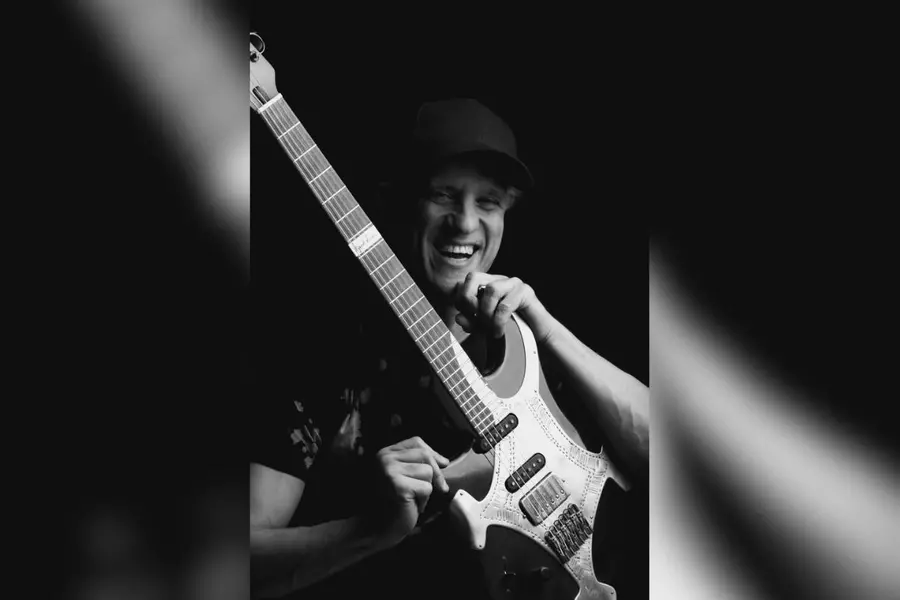
World-renowned guitarist and folk singer Djamel Laroussi mesmerised audiences in Thiruvananthapuram on February 5 with a global music performance that blended jazz, folk, Indian classical influences, and contemporary sounds.
Held at the Technopark Amphitheatre, the concert marked Laroussi’s first-ever performance in India and featured collaborations with musicians from multiple nationalities, along with reinterpretations of Kerala classics.
Also Read
An Algerian–German musician celebrated internationally for his unconventional left-handed playing on a right-handed guitar, Laroussi is known for his emotionally resonant vocals, multilingual repertoire, and genre-defying compositions. Over the years, he has built a distinctive global presence, captivating audiences across continents with music that transcends language and cultural boundaries.
Speaking to Mathrubhumi on his Thiruvananthapuram performance, Laroussi reflected on his long-cherished dream of touring India, the philosophy behind his unique sound, the universality of rhythm and storytelling, and how Indian music continues to inspire him deeply.
Excerpts from the interview:
1. This is your first tour of India. What drew you to Indian audiences, and what were your first impressions when you arrived in Thiruvananthapuram?
“Namaskaram! Touring India was always a dream for me, as listening to the music and seeing the culture here always made me feel a sense of deja vu, like I always belonged here; a sense of second home. But coming here, I was so overwhelmed by the love and hospitality from people I had never known before; it is perhaps the same warmth and emotional depth that makes Indian music so alluring to listeners around the globe.”
2. You are globally known for playing left-handed on a right-handed guitar. How did this technique develop, and how has it shaped your sound and songwriting over the years?
“Honestly, I didn't know any better (laughs)! I received a guitar as a gift from an uncle who didn't play it, and while I come from a musical background, the guitar was completely foreign to our world. Since that guitar was strung right-handed, I started playing and would continue practicing for days on end, not knowing the ‘correct’ technique, and did struggle for quite a while but was too stubborn to give up. The first chord I played was an A minor, and I remember the ecstasy I felt like it was yesterday!”
“While I wouldn’t recommend this style for new students, it certainly is the key to my unique sound, with the bass strings ringing out at the end of a strum, as opposed to conventional technique, and gives me a stand-out soundscape.”
3. Your music spans jazz, folk, classical, Indian pop, and Bossa nova, often across languages. How do you approach blending such diverse traditions without losing authenticity?
“Music, in its essence, is simply conversation through sound. So it’s important everyone involved gets a chance to speak, and more importantly, a good artist must stay silent when the other speaks. Sometimes your silence conveys much more than anything you can sing or play.”
4. You’re performing with musicians from five different nationalities. What challenges and creative surprises come with building such a multicultural band?
“It's certainly a learning experience; seeing such diverse forms of music makes you want to sit down and learn everything you encounter musically, but my experience has taught me the importance of staying true to your own style and to lean into your strengths; after all, it is what the audience wants from each artist.”
5. Many listeners say your lyrics and vocal style carry strong emotional depth. How important is storytelling in your music, especially when performing for audiences who may not understand every language you sing in?
“I'd like to answer that with a story (chuckles). I was commuting to the rehearsal yesterday with our singer Aakash Binu, who is a Thiruvananthapuram local. We were passing a temple when I came across a song with a beat so groovy, before I knew it I was doing a mini-dance routine inside the vehicle! It was such a great tune, but its intoxicating effect lay in the unique polyrhythmic groove, almost identical to my North-African folk style of the Berber tribes. Aakash informed me that the song was ‘Appadi Podu’, a popular Tamil Dappankoothu song. My experience playing Algerian folk music all over the world has been similar, with everyone from Germans to Brits moved to dance by my music; I mean, if you can get Germans to dance and let loose, you can move anyone in the world (laughs hysterically)!”
6. After this 1.5-hour global music experience in Technopark, what do you hope Indian audiences take back with them, and can we expect more collaborations with Indian musicians in the future?
“I think people will go home after a musical trip to some really far-flung, exotic parts of the world, but we are equally excited to see how the audiences will react to our reinterpretations of popular classics from Kerala; after all, the audiences are the true arbiters of good vs bad music, and we hope to do justice to the incredible musical heritage of Kerala. As for my plans, I am staying back in India, specifically Mumbai, for a couple of days to learn more about ragas and Indian rhythm, as Indian classical music continues to shatter my notions of what's truly possible as a musician. I hope to return with a fresh and broadened mind, with a part of India etched in my soul.”
Published: 06 Feb 2026, 03:36 pm IST
ABOUT THE AUTHOR
Related Topics
Disclaimer: Kindly avoid objectionable, derogatory, unlawful and lewd comments, while responding to reports. Such comments are punishable under cyber laws. Please keep away from personal attacks. The opinions expressed here are the personal opinions of readers and not that of Mathrubhumi.