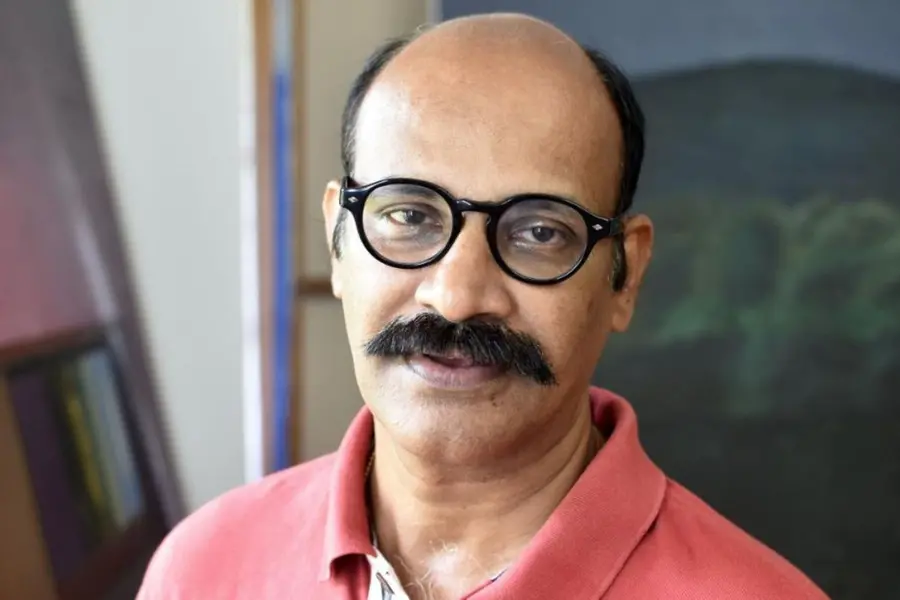
At the Kochi Muziris Biennale 2025, artist Tom Vattakuzhy turns literature, lived experience and Kerala’s shared memory into quiet, emotionally charged story-paintings that linger long after the first glance.
Artist Tom Vattakuzhy. Photo: X
Kozhikode: Kochi-based artist Tom Vattakuzhy will be participating in Edam, an exhibition opening on December 13, 2025, alongside the Kochi Biennale. This edition of Edam aims to foster intergenerational dialogue and highlight diverse artistic voices from across Kerala, bringing together practices rooted in lived experience, literature, and memory.
Vattakuzhy, known for his luminous, introspective painting style, will showcase works that merge delicate realism with a quiet, contemplative sense of light and memory. Vattakuzhy's inclusion as part of Edam's 36-artist roster is an attempt by the Kochi Biennale Foundation to put a spotlight on artists whose roots in Kerala culture resonate with broader, contemporary sensibilities.
Speaking to Mathrubhumi, Vattakuzhy reflects on literature, lived experience, and intergenerational memory as he prepares for the Edam exhibition at the Kochi Biennale. Known for his quietly powerful story-paintings, Vattakuzhy’s works stand at the intersection of tradition, memory, and the evolving artistic identity of Kerala.
Q: Your works often transform intimate, everyday human experiences into something universal and timeless. How do you choose the stories—of farmers, sex workers, dissidents, or wanderers—that find their way into your canvases? Usually, that is the case. But with the story paintings, the creative spark or the inceptive idea comes from the literature entrusted to me to paint. My role then is to find the core idea and the emotional situation of the literature and make a painting out of it. It is similar to how Renaissance painters made paintings based on Biblical stories. The universality in these works comes from responding to what the stories already hold and translating that inner life into an image that could go beyond the stories themselves.
Vattakuzhy's 'Mrudwamgiyude Durmruthew (Drama)'
Q: Memory, faith, and lived reality blend subtly in your visual language. When you begin a painting, what usually comes first for you—the narrative, the mood, or the image? Memory, faith, and lived experience shape our reality and influence how we see the world. In my paintings, the same holds. For the story-based works in this exhibition, the narrative often sparks a mood, and a certain image opens into a larger atmosphere or other visual references. For instance, The Green Vein of a Leaf by P Surendran immediately brought to mind Henri Rousseau’s The Sleeping Gypsy. Or take Trees Slanting Towards the Roof by Srikrishnapuram Krishnankutty, set against the backdrop of a political assassination that once shook Kerala. In the story, the protagonist finds himself unwittingly betraying someone close to him. He carries that burden like a cross. I often find the image of Christ in the downtrodden, and his predicament echoes that for me. So, while the narrative initiates the process, it is the mood and the visual memory it evokes that guide the painting. In this case, Fra Angelico’s The Mocking of Christ became a quiet subtext running through the work.
Q: Kerala’s shifting socio-political landscape appears quietly but powerfully in your work. How consciously do you weave contemporary Kerala into your story-paintings? When I paint, I don’t begin with an agenda to depict Kerala’s socio-political climate. But the stories I respond to are already steeped in it, and since I am shaped by this land—its anxieties, its faith, its humour, its contradictions—those realities enter the paintings almost instinctively. Kerala’s political and social shifts often surface in the stories themselves. For example, in Trees Slanting Towards the Roof, Devan’s guilt and the shadow that falls over him are not merely personal; they echo a climate where political violence quietly alters the emotional life of ordinary people. Similarly, Lenin and the Farmer deals with the disillusionment of a farmer confronting institutional rigidity. The expectation of finding a saviour, and instead encountering the same old indifference, mirrors the lived frustrations in rural Kerala today. The two paintings on the story channel convey quiet despair without making it overt. In The Mason of Kattoor, the relationship between a left-wing activist and a nun, shaped by poverty, speaks of Kerala’s long entanglement between ideology, religion, and survival. That emotional texture enters the painting through gestures and symbols.
Even works that appear surreal at first glance, like The Land of Those Who Departed, painted for an essay on Gulf migration, carry what I would call Kerala’s shared memory. A floating cloud inside a home, a corridor thick with silence—these are metaphors born out of a state shaped by departures, separations, and remittances. So, the “consciousness” is not didactic; it is absorptive. Contemporary Kerala enters the work the way mist passes through trees; you feel it before you articulate it. The stories give me a narrative spark, but the Kerala I know—its moral dilemmas, political turmoil, humour, and melancholy—creates the climate of the painting.
Q: The Edam exhibition this year focuses on intergenerational dialogue. As an artist deeply rooted in Kerala’s visual and cultural traditions, what does “intergenerational dialogue” mean to you? Intergenerational dialogue, to me, is not merely an exchange between the old and the young. It is the quiet continuity of sensibilities—how one life, one memory, one image flows into another. Much of Kerala’s cultural life is built on this slow transmission. When I paint stories like The Smell of Camphor, where an elderly woman revisits her childhood friendship, or Clara, where an old woman interacts with the world through the prism of life and impending death, I am reminded that our inner lives are never confined to one age. The past sits beside the present, peeking through it. Even in works shaped by political and social history, such as The Mason of Kattoor or The Death of Gandhi, there is always a generational undercurrent. We inherit beliefs, wounds, and aspirations not directly, but through our surroundings and circumstances. They pass through gestures, rituals, and stories long before they appear in public life. As an artist, I feel that dialogue is a kind of responsibility. I carry forward the images that formed me—the church festivals, the workers’ colonies, the reading rooms, the ancestral houses where photographs, clocks, and memories hung side by side. These visual traditions are not to be replicated but reimagined so that my contemporaries recognise something familiar, and the next generation discovers them in a new light. So, intergenerational dialogue, for me, is this: the act of keeping memory alive without freezing it, allowing it to move, to transform, and to speak differently to each new era, to each individual.
The artpiece titled, 'Kaathu Kidakkunnu'
Q: Your characters often seem suspended between tenderness and turbulence. How do you approach depicting people whose lives are shaped by struggle, marginalisation, or silence? Many of the figures I paint come from stories shaped by hardship, silence, or marginalisation. But what draws me to them is not their suffering alone—it is the dignity with which they endure it. In Lenin and the Farmer – 2, for instance, the farmer’s despair is real, yet as you see him walking into the wilderness, I wanted the painting to hold his quiet dignity as much as his helplessness. In The Mason of Kattoor, Sister Jennifer and the comrade Ramankutty both carry wounds shaped by poverty and ideological turmoil. Still, what I tried to capture was their companionship—two lives touching across very different circumstances. Even in hardship, tenderness becomes a form of resistance. In Clara, the old woman waiting for death does not cry or protest; instead, she sits with a soft, almost luminous patience. The turbulence is internal, but the gentleness on the surface is what makes the moment human. So, my approach is never to dramatise suffering. Instead, I try to show the emotional truth that flickers between vulnerability and strength. These characters remind me of people I grew up around—ordinary Malayalis whose lives were marked by political uncertainty, social expectations, or private grief, yet who still found ways to dream, to love, to wait, and to hope.
Q: Many viewers describe your works as cinematic, almost like fragments of a larger narrative. Do you think of your paintings as standalone stories, or as part of a continuous visual novel you’re writing over time? I understand why viewers sense a cinematic quality in the paintings. Each work holds a moment suspended, as though the scene has been paused between two movements—something has just shifted, and something else is about to begin. But I never think of them as film stills or as chapters of a single predetermined novel. Each painting is complete in itself. I recognise that the emotional climate behind them—the way light gathers around a figure, the quiet tension in a gesture, the stillness that surrounds an interior—remains remarkably consistent. In Pakarnnattam, the solitary performer stands half-lit on an empty stage, the mask about to slip; the whole scene feels poised on a fragile threshold between triumph and ruin. In The Women Without Brains, the couple sits across a small table in a plain, softly lit room—the man bent in doubt, the woman withdrawn into her own thoughts—an everyday moment charged with quiet tension and disbelief. None of these images “continue” into one another, but they share a temperament, a certain uncertainty in the air, a sense of people caught in intimate, precarious states. So, if there is a thread running through them, it is not a single narrative but a way of approaching human experience. The characters may never encounter each other, the stories may never intersect, but perhaps they inhabit the same emotional world—the world I inhabit.
At a moment when Indian contemporary art is expanding rapidly, what questions or emotions do you hope younger artists and viewers carry with them after experiencing your work at the Biennale? I don’t hope that viewers, especially younger artists, leave my work with answers. If anything, I hope they leave with a quiet uneasiness, or with a question they cannot immediately resolve. Contemporary Indian art is expanding so quickly that it is easy to mistake scale for depth. But what stays with us, ultimately, are the small human tremors a work allows us to feel. When someone sees a young girl standing alone in a stark room, or a young woman and an elderly woman sitting by a window—one waiting for experience, the other weighed down by it—these moments are modest, yet they hold entire worlds within them.
Name of painting: Sakalathinum Porul
These are the kinds of scenes that reveal the fragile, often overlooked emotional life of everyday people. What I hope younger artists take away is that attention is a moral act. To look closely at gestures, at tender, fleeting moments, at discomfort, at the contradictions people carry silently, is already a way of honouring the world. And for viewers, especially in a Biennale setting full of spectacle, I hope the paintings offer a pause: a reminder that the smallest human situations can contain the deepest truths. Progress and technology will keep advancing, but they cannot replace the need for compassion, humility, and a willingness to see others clearly. This is because art is not a proclamation; it is an invitation to feel more truthfully and to observe more attentively.
Web journalist who lives for breaking news, political scoops, ruthless edits and impossible deadlines. Print loyalist with a soft spot for cinema, gender, rural Bengal and cities that tell the best stories.
Disclaimer: Kindly avoid objectionable, derogatory, unlawful and lewd comments, while responding to reports. Such comments are punishable under cyber laws. Please keep away from personal attacks. The opinions expressed here are the personal opinions of readers and not that of Mathrubhumi.