
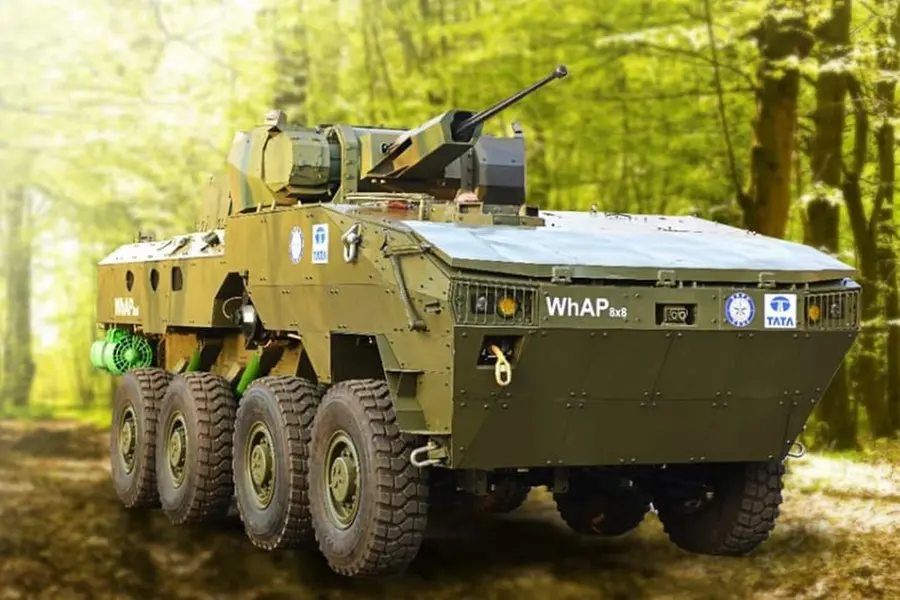
The Defence Research and Development Organisation (DRDO) and Tata Motors have launched a more advanced version of their Wheeled Armoured Platform (WhAP) 8x8. This second-generation model boasts a refined design and enhanced capabilities for more efficient operations.
Developed in collaboration with the DRDO, the WhAP incorporates advanced technologies, such as an integrated power pack with automatic transmission, along with flotation and propulsion features.
Also Read

Amphibious Vehicle
The WhAP is a 24-ton amphibious vehicle. It uses hydro-jets at the back to move through water at a speed of 10 km/h. The vehicle has a maximum speed of 100 km/h on-road and 40 km/h off-road.
The vehicle can climb slopes up to 30 degrees and cross trenches that are 1.8 metres wide. This means it can handle steep hills and gaps in the ground effectively.
Enhanced Protection
A key highlight of the new WhAP is its state-of-the-art night vision technology, which allows it to function well in low-light conditions.
It also has strong protection against chemical, biological, radiological and nuclear threats, ensuring the crew’s safety in dangerous environments.
Another key improvement is the increased ground clearance compared to the earlier model.
Interestingly, the second-generation WhAP from the DRDO and Tata shares features with the DRDO-Mahindra Defence version designed for CBRN roles, suggesting a common platform for different specialized models.
While the original WhAP was thoroughly tested, including trials in high-altitude areas and water, the new model is expected to enhance performance and survivability for the Indian Army.
Innovative Armoured Design
The technology for the DRDO’s 8x8 wheeled, armoured vehicle, WhAP, has been handed over to TASL for manufacturing.
The nomenclature ‘8x8’ refers to a vehicle with eight wheels, all of which are powered. This configuration helps with better traction and mobility, especially on rough terrains.
The 8x8 vehicle uses hydro-pneumatic suspension with a double-wishbone setup. This means the vehicle has a system that combines liquid and gas to absorb shocks and provide a smoother ride.
The double-wishbone design is a suspension system with two arms shaped like wishbones. It helps keep the wheels stable and improves handling, especially on uneven surfaces, providing a smoother ride on bumpy roads.
All the wheels have a 'run-flat' feature, which lets the vehicle keep moving even if the tyres get punctured. The vehicle has four axles, and the front one is steerable, which means it can turn more easily with a smaller radius. Unlike this vehicle, not all vehicles have a steerable front axle.
Safety and Weaponry
The Tata WhAP offers protection up to STANAG Level III, meaning it can withstand armour-piercing bullets from rifles.
Its flexible design allows for extra armour to be added for increased safety. The vehicle has a lightweight body made from ultra-high strength steel (UHSS) and composite armour.
This combination keeps it strong and durable while reducing weight, making it easier to manoeuvre.
The hull is designed with a V-shaped bottom and two layers: an inner panel and a bottom panel. This design helps absorb impact and provides better protection and stability.
The bottom panel is designed to deflect blast energy and absorb the force, reducing the impact that reaches the vehicle. This helps protect the people inside by minimizing damage.
Blast-resistant seats and energy-absorbing mats on the floor help protect the crew, following STANAG 4569 safety standards.
The seats in the crew compartment are arranged in the centre, facing outwards. This setup allows each soldier to have a firing port, making it easier for them to engage in combat.
The seats are hung from the roof and are not attached to the floor. This design helps reduce the impact felt from a mine blast, keeping the crew safer.
The vehicle can be equipped with a remote-controlled weapon system (RCWS) that includes a 7.62mm machine gun from Electropneumatics & Hydraulics (I) Pvt.
This means the weapon can be operated remotely for safer and more efficient targeting. The vehicle has an advanced sighting system from BEL.
In the armoured personnel carrier (APC) setup, it can carry 10 soldiers plus 2 members of the crew. With the RCWS, it holds 8 soldiers, 2 members of the crew and 2 additional operators.
Published: 20 Aug 2024, 01:44 pm IST
Disclaimer: Kindly avoid objectionable, derogatory, unlawful and lewd comments, while responding to reports. Such comments are punishable under cyber laws. Please keep away from personal attacks. The opinions expressed here are the personal opinions of readers and not that of Mathrubhumi.