

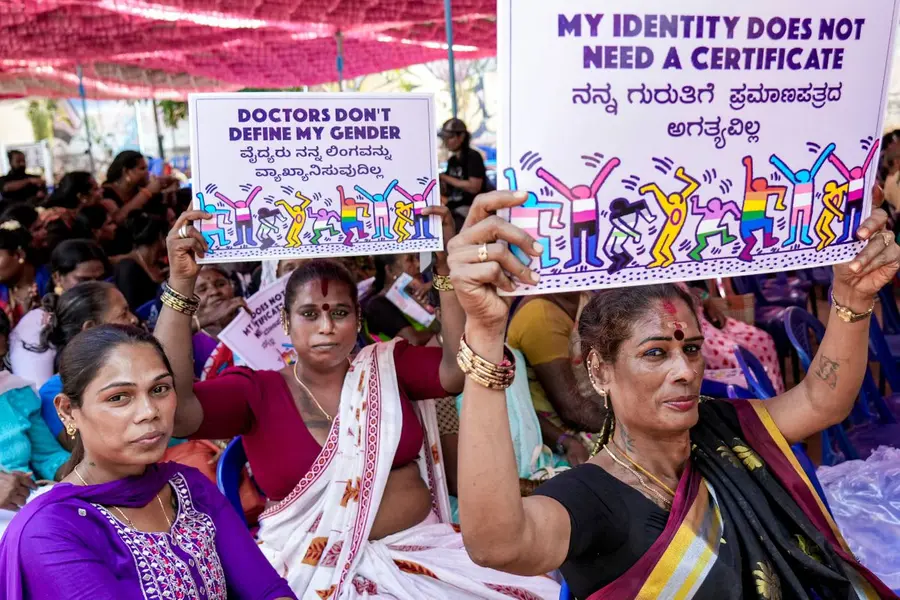
India recently passed the Transgender Persons (Protection of Rights) Amendment Bill, 2026. The Bill, which narrowed the legal definition of "transgender," curbing self-identification, and mandating rigorous medical certification for official recognition. The passing of Bill in Parliament has triggered outrage. As part of the ongoing coverage related to the Act, we reached out to multiple stakeholders. Here is part 4 of the series.
Part 1: ‘Where do we go now?’ A trans woman’s question as India rewrites identity law
Part 2: Born different, made afraid: Intersex lives at the margins of the Trans Bill debate
Part 3: ‘Parents who threw us out; why will they give consent?’ A trans man’s anguish over India’s new law
For nearly 25 years, Chennai-headquartered SAATHII has worked with marginalised communities, including people living with HIV, LGBTQ+ individuals, prisoners, and rural women, to bridge gaps in access to healthcare. Its Senior Vice President, Dr L Ramakrishnan, now warns that recent changes under the Transgender Amendment Act, 2026, now law, risk undoing years of progress.
At the heart of his concern is what he calls a growing disconnect between law and lived reality.
“The bill has been drafted by people who do not understand transgender persons,” he says. “It is completely divorced from science and medicine.”
He points back to the landmark NALSA vs Union of India, which recognised gender identity as an individual’s internal sense of self-distinct from the sex assigned at birth. That judgment, he says, gave people the confidence to come forward.
“Between 2014 and now, many people found courage in the law,” he notes. “They came out, applied for trans identity cards. Now, their identities are again being questioned.”
How the new law defines identity
One of his key concerns is the proposed definition of who qualifies as transgender. By grouping identities under socio-cultural categories like Hijra or Kinnar, he argues, the law risks excluding many who do not fit into those frameworks.
According to the proposed definition, a person may be recognised as transgender if they belong to a socio-cultural community (Hijra or Kinnar), are intersex, or have undergone bodily changes to appear as transgender.
But, he says, this approach misses the core reality of gender identity.
“What the law seems to miss is that anyone can experience a mismatch between their innate gender and the socially assigned one that is dictated by sex assigned at birth.”
He also cautions against conflating intersex and transgender identities.
“Intersex are not necessarily transgender,” he explains, warning that merging categories ignores established medical understanding.
How identity is recognised
After the 2019 Act, gender recognition followed a two-track system.
A person assigned male at birth, for example, had two pathways:
- Identify as transgender (T), requiring only a self-affidavit
- Identify as female (F), requiring medical assessment
Importantly, he clarifies that this medical assessment was not about physical verification, but about confirming gender incongruence, a clinical term describing a persistent mismatch between a person’s experienced gender and their sex assigned at birth.
Earlier frameworks, he says, balanced self-identification with limited medical certification. The concern now is that new amendments could shift toward rigid verification systems.
“Third party verification, if needed, should only be about documenting persistent gender incongruence based on clinical history-taking,” he says.
“Proof is not in the body. It is in the mind.”
Fear among doctors
These legal uncertainties, he argues, are already affecting healthcare delivery.
Gender-affirming procedures remain expensive and inaccessible for many. For those who do seek care, the fear of legal consequences is creating hesitation among medical professionals.
“A poor trans man cannot afford surgery,” he says. “If identity depends on that, you are taking away their access to welfare.”
He cites a recent incident in Tamil Nadu where, among five individuals shortlisted for surgery, three were denied because they could not provide a parental consent video requested by doctors.
According to him, such requirements reflect growing anxiety within the medical community.
Doctors fear complaints from parents and legal repercussions under the amended framework. “There have been cases where parents come back and say, ‘My child was normal, you changed them,’” he notes.
As a result, surgeons and endocrinologists are becoming increasingly cautious, further limiting already scarce access to care.
Misuse vs recognition
Concerns about misuse are often raised in policy discussions—but Ramakrishnan rejects the framing.
“You cannot secretly ‘become’ transgender,” he says. “You risk losing your job, your family, your social circle. And the benefits? Maybe ₹1500 a month. Why would anyone fake it in a society that hasn’t fully accepted them?”
He argues that available data suggests not misuse, but under-recognition.
The 2011 Census (for the first time) recorded around 4.8 lakh people under the “other” gender category. Yet only about 32,000 have applied for transgender identity cards.
“That itself shows under-recognition, not misuse,” he says.
For him, the solution is to separate identity from welfare access.
“Let anyone identify as transgender if they want to,” he says. “If the government is worried about benefits, create additional eligibility criteria, but don’t question identity itself.”
“For a country the size of India, misuse is bound to happen. But the question is—Is misuse so big that the law itself needs to be changed, or is the real issue that the law is moving away from the people it is meant to recognise?”
ALSO READ | ‘Transgender amendment redefines who gets to say THIS IS WHO I AM’
Published: 19 Apr 2026, 08:00 am IST
ABOUT THE AUTHOR
Related Topics
Disclaimer: Kindly avoid objectionable, derogatory, unlawful and lewd comments, while responding to reports. Such comments are punishable under cyber laws. Please keep away from personal attacks. The opinions expressed here are the personal opinions of readers and not that of Mathrubhumi.