

Narthaki Nataraj, the Padma Shri–winning Bharatanatyam artiste who reshaped both classical dance and Tamil language with the word “Thirunangai,” insists she be remembered for her art—not her identity
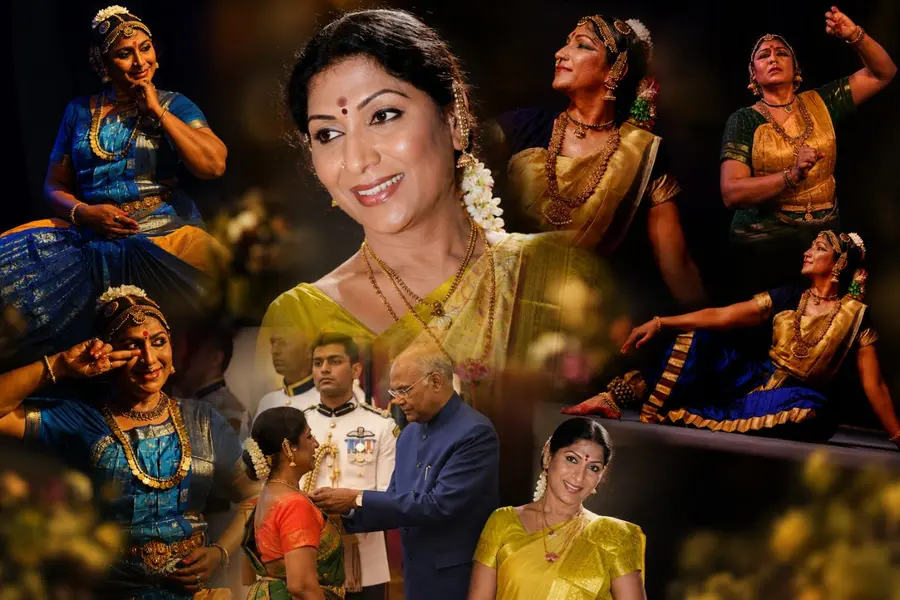
For decades, audiences applauded Narthaki Nataraj as they would any accomplished Bharatanatyam artiste. They admired her mastery over the compositions of the Tanjore Quartet, her nuanced interpretations of Adhyatma Ramayanam and the classical rigour she inherited from her guru K.P. Kittappa Pillai.
Then someone would whisper what they believed was the most interesting thing about her.
“But, do you know she is a transgender?”
The question irritated her.
Not because she was ashamed of her identity. She had fought too hard to live openly as herself. She had left home as a teenager, survived on the streets, completed her education while moving between acquaintances’ houses, undergone gender-affirming surgery under precarious conditions and endured decades of social ostracisation.
What troubled her was that the dance suddenly became secondary.
“I never wanted to use my transgender identity as a trump card,” she says. “People should look at my talent. You can criticise me for my dance. Dance is something I earned through my merit.”
It is the paradox that runs through Narthaki’s life.
The artiste who spent decades asking society not to reduce her to her gender would eventually give Tamil society one of its most enduring words for transgender women: Thirunangai.
Today, the word appears in government documents, policy discussions and everyday conversations. It entered official usage through a Tamil Nadu government gazette in 2009. But its origins lie in a dancer’s search for dignity—not only for herself, but for the language used to describe her community.
How ‘Thirunangai’ was born
“When people praised my performance and then learned I was transgender, some of them became disappointed,” she recalls. “I realised they were appreciating me as a woman performer. That credit did not belong to me. It belonged to a woman. I wanted people to appreciate me for who I was.”
The search for that dignity led her to language.
“Nangai means woman. Thiru carries respect, sacredness. That is how Thirunangai was born.”
Years later, the word would be embraced by governments, activists and communities across Tamil Nadu. Former Chief Minister M. Karunanidhi would help institutionalise its use in official discourse.
Ironically, the woman who gave the community a new vocabulary never wanted that vocabulary to become the entirety of her own story.
Her story…
Born into a well-to-do family in Madurai in the 1970s, one among ten siblings, Narthaki says she never experienced herself as a boy.
“The sun rises in the east. The sky has its colour. In the same way, I knew I was not a boy.”
She gravitated towards the women more than the men in her family and found comfort at home, away from a world that constantly reminded her she was different. Dance became refuge before it became a profession.
There was also Shakthi Bhaskar.
The two (young boys at the time) met as children in a Madurai neighbourhood where neither quite belonged. Other children excluded them. Both were beginning to understand identities for which there were no words, role models or acceptance.
“We were two children who realised something about ourselves long before society was ready for us.”
Over the decades, Shakthi became an audience, companion, critic, sister, philosopher and, as Narthaki often describes her, a mother figure. Long before institutions recognised Narthaki, Shakthi recognised the artiste.
At sixteen, another turning point arrived.
Guru K.P. Kittappa Pillai, the hereditary custodian of the Tanjore Quartet tradition, accepted her as his disciple and gave her the name “Narthaki.”
The name stayed.
The struggle did too.
Her father discouraged her from dancing. Educational institutions often refused to recognise her identity. When she enrolled to study Saiva Siddhanta and Tamil literature at Madurai Kamaraj University, she was told every certificate would carry only her birth name—Perumal Pullai Natarajan.
“Call me any abuse you want,” she remembers telling them. “But never call me a boy.”
She was denied the name she wished to live by.
The desire to live authentically eventually led her to gender-affirming surgery under conditions that seem unimaginable today. There were no painkillers. Only faith in the people from the community.
“I gave life to get life,” she says.
“Nan ponna irukanum, ilena nan mannode poidanum.” (If I cannot live as a woman, then let me return to the earth).
She survived the procedure.
More importantly, she danced.
Over the next four decades, Narthaki built one of Bharatanatyam’s most respected careers. She performed across India and abroad, travelling to more than two dozen countries despite never receiving formal education in English.
One invitation particularly stayed with her.
A ninety-year-old professor from Norway wrote asking her to perform.
“Do not try to satisfy us by becoming contemporary, do not dilute the art to make us understand,” the email said. “Be who you are. What we need is a good dancer. That is the identity of yours we are looking for.”
For Narthaki, those words carried a quiet validation.
Not because they ignored her identity.
Because they looked beyond it.
The same tension surfaced when she became the first transgender woman to receive the Padma Shri in 2019.
People expected celebration.
Instead, she felt oddly detached.
“Reporters asked me what I felt. I felt nothing. I was numb.”
The award mattered. But what mattered more was what it recognised—over forty years of relentless practice, performance and perseverance.
Today, her journey is part of Tamil Nadu state board textbooks. She has served on government bodies, including the State Development Policy Council, and continues to mentor young dancers through the Velliyambalam Trust.
Yet when she speaks about success, she rarely lists awards.
She talks about self-respect.
“My identity has often been my enemy,” she says. “But my victories came from self-respect and determination.”
Then she smiles.
“I have created a kingdom for myself and live as a queen.”
She spent a lifetime asking audiences not to see only a transgender woman on stage.
History may remember her, in part, for giving Tamil a more dignified word for transgender women.
That irony never seemed to trouble Narthaki Nataraj.
She did not coin Thirunangai so she would become its symbol.
She coined it because language, too, deserved dignity.
What she wanted for herself was something much simpler.
Not admiration for surviving.
Not applause for being transgender.
Only the respect reserved for a great Bharatanatyam artiste.
Everything else can come on its own.
Read more stories from and about transgender community here:
- He was seen as a daughter, wife, and mother for 34 years. Story of Fred, a trans man in Chennai
- ‘We are here. We will be here…’ Trans men, visibility, and India’s transgender law in Manipur
- Born different, made afraid: Intersex lives at the margins of the Trans Bill debate
-
‘Where do we go now?’ A trans woman’s question as India rewrites identity law
Published: 26 Jun 2026, 03:57 pm IST
ABOUT THE AUTHOR
Related Topics
Disclaimer: Kindly avoid objectionable, derogatory, unlawful and lewd comments, while responding to reports. Such comments are punishable under cyber laws. Please keep away from personal attacks. The opinions expressed here are the personal opinions of readers and not that of Mathrubhumi.