

Born into a world without language for his identity, Fred's journey from mother to father became a powerful fight for visibility, dignity and rights for transgender men in India
A father who gave birth to his children? A Tamil Brahmin named Fred? The contradictions begin there—but don’t end there.
Fred did give birth to his two children. And today, they call him “Appa.”
Born in 1979 into a conservative Tamil Brahmin family in Chennai, Fred spent decades being seen by others as a daughter, then a wife, and later a mother. He fulfilled every role expected of him. He married. He raised children. He built a life.
But beneath those labels lived a truth he had known since childhood—without the words to name it.
“I am not a girl,” he remembers thinking. “I am a boy.”
A boy without a word for himself
Even today, transgender men remain largely invisible in India. In 1980s and 90s Chennai, they were unnameable.
“There was no terminology,” Fred says. “No internet. No support groups. Nothing. All I knew was that I wasn’t a girl.”
He hated menstruation. He recoiled from being treated as female. Every expectation attached to girlhood felt wrong.
At 13 or 14, while reading Tamil magazines with his mother, he first encountered articles about sex reassignment surgery.
“I told my mother we should go to Bombay and get this surgery done.”
She shut it down. The idea had to disappear, she said, for the sake of the family.
The dysphoria did not.
Learning to survive
Like many transgender people of his generation, Fred lived two lives at once: the self the world saw, and the self he knew himself to be.
He excelled in school, earned a degree in microbiology, and began tutoring children while still young.
He missed postgraduate admission by just 0.2 percentage points and turned to teaching instead, continuing to support his family.
Life moved forward. Silence remained.
A marriage he could not explain
Pressure to marry came slowly, then all at once.
After the marriage of his two sisters, when asked why he remained unmarried, he had no answer he could safely give.
“I had no courage. I couldn’t come out again after what happened earlier.”
Eventually, in 2005, he married.
“I had to fulfil the expectations of my assigned sex role,” he says.
“Even though I was dysphoric, I had to conform.”
He became a spouse. A parent. A mother. Everything expected of him—except himself.
For twelve years, he lived what looked like a complete life from the outside.
Inside, the dissonance deepened.
The day the silence broke
The internet changed everything.
Through online chat rooms, Fred discovered language—and people like him.
For the first time, he wasn’t alone.
In January 2016, after the birth of his two children, he finally said it aloud:
“I am a man.”
At first, his spouse thought it was a joke. A week later, he repeated it. This time, it became real.
Therapy followed. So did conversations with family.
His parents struggled to understand. At one point, they believed it was black magic.
But a therapist offered a different path: “Build your own support system.” Fred did.
Finding community
He found support among activists like Kalki Subramaniam and L Ramakrishnan of SAATHII NGO.
"Kalki connected me to a Transmasculine person who then connected me to Dr.Ramki of SAATHII NGO & volunteer of Orinam lgbtqiap + collective in Chennai and Satya Rai Nagpaul of Sampoorna India - a network of trans & intersex Indians for trans and intersex Indians across the globe,” he said.
“It gave me something I had never had before—community.”
He enrolled in a Master’s in Psychology.
“I didn’t want anyone else to go through what I had gone through. I wanted to help people like me.”
Becoming Appa
Coming out reshaped every relationship.
His marriage eventually ended by mutual consent. According to Fred, it was among the first divorces in India where gender dysphoria was the sole reason for the separation.
But the harder question was personal: what about his children?
The younger one was barely one-and-a-half at the time.
They grew up alongside his transition, supported by family and therapists who explained gender in age-appropriate ways (using animated materials the community provided).
“They would often correct my parents,” Fred recalls.
“‘Call him Fred. Don’t call him daughter.’”
Slowly, acceptance spread—first his mother, then his father, then the extended family.
Today, his nieces and nephews call him “Fred Papa.”
His children call him “Appa.”
Rebuilding a life
In 2018, Fred underwent gender-affirming surgeries, including masectomy and a hysterectomy.
Then came the bureaucracy: affidavits, newspaper notices, government offices.
He changed his name to Fred.
He chose “Fred” inspired from a fictional rebel character called Fred Rogers from Jeffrey Archers’ novel.
“My parents asked me to at least choose a Hindu name. I told them, ‘This is where I align. I am only changing my name, not my religion,’” he said.
For the first time, the decision belonged entirely to him.
Building something larger than himself
Fred’s work soon extended beyond his own transition.
He saw a pattern: transgender women were increasingly visible, while transgender men remained largely absent from public discourse.
That invisibility became his focus.
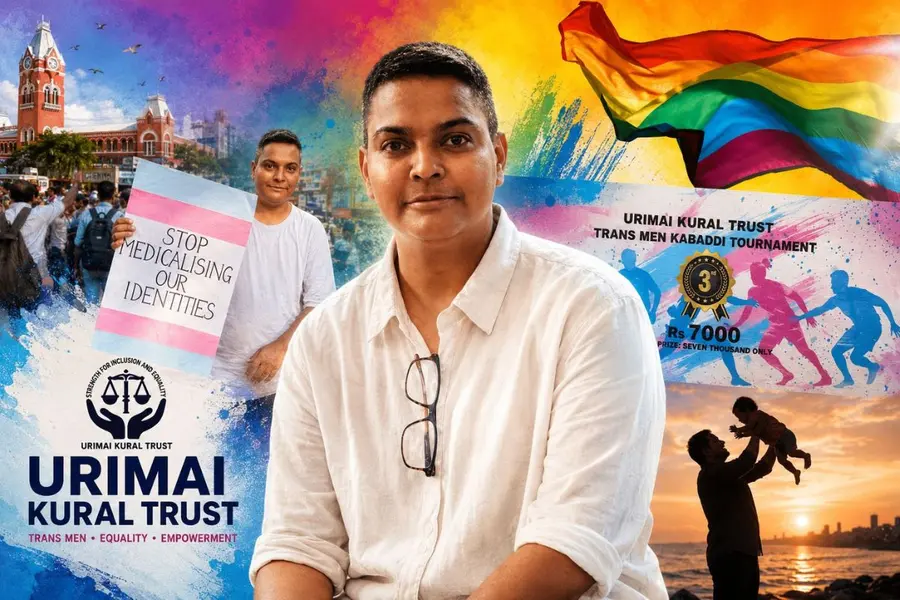
He established the organisation Urimai Kural—“Voice of Rights.”
His mother became a trustee.
His work expanded into shelter programs, legal aid, and access to healthcare.
By 2025, the organisation launched a funded shelter for transgender people, especially trans men—offering the safe space he never had:
A place where no one has to explain who they are.
The boy who was right
For Fred, the most meaningful victories are small.
A classroom where his children casually mention they have two fathers.
A teenager asking about identity without fear.
His children’s friends who visit their home without hesitation.
The struggle is far from over. Barriers remain. Visibility is still uneven. Trans men remain underrepresented.
But Fred’s story was never only about transition, surgery, or paperwork.
It is about a child who knew himself long before language existed to explain him.
A child who said, simply:
“I am a boy.”
And waited decades to be heard.
Today, he is.
Not only by society. Not only by institutions.
But by the people who matter most.
His children.
And when they call out, they use a word he once never imagined he would hear.
“Appa.”
Read more stories from and about the transgender community:
- ‘We are here. We will be here…’ Trans men, visibility, and India’s transgender law in Manipur
- 'New Transgender law is completely divorced from science and medicine'
- Born different, made afraid: Intersex lives at the margins of the Trans Bill debate
- ‘Where do we go now?’ A trans woman’s question as India rewrites identity law
Published: 20 Jun 2026, 08:00 am IST
ABOUT THE AUTHOR
Related Topics
Disclaimer: Kindly avoid objectionable, derogatory, unlawful and lewd comments, while responding to reports. Such comments are punishable under cyber laws. Please keep away from personal attacks. The opinions expressed here are the personal opinions of readers and not that of Mathrubhumi.