
Clay, earth, and fire in my material usage become anti-colonial technologies
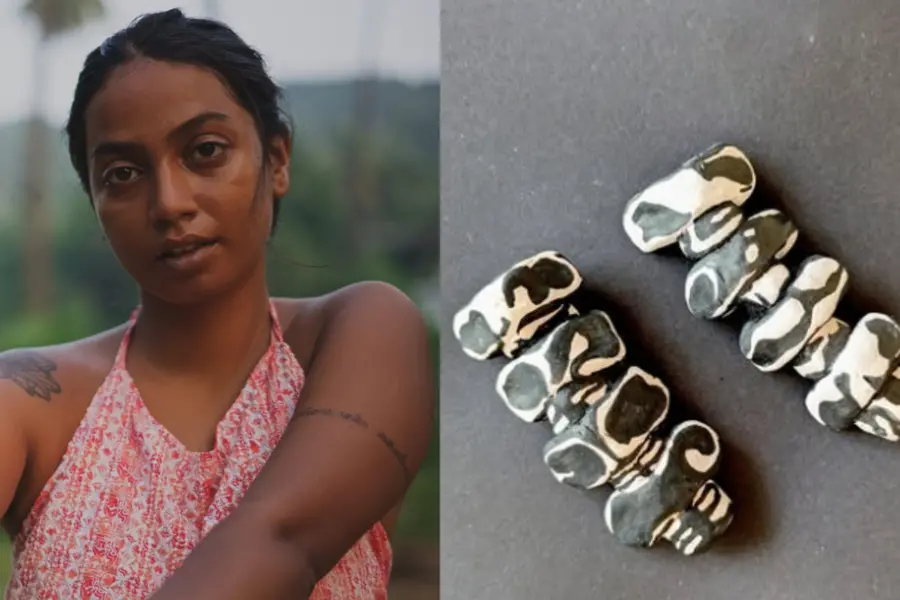
For multidisciplinary artist Rini Alphonsa Joseph, clay is not just one medium among many, it is the one that insists on presence. Though her practice includes painting, video, and text, clay remains central for the way it slows her down and demands commitment.
Speaking to Mathrubhumi, the artist reflected on her material practice, politics, and process.
Excerpts from the interview
Why clay and pottery? What does this medium allow you to express that others don’t?
Although it is not my only medium of work, clay becomes the most potent material I work with. Clay keeps me grounded and brings me back to earth. It helps me sit with difficult truths, experiences, and feelings, transforming them through creation into something entirely new and rewarding — transmutation, as they say.
Unlike other medium I work with, such as painting, video, and text, clay is challenging and demands a commitment bound with discipline. Every stage requires patience. The process of firing the pieces, especially because I do it myself in a gas-fired kiln, is a test of faith and helps one embrace uncertainty. It teaches a valuable lesson in detachment. Creation then becomes an act of love.
How has anti-caste literature shaped the way you think and work as an artist?
The anticaste movement and its literature including Sujatha Gidla's ‘Ants Among Elephants’, Yogesh Maitreya's heartwrenching poetry, Bhavani Kunjulakshmi's bold, unapologetic voice as well as essays by Mavelinadu Collective and Fourteenmag, have been an essential resource to validate a lot of personal casteist trauma and experiences. It holds space for a reality that was denied for far too long in my own thinking and life. It helped me make sense of a lot of pain and confusion around identity.
Besides it made me understand the state of the caste system in different parts of the country and the systemic violence that still exists today. The discourse gave me a sense of deliberate action and thought towards creating. Art was no longer about aesthetics. It helps me search for my own voice and understand why it's important to articulate it. Art became a tool to bring attention to caste as a problem, reframe the gaze and denial about it and reimagine a reality beyond it. In the process, it brought me closer to my own roots and ancestry.
What does it mean, in practical terms, to decolonise art?
I decolonize through my work by decentering not just the white gaze but also the savarna gaze. I recenter, instead, indigenous time, body, and magic.
Clay, earth, and fire in my material usage become anticolonial technologies. I root back into traditional methods and locally sourced clay, interacting with potters whose practice has been carried through generations past. I prioritize terracotta to ditch elite/Western ceramic hierarchies — how porcelain, stoneware, and glazes take up so much value in the market. Black-firing and reduction firings reiterate my love for terracotta. I accept rupture, warping, and errors as essential to the art form, unlike the wasteful, perfectionist colonial obsession with control and permanence.
In language, within my works with text, I resist the compulsion of academic English as the carrier of truth. Instead, I use English unseriously, creating hybrid phrasing with Malayalam popping up time and again.
With imagery, I recenter indigenous ways of being, where nature becomes not just a muse but also kin. Fantasy becomes a form of survival — a reminder that, as oppressed people, we live with trauma but transform it. Myth and magic become companions to history, unlike colonial ideas of biased scientific truth. Many of my visual subjects are misfits and run contrary to definitions of beauty determined by both white and savarna aesthetics — like crows, dead birds, insects, and bugs, etc.
And most importantly, I decolonize through my art by vehemently remembering ancestry, indigeneity, and genealogy that are often erased through assimilation and colonization.
Have you faced resistance because of the politics in your work?
Not an obvious, upfront resistance, but a sugar-coated one. Institutions and individuals seem to like to think of the anti-caste lens as forced, or it is reframed as a sort of victim complex. And even if they recognise Dalit artists, they box individuals into restrictive identities and aesthetics that favour savarna saviour complexes. I do not fit into these boxes and, more importantly, for a long time, I was not equipped with a self-articulation that access and privilege provide. My personal is political, and very often it is personal chides and dismissal that are received in response to expression.
But at the same time, the growing underbelly of society’s fringe identities is creating new collectives, institutions, and voices. These are products of self-determination that have been honed through resilience against oppressive systems for generations. I am proud to be associated with so many people who create these spaces.
I grew up mostly in savarna and upper-caste environments — I still live in one. This proximity often determined my audience because of limited powers of influence. These environments become extremely alienating when you do not just stand out physically — whether it is dark skin or how differently one expresses — but when you repeatedly hold up a mirror to an oppressive society. I have been called aggressive for my expressions of discomfort, anger, or disagreement — an extremely casteist trope. This, especially, is dangerous in a society where casteist violence exists in different degrees, both private and public. I, like many other DBA voices, am constantly told that I make everything about caste. This leaves a bitter aftertaste in one’s self-expression. Thankfully, my palate can tolerate a range of unfavourable flavours.
Why was the Kochi Biennale an important site for presenting this work?
This Collateral Project at Monsoon Culture brought me back to Kerala. It brought my work to Kerala. Growing up displaced from the land and feeling a sense of not belonging everywhere I was (including Kerala where I felt like an outsider for not growing up here), coming back to a Kochi thriving with culture, bold voices, a youth that is increasingly open-minded, charming, humourous and politically expansive, felt like a very warm hug.
It also brought my attention back to Kerala's rich biodiversity. My work is an ode of sorts to this land's abundance and fertility, and a prayer for its preservation. Exploring indigenous memory in the land it is rooted in, is a form of remembering. The site that Monsoon Culture occupies is one that shows age and passing time. It seems appropriate to be the canvas for a work on fading histories and memories, - a lot of it a forced erasure.
Kochi Biennale often feels like a controversial external intervention into a land that is already thriving with cultural, literary and artistic genius. Nonetheless, I feel it is an excellent opprotunity for multiculturalism in a country heading increasingly towards cultural homogenisation. I believe it is not a coincidence that Kerala makes room for radical thought and artistic expression.
I also think it's important that a show like "Rajavu Nagnananu/The Emperor's New Clothes" spotlights DBA voices and indigenous/caste histories that are often invisibilized in Kerala's mainstream identity. And it is increasingly relevant in our country's political climate.
What do you hope audiences carry with them?
I often tell people that the ultimate purpose with my art is to leave a mark on children's imagination that makes them somehow look beyond systemic prejudices and expectations. I hope my work helps the expand their imagination in terms of how we are forced or expected to view the world. Children are my favourite and most important audience because they inherit our futures. Whereas for my older audience, I want to invoke a similar childlike wonder, curiousity and play - no matter how dark the concept or how difficult the message is to digest. I hope the audience sees an articulation of the DBA identity grounded in a place of power and joy and not just trauma. I wish to force the imagination of onlookers out of pigeon holing marginalized and historically oppressed identities. I want to iterate how oppression is a systemic act and within our own independent identities, avarna truths are essentially more profound and more magical than the system that tries to erase it.
My work "Mullondu. Thinnumo? / Thorny. Will you eat?" is part of "Rajavu Nagnananu/The Emperor's New Clothes" - a collateral project by Monsoon Cultural in Jew Town, Mattancherry at Kochi Muziris Biennale 2025-26. My work talks about the displacement of memory and histories and how we try to fill it in with imagination - creating something new while reviving something old. The physical manifestation of this is a collection of fruits, vegetables, seeds, leaves and nuts, that echo the flora of Kerala's ancient forests where my ancestors lived an interdependent life with nature. The worn out walls of the site are speckled with images of endangered plants of these forests. It speaks of fragmented memory and ecological erosion.
It gives me great honour to present this work in Kerala - my motherland. It is a massive milestone.
I cannot wait to tell more stories and create more art that alchemize indigenous knowledge and spirit.
Published: 31 Dec 2025, 08:22 pm IST
Related Topics
Disclaimer: Kindly avoid objectionable, derogatory, unlawful and lewd comments, while responding to reports. Such comments are punishable under cyber laws. Please keep away from personal attacks. The opinions expressed here are the personal opinions of readers and not that of Mathrubhumi.
