
Navi Pillay’s journey from South Africa’s Tamil community to the global legal arena highlights the enduring legacy of Indian indentured labourers and their forgotten roots
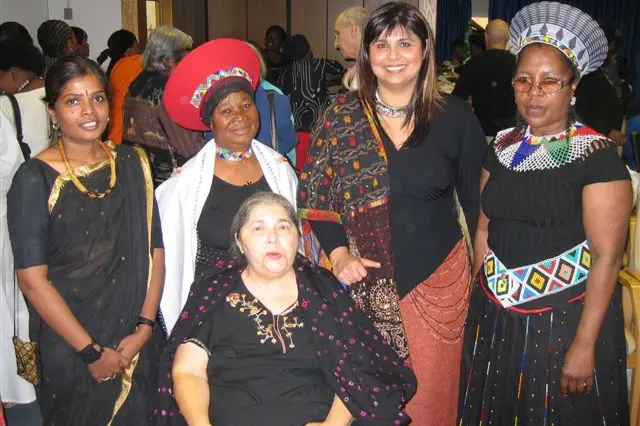
Navanethem “Navi” Pillay, is a typical South Indian Tamil name. But when “Navi” Pillay, was honoured with the Nobel peace prize, she was described as a person of South African Tamil origin. Much to the discomfort of even US President Donald Trump, it was said that, “The Norwegian Nobel Committee attaches importance to Navi Pillay’s role as a driving force in the development of an international system of law and order, while further emphasizing her judicial rigour, personal integrity and considerable courage.”
In a world traumatized by war in the Middle East and elsewhere, the 81 year old Navi Pillay, born in the then Indian ghetto of Clairwood, in Kwa-Zulu Natal Province of South Africa in 1941 has emerged as an apostle of world peace. Emphasizing Navi Pillai’s role as the judge of International court of Justice, the Noble committee said;” At a time when the number of wars and conflicts is rising, and when judges and institutions of international law are under political attack, the Nobel Committee wishes to issue a reminder that the ability to resolve conflicts without force or violence is dependent on the international rule of law. An international legal system in which war criminals are held to account and the victims of abuse see justice served is a precondition for a peaceful world.”
Also Read

Over and above the achievements of “Navi” Pillay, to bring peace through an international legal system, the Nobel Peace prize also brings focus on her origins as a South African Indian from the century’s old indentured labour community. I checked up with my Tamil friends, as to whether anyone has unearthed the origins of “Navi Pillay”, in Tamil Nadu’s public space, following her Nobel Prize and was told that nothing so far in the local media. She is born in a Naidoo family and married to a Pillay, making the search for origin even more difficult as the two communities are generally seen at the two ends of the State. Adding to this is the fact that history of the indentured labour dates back to three centuries ago, when documentation on immigrants were scarce or not kept at all. Over 2.7 percent of the population (1.7 million) of South Africans are of Indian origin and majority are the descendants of the indentured labour families, barring the minority rich Muslim trades.
History says that following the abolition of slavery in the British Empire, more than 1.6 million (or over 2 million by some accounts) workers from India were transported to overseas colonies like Mauritius, the Caribbean, Fiji, South Africa, and Malaysia to work on sugar and plant crops. Most of them were lower castes from various regions of India. In South Africa the indentured labour popularly known as “coolies” then were from the South Indian peninsula. The indentured labour immigration happened between 1834- 1917.
Indentured labour is a contractual labour agreement where individuals work for an employer for a fixed time or until a debt is paid off. It was almost like bonded labour practice in India till 1980s.The debt covers transportation, housing, and food costs provided by the employer. Historically, indentured labour is linked to European colonization from the 1500s into the 20th century, though it still exists today, as we heard from the US Vice President recently while announcing the issue of H1 B visas for IT companies. Harsh conditions often blurred the lines between indentured labour and slavery.
Typically the indentured labour in South Africa was employed in the plantations of Kwa-Zulu Natal province and areas around. Durban is the main centre of the area and over a million descendants of indentured labour in and around the city of Durban today. Areas like Chatsworth, Phoenix, where Gandhi had his first ashram and Clair wood where Navi Pillay was born are typically referred to as Indian ghettos. The apartheid South Africa had ordered racial segregation of residence for the Indians and black people. Indians under the banner of Natal Indian Congress established during the stay of Mahatma Gandhi in Durban’s Phoenix had played a major role in the country’s struggle against White apartheid regime standing alongside the black African movement of African National Congress. Both Gandhi and John Langalibalele Dube, the founder of ANC were neighbours at Phoenix, Durban.
Independent South Africa’s first President, an iconic leader Nelson Mandela, in his forward to his Indian college mate turned advisor, Ismail Meer’s autobiography wrote and South African Indains. “Ismail gave me a new perspective on South African Indians. I knew Johannesburg Indians as rich shopkeepers and thought all Indians to be the same. From him I learnt about Natal’s Indian’s, who constituted by and large a working- class population. I learnt about their slave-like origin in this country as indentured labourers. It was through him that my image of Indians as exploitative capitalists eroded and I came to see them as part of the large black working class, discriminated against and oppressed by the white government, though in different ways”. Ismail and Mandela were fellow law students at Johannesburg University and were activists of ANC, against apartheid regime.
On a visit to Durban two decades ago, Prof Fathima Meer, wife of Ismail Meer, introduced me to the Chatsworth population of Indians in the city. There were still in a ghetto of Indians inhabited by lower middle class persons. Prof. Fathima was part of the civil society groups working with Chatsworth Indians. It was through interactions with Prof Fathima and Ela Gandhi one came to know the life of South African Indians up close. Durban had mostly South Indian origin people, while rich Indian origin Muslim merchant families were settled in Johannesburg. The new generation educated in Indian schools during the apartheid regime had emerged as professionals in many fields, like Navi Pillay much to the irritation of the black population. Irritation was whenever, African National Congress (ANC) regime tried to replace whites from crucial administrative posts in the 1990s and 2000s, the next in line who emerged was an Indian. Most of them had got into the administrative services as educated professionals during the apartheid regime itself.” It is like finding a white or Anglo Indian person as the most suitable person for a post soon after Indian independence”, explained Ela Gandhi, granddaughter of Mahatma Gandhi who was an ANC member of Parliament from Durban, though she was a card holding communist party member.
Prof. Fathima Meer and her brother Dr. Farooq Meer, were leaders of Natal Indian Congress till it merged with ANC, were active social workers among the poor Indians. They both lived in lower middle class areas intervening in civil society matters regularly. Unlike many indentured Indian descendants, Prof Meer and family could trace their origins from Surat region in Gujarat and even knew the Haveli which their ancestors ‘lived once. Obviously their ancestors went to South Africa as traders and remained as rich Indians. As the descendants of Indian South Africans from indentured labour groups climb the social ladder, there is always an effort to find their roots in India. There are travel agencies offering such services in Durban and I found one such couple in Delhi looking for their ancestor village in Eastern Uttar Pradesh years back. As there was hardly any clear archival documentation of indentured Indian labour of South Africa, in both counties, the best they could get was that of the village or the area from where their forefathers immigrated.
Like Navi Pillay, the South African Indians have nothing to do with the Indians as far as their culture and social habits are concerned. Majority are lower caste Hindus, but since there were hardly any upper castes around, they never inherited caste biases. And for a generation they had apartheid as a socio-political reality uniting them to fight. Their social habits are best explained, at a Durban beach festival, which I witnessed. The beach had a lot of tents showcasing various products and eateries, but the place was clean as always with no littering. Indian’s who do not litter? I exclaimed and was told that during the apartheid regime, the entire population was severely punished for public littering even in their ghettos and that old Indian habit of littering disappeared over the years.
The Indians in South Africa appeared to be a homogenous society unlike their counterparts in India, as hardly anyone spoke any other language than English in public. The anti-apartheid fight had brought Indians and black together as both were the victims of the white regime, though Indians were treated better than blacks.
To understand Navi Pillay, one needs to look at her involvement in anti-apartheid struggles. From early childhood in her Clairwood locality at Durban. Her family is of Indian Tamil origin. Pillay was born as Navanethem Naidoo on 23 September 1941 in Clairwood-Durban, to Narrainsamy and Santhama Naidoo. Her grandparents came from India as indentured labourers to work on South African sugar plantations in Natal in the 1890s. She experienced racial and gender discrimination first-hand. Despite this, she built a legal career. In 1967 she became the first woman of colour to establish a legal practice in her province. She married Gaby Pillay and adopted his name.
Ms. Pillay used the very legal system that sustained injustice to challenge its abuses, as a lawyer. As an Indian anti-apartheid activist, she represented political activists, exposed torture and challenged the treatment of political prisoners.
She was also involved in the Women’s National Coalition, which helped shape the equality provisions of South Africa’s democratic constitution. These prohibit discrimination on grounds including race, sex and sexual orientation. After apartheid ended, President Mandela in 1995 appointed her as a High Court judge. . In the 1980s she studied at Harvard University and earned her Doctor of Juridical Science degree there in 1988.
Her profile given out by the Nobel Prize committee read as follows: ” Navanethem “Navi” Pillay has been at the forefront in the development of an international legal order. She became a judge and President of the International Criminal Tribunal for Rwanda (ICTR), where she gained distinction for her role in establishing that sexual violence and rape as well as the spreading of propaganda could lead to indictment for crimes against humanity and genocide. She was then named to serve as a judge on the International Criminal Court (ICC). From 2008 to 2014 she served as the United Nations High Commissioner for Human Rights (OHCHR). Navi Pillay also chaired the UN Independent International Commission of Inquiry on the Occupied Palestinian Territory from 2021 to 2025, and in 2019 she became an ad hoc judge on the International Court of Justice (ICJ) in the case in which Myanmar stands accused of genocide.”
There is no one in India owning up to the achievement of an Indian origin person bringing peace and international law to the world. There is no one in Tamil Nadu going to her village the way they did with US Presidential candidate Kamala Harris. There is no media build up in India or commemoration by the government about Ms Pillay’s Nobel peace prize. But that coveted prize is also a reminder to Indians, that there are people like us across the world living and contributing to humanity for generations. And they happened to be descendants of once poor and indentured labour from mainland India and they are still identified as Indians of their country even today.
(V K Cherian is a writer based in Delhi and was associated with Afrikhadi-an Indo South African foundation for a decade).
Published: 14 Oct 2026, 03:36 pm IST
Related Topics
Disclaimer: Kindly avoid objectionable, derogatory, unlawful and lewd comments, while responding to reports. Such comments are punishable under cyber laws. Please keep away from personal attacks. The opinions expressed here are the personal opinions of readers and not that of Mathrubhumi.