
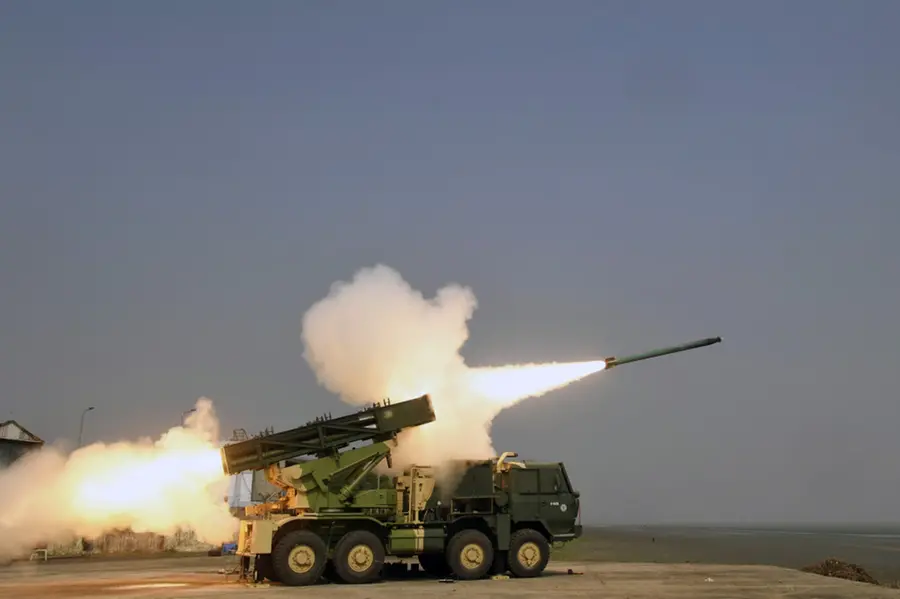
The Pinaka Weapon System, named after the bow of Hindu God Shiva, was developed by the Pune-based Armament Research and Development Establishment (ARDE), an important arm of the Defence Research and Development Organisation (DRDO).
Developed to succeed the Soviet-era 'Grad' and 'Smerch' systems, which are still in use, it is one of the first Indian military technologies to be sold to other countries, including Armenia.
Also Read

Variants of Pinaka MBRL
1) Pinaka Mk-1: Has a range of 48 km (30 miles)
2) Pinaka Mk-I Enhanced: Can reach up to 60 km
3) Pinaka Mk-II: Has a range of 90 km
4) Pinaka Mk-III: Currently in development, with a range of 120 km
5) Pinaka Mk-III Enhanced: Currently in development, with a range of 300 km
Kargil War Showcased Pinaka's Power
Private companies, such as Larsen & Toubro, Tata Defence and Economic Explosives Limited, are working on the Pinaka project. They have established production lines to supply the weapon system in large quantities to the armed forces.
On the battlefield, such long-range artillery as Pinaka is used to hit enemy targets before close combat starts. Close combat involves shorter-range artillery, tanks and infantry.
After successful tests of the Pinaka Mark-1 in the late-1990s, it was first used effectively during the Kargil War in 1999. Following that, several regiments of the system were established throughout the 2000s.
Versatile Multi-Barrel Rocket Launcher
The Pinaka is mainly a multi-barrel rocket launcher (MBRL) that can launch 12 rockets in just 44 seconds.
* The Indian Army typically uses a battery with a total of 72 rockets
* A battery of six launchers can cover an area of 1000 m x 800 m
Each Pinaka battery includes
* Six launcher vehicles (each with 12 rockets)
* Three replenishment vehicles
* Two command post vehicles (one on standby) with a fire-control computer
A key tactic in long-range artillery battles is for the launchers to 'shoot and scoot'. This means they must quickly move after firing to avoid becoming targets, especially because of the blast that follows. Therefore, the launcher vehicles need to be very manoeuvrable.
Calibre Dictates Power and Range
The Pinaka artillery calibres include 122 mm (4.8 inches) for the ERR 122 and 214 mm (8.4 inches) for the Pinaka series (Mk-I, Mk-I Enhanced, Mk-II, Guided Pinaka).
The 122 mm is lighter and more mobile, while the 214 mm is heavier, providing greater impact and range for modern operations. The term ‘ERR’ stands for ‘Enhanced Rocket Regimental’, which refers to a specific type of artillery system designed for improved performance and accuracy in military operations.
'Calibre', in the context of artillery, refers to the internal diameter of the gun barrel or the size of the projectile that the weapon can fire. It is typically measured in millimetres or inches.
A larger calibre generally indicates a larger projectile, which can deliver more explosive power and have a longer firing range. In this case, the 122 mm and 214 mm calibres denote different classes of artillery systems, with the 214 mm Pinaka series being heavier and capable of more significant impact compared to the 122 mm ERR 122.
Pinaka Rocket Warheads
The rocket can reach a speed of Mach 4.7 (5,800 km/hr), making it very fast and difficult to intercept. The rocket's warhead weighs between 100 kg and 250 kg and can have different designs for various combat uses.
* High Explosive Fragmentation: This type of warhead creates many small, sharp pieces upon explosion, causing damage to a wide area and targeting enemy troops and equipment
* Cluster Munition–Incendiary: This warhead releases multiple smaller bombs that can ignite and burn targets, making it effective against groups of enemies or vehicles
* Anti-Personnel: Designed to harm or kill individual soldiers, these warheads are often used in areas where enemy troops are concentrated
* Anti-Tank: This type targets armoured vehicles, designed to penetrate defences and cause significant damage to tanks
* Mine-Laying: These warheads release mines that can be hidden in the ground, exploding when triggered by vehicles or personnel
Missile Can Detonate In 3 Ways
* Contact: It detonates when it hits a target directly
* Proximity: This method triggers the explosion when the missile gets close to the target without direct contact
* Electronic Time Fuse: The missile is set to explode after a specific time, regardless of distance from the target
Tatra: Advance Launching System
The Pinaka is a rocket launcher system mounted on a 6x6 military truck -- a truck with six wheels, all of which can drive, making it more stable and capable of handling rough terrain—called the BEML-Tatra T813/T815.
At the back of the truck, there are two groups of six tubes that hold the rockets. The system can launch both free-flight rockets (which fly on their own once fired) and guided rockets (which can be steered to hit specific targets).
Published: 10 Aug 2024, 12:24 pm IST
Disclaimer: Kindly avoid objectionable, derogatory, unlawful and lewd comments, while responding to reports. Such comments are punishable under cyber laws. Please keep away from personal attacks. The opinions expressed here are the personal opinions of readers and not that of Mathrubhumi.