
More than a year after the CAG flagged serious gaps in Delhi's air pollution monitoring, vehicle-emission checks and public transport system, the capital is once again battling severe winter smog. While the government has introduced several pollution-control measures, the latest crisis raises questions about whether the structural problems identified in the 2025 audit have been adequately addressed.
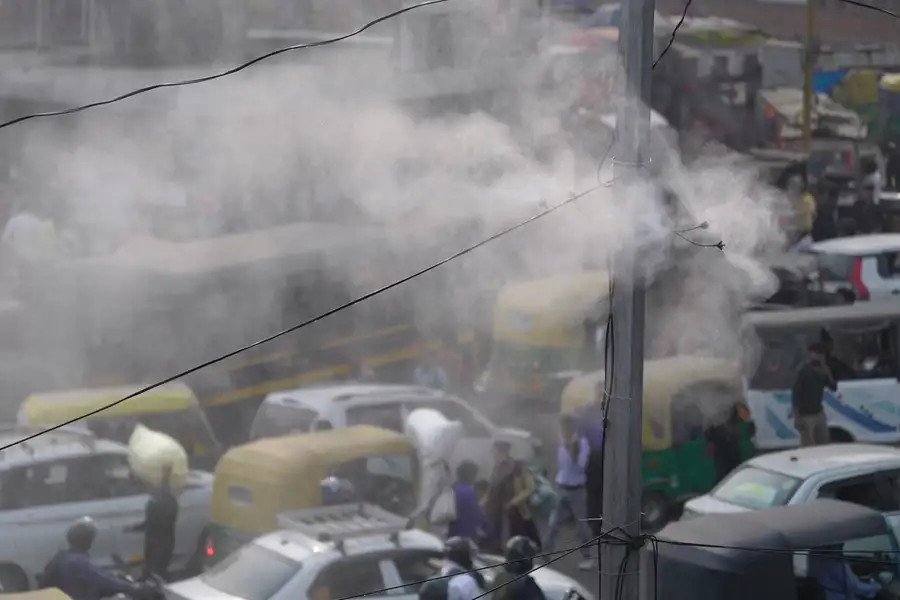
New Delhi: More than a year after the Comptroller and Auditor General’s report on Delhi’s vehicular air pollution was tabled in the Delhi Assembly, the capital is once again struggling through a severe winter smog episode. The latest official data show that Delhi’s air quality has deteriorated sharply after Diwali, with PM2.5 concentrations reaching levels several times the national standard, even as the same monitoring, enforcement and public-transport weaknesses flagged by the CAG continue to shape the city’s response.
The CAG’s Performance Audit on the Prevention and Mitigation of Vehicular Air Pollution in Delhi, Report No. 2 of 2022, was tabled in the Delhi Legislative Assembly on April 1, 2025. The report examined the period up to March 2021 and found that Delhi’s air-quality monitoring system was deficient, public transport remained inadequate, pollution-under-control certificates were unreliable, vehicle-fitness testing was weak, and emergency measures under the Graded Response Action Plan were often not enforced.
The central question now is whether Delhi has moved beyond emergency responses such as water sprinkling, anti-smog guns and vehicle restrictions. The evidence suggests that while the government has taken some steps -- particularly on cleaner fuels, electric mobility, industrial emissions and dust control -- the structural reforms sought by the CAG remain incomplete, and the city’s air quality remains dangerously poor.
What the CAG found
The CAG’s audit focused on vehicular pollution, which it described as a major source of pollution originating within Delhi and therefore potentially controllable by the Delhi government. It found that Delhi’s air quality had been in the “Poor” to “Severe” category on 1,195 of 2,137 days -- about 56 per cent -- during the five years examined by the audit.
The auditor’s most serious concern was the reliability of the city’s air-quality monitoring system. It found that several Continuous Ambient Air Quality Monitoring Stations were not located in accordance with Central Pollution Control Board norms, raising the possibility that the data they generated -- and therefore the AQI values based on them -- were unreliable.
The CAG also found that the Delhi Pollution Control Committee did not have the required minimum of 16 hours of pollutant-concentration data on many days. It said lead was not measured at any of DPCC’s monitoring stations, while the other pollutants were not measured regularly enough.
The audit further found that the Delhi government had no real-time information on pollution sources, no assessment of the vehicular emission load on Delhi’s roads, and no monitoring of benzene at fuel stations, despite benzene levels exceeding permissible limits at 10 of 24 monitoring stations.
Monitoring flaws remain relevant
The CAG’s concerns about monitoring have acquired fresh relevance during the current smog episode. During the post-Diwali pollution spike, readings for PM2.5 and PM10 were unavailable at several government monitoring stations at critical hours, even as the city experienced extensive firecracker bursting and a sharp deterioration in air quality.
At Anand Vihar, one of Delhi’s major pollution hotspots, the reported AQI was 345 at 2 am on November 8 even though data for both PM2.5 and PM10 were missing during parts of the night. Delhi’s average AQI stood at 333 at 7 pm while data from 12 stations were unavailable.
The Delhi Pollution Control Committee subsequently released delayed hourly readings showing extraordinarily high PM2.5 concentrations. Mundka recorded 3,744 micrograms per cubic metre at 2 am on November 9, JNU recorded 3,023 micrograms per cubic metre at 4 am, and NSUT’s West Campus recorded 3,008 micrograms per cubic metre at 5 am.
The CPCB said the readings were not missing but had been omitted because its analysers were calibrated only up to 1,000 micrograms per cubic metre, and readings beyond that range were treated as outside range. That explanation has revived the CAG’s original warning: if monitoring equipment cannot capture extreme pollution, the public record may understate the severity of the crisis.
Has Delhi’s air worsened?
Delhi’s air quality has worsened sharply in recent days. On November 11, the city’s AQI stood at 301, placing it in the “very poor” category, with PM2.5 the dominant pollutant at most monitoring stations.
By November 13, the situation had deteriorated further. Delhi’s 24-hour rolling AQI climbed from 313 at 2 am to 366 by 6 pm and 387 by 10 pm, while the day’s official AQI stood at 350 at 4 pm, also in the “very poor” category. PM2.5 concentrations across the city more than doubled in 24 hours to 244 micrograms per cubic metre by 6 pm, about four times the national standard.
The deterioration was widespread rather than confined to a few hotspots. By Thursday evening, 21 of 58 reporting stations were in the “severe” zone, with AQI above 400, compared with one station in that category the previous evening and none on Tuesday.
The post-Diwali episode also showed how quickly pollution can become extreme. Delhi’s overall AQI was 370 at 9 pm on November 8 and 373 by 11 pm, before remaining at 367 at 3 am on November 9. PM2.5 was the dominant pollutant throughout.
GRAP: action, but late and reactive
The CAG had criticised the Delhi government for failing to implement the Graded Response Action Plan on most occasions when pollution levels were high. Between January 2017 and March 2020, it found that the conditions for imposing odd-even restrictions and truck-entry curbs arose on 95 occasions, but the Transport Department issued notifications for odd-even on only five occasions and truck restrictions on only eight.
The current response shows that GRAP remains central to Delhi’s pollution management, but it continues to operate largely as an emergency framework. The Commission for Air Quality Management invoked Stage III of GRAP across Delhi-NCR on November 6, three days before Diwali, as pollution deteriorated into the severe category.
Stage III measures include intensified dust control, restrictions on certain vehicle movements, increased enforcement and directions to agencies to prevent further deterioration. The Delhi government has deployed water sprinklers across the capital as part of these measures.
On November 11, CAQM invoked Stage I of GRAP across the entire National Capital Region with immediate effect, directing agencies to implement all 25 action points. These include strict enforcement of PUC norms, impounding or penalising visibly polluting vehicles, restricting entry of non-EV, non-CNG and non-BS-VI inter-state buses, and augmenting public transport through CNG and electric buses, metro and RRTS services.
The recurrence of GRAP-based emergency measures does not itself prove that the CAG’s recommendations have been ignored. But it does suggest that Delhi continues to rely on reactive restrictions when pollution rises, rather than on the permanent, source-wise reforms the auditor had urged.
PUC system: partial progress
The CAG found serious irregularities in Delhi’s Pollution Under Control Certificate system. It found that test values were not recorded for 24 per cent of 22.14 lakh diesel vehicles checked between August 2015 and August 2020, while 4,007 diesel vehicles that exceeded permissible limits were nevertheless declared pass and issued certificates.
The audit also found that 1.08 lakh petrol, CNG and LPG vehicles were issued certificates despite emitting carbon monoxide and hydrocarbons beyond permissible limits. It further flagged cases in which multiple vehicles were shown as checked at the same time, and instances where certificates were issued within one minute, raising doubts about the reliability of testing.
The CAG recommended stronger oversight of pollution-checking centres, regular calibration of instruments, third-party audits and linkage of PUC data with the VAHAN database. It also recommended adoption of remote-sensing technology to identify high-emitting vehicles on the road.
Some action has been taken at the policy level. The Ministry of Road Transport and Highways says it is working to improve and strengthen the PUC certificate system across the country. CAQM’s Stage I GRAP order also directs strict enforcement of PUC norms and action against visibly polluting vehicles.
Delhi has also introduced a “No PUC, No Fuel” rule as part of its expanded winter pollution-control measures from November 1, 2026. But the available official material does not establish that the deeper reforms recommended by the CAG -- such as comprehensive third-party audits, routine calibration verification and full integration with VAHAN -- have been completed.
Public transport: still short
The CAG found that Delhi had only 6,750 public transport buses against a reassessed requirement of 9,000, a shortfall of 25 per cent. It also found that 238 of 657 notified bus routes were not being served, while DTC buses had stopped providing NCR connectivity.
The auditor said the shortage of buses, inadequate last-mile connectivity and poor maintenance were pushing commuters towards personal vehicles. It recommended immediate action to address the bus shortfall, improve last-mile connectivity, rationalise routes and consider alternatives such as light rail transit and electric trolley buses.
There has been some movement. Delhi Transport Corporation says it has inducted electric buses and continues to operate a large CNG fleet. Its citizen charter states that the corporation has a target fleet of 5,500 CNG buses and currently has 3,762 buses.
CAQM has also directed governments in Delhi-NCR to augment public-transport infrastructure and allow only BS-VI, CNG or electric public-transport buses to enter Delhi, including tourist buses, from November 1, 2026. It has further mandated the induction of only electric L5-category three-wheelers in Delhi.
These measures align with the direction of the CAG’s recommendations, but they do not amount to a demonstrable closure of the audit’s core finding. The CAG’s concern was not merely cleaner buses; it was whether Delhi had enough reliable, well-maintained public transport to reduce dependence on private vehicles. That question remains unresolved.
EVs and cleaner fuel
The CAG found that electric-vehicle adoption in Delhi had been insignificant despite financial incentives, while charging infrastructure was limited and unevenly distributed. It also found that the EV Board, EV Cell and State EV Fund envisaged under Delhi’s EV policy had not been established.
Delhi’s Environment Department now lists several measures, including subsidies for battery-operated vehicles and e-rickshaws, promotion of gas-based power, a shift of industrial units to piped natural gas, and restrictions on older vehicles. It says only BS-VI-compliant vehicles are being registered in Delhi, while petrol vehicles older than 15 years and diesel vehicles older than 10 years have been phased out.
At the national level, the Centre says it is promoting electric vehicles through the PM E-Drive and PM E-Bus Sewa schemes. It has also launched PARIVARTAN, a fleet-modernisation programme intended to incentivise the replacement of BS-IV and older trucks and buses with BS-VI, CNG or electric vehicles in the NCR.
These are meaningful steps, but the CAG’s original concern was implementation capacity: whether incentives, charging networks and institutional mechanisms were actually reaching users and reducing vehicular emissions. The current evidence shows policy continuity, but not a complete or independently verified resolution of the audit’s findings.
Dust, construction and industry
The CAG’s report focused primarily on vehicular pollution, but its broader warning was that Delhi needed source-wise strategies rather than generic emergency responses. The Delhi government’s current programme does show a wider pollution-control agenda, including action on construction dust, industrial emissions, waste burning and road dust.
The Environment Department says 13 pollution hotspots have been identified on the basis of annual PM2.5 and PM10 concentrations. These include Narela, Bawana, Mundka, Wazirpur, Rohini, RK Puram, Okhla, Jahangirpuri, Anand Vihar, Vivek Vihar, Punjabi Bagh, Mayapuri and Dwarka.
Measures listed for these areas include removal of plastic, garbage and construction debris; repair of potholes; decongestion of traffic points; mechanical road sweeping; water sprinkling; closure of polluting and unauthorised industries; night patrolling against biomass burning; and greenery development.
The Centre has also notified revised particulate-matter emission norms of 50 mg/Nm3 for polluting and large industries, applicable from October 1, 2026. It says air-pollution-control devices are being installed across identified industrial units, while CPCB has directed 17 highly polluting industry categories to install online continuous emission-monitoring systems.
These measures address some of the non-vehicular sources that contribute to Delhi’s pollution burden. But they do not directly answer the CAG’s central criticism: that Delhi lacked a reliable, real-time understanding of its emission sources and could not assess whether its interventions were actually working.
What has changed since 2025
Since the CAG report was tabled on April 1, 2025, the Delhi Assembly directed the Public Accounts Committee to examine it and submit a report within three months. It also directed all concerned departments to submit Action Taken Notes within one month.
The Assembly’s session record says the Speaker noted that most departments had not submitted Action Taken Notes on CAG reports. He directed that the Audit Para Monitoring System developed by NIC and used by the Union Ministry of Finance be adopted in Delhi as well.
That is significant because it suggests that, at the time of tabling, the government’s formal response to the audit findings was itself incomplete. The available official material does not show a comprehensive, department-wise implementation report demonstrating that each CAG recommendation has been closed.
Since then, Delhi has continued to implement GRAP, dust-control measures, vehicle restrictions, cleaner-fuel policies and hotspot-based interventions. But these measures are largely consistent with the existing pollution-control framework rather than evidence of a systemic overhaul of the monitoring, enforcement and transport systems identified by the CAG.
The larger lesson
Delhi’s current smog crisis shows that the city’s pollution problem is not simply a failure of emergency response. It is a failure of prevention, measurement and institutional follow-through.
The CAG warned that unreliable monitoring data, inadequate public transport, weak emission testing, poor enforcement and unimplemented GRAP measures would prevent Delhi from mounting an effective response. The latest episode suggests that many of those warnings remain relevant.
Delhi has made some progress on cleaner fuels, electric mobility, industrial emissions and hotspot-based dust control. But until the government can demonstrate reliable real-time monitoring, credible vehicle-emission enforcement, adequate public transport and a transparent account of CAG recommendations, the capital’s air-quality crisis will continue to be managed episode by episode rather than solved at its source.
Published: 13 Nov 2026, 11:43 am IST


ABOUT THE AUTHOR

Related Topics
Disclaimer: Kindly avoid objectionable, derogatory, unlawful and lewd comments, while responding to reports. Such comments are punishable under cyber laws. Please keep away from personal attacks. The opinions expressed here are the personal opinions of readers and not that of Mathrubhumi.