
The IAF is holding off on a stopgap fifth-generation fleet and focusing instead on the indigenous Advanced Medium Combat Aircraft (AMCA), even as China and Pakistan accelerate their own stealth programmes.
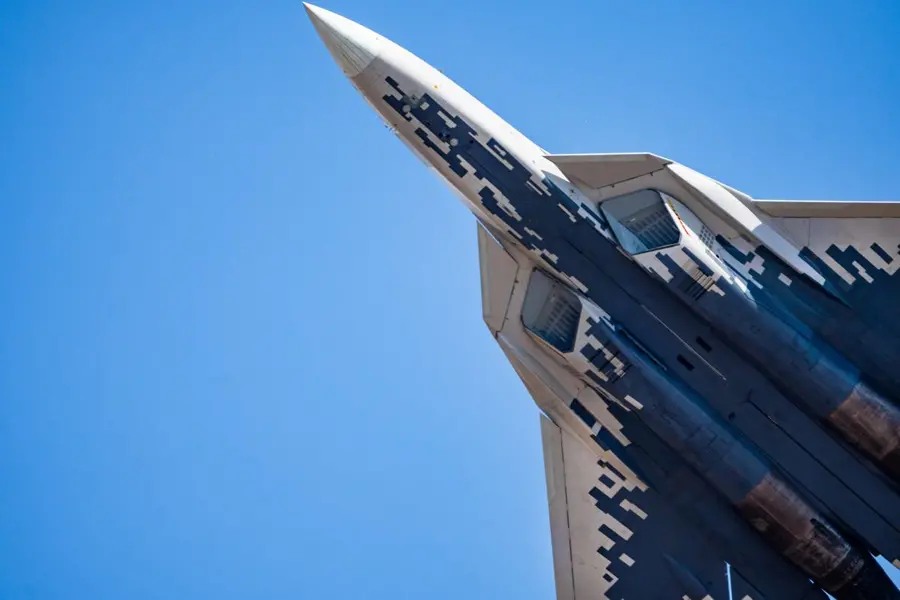
An offer from Moscow lies on the table, and India has chosen not to pick it up. India has decided against buying any additional Russian Sukhoi fighter jet variants for now, keeping the Su-57 -- Russia's first operational fifth-generation stealth fighter -- out of its current purchase plans.
Russia had offered generously, repeatedly proposing to manufacture the Su-57 fully in India through a joint production partnership. Sections of the Indian Air Force (IAF) studied the idea as a temporary fix -- two or three squadrons (a squadron usually has 16 to 18 aircraft) giving India at least a limited stealth capability until its own fifth-generation jet arrives.
Also Read: What India's private firms need to deliver
That jet is the Advanced Medium Combat Aircraft, or AMCA, India's home-built stealth fighter. Defence Secretary RK Singh, who retires in about three months, has confirmed that India is not planning to buy any new Sukhoi variant at present. He did not name the Su-57, but the meaning was clear.
The focus now shifts to the aircraft India already flies. Singh called the Su-30MKI -- built here under a licence from Russia (permission to manufacture another country's design locally) -- a major success and still one of India's main frontline fighters. Its punch grew sharper once the BrahMos supersonic cruise missile (which flies faster than sound and strikes ships or ground targets with great accuracy) was fitted.
So the IAF's plan of buying a few fifth-generation jets as a stopgap stands on hold, while AMCA moves ahead. Tata Advanced Systems, Larsen & Toubro and Bharat Forge have been chosen as private partners to build five flying prototypes (test aircraft made before regular production begins).
Also Read: How America is hijacking India’s AMCA stealth fighter
The calendar is honest about the wait. The first prototype should be assembled around 2027, rolled out in 2028 and fly between 2028 and 2029. Even if nothing goes wrong, AMCA enters service only by the middle of the next decade.
As multiple media reports have reported, it is this waiting period that worries planners. Meanwhile the world is debating how safe stealth jets really are. Reports that a US F-35 was damaged by an older Iranian air defence system in the ongoing West Asia conflict have raised uncomfortable questions.
Experts reply that stealth was never only about hiding from radar. Its strength lies equally in advanced sensors, electronic warfare systems (equipment that jams or confuses enemy radars and communications), secure data links and precision-guided weapons.
The larger worry sits across the Himalayas. China has already inducted more than 350 J-20 'Mighty Dragon' stealth fighters, and its total fifth-generation fleet is estimated at around 500 aircraft. Powered by its own WS-10C and WS-15 engines, these jets roll out quickly and are deployed across all theatre commands (regional military commands), including the Western Theatre Command facing India.
Also Read: Blue Shark vs F-35C: China’s affordable answer
At this speed China could hold nearly 1,000 J-20s by 2030, plus more J-35s. India does not yet fly a single operational fifth-generation fighter.
Pakistan is moving in the same direction. It flies no fifth-generation jet today, but Islamabad has announced plans to buy the Chinese Shenyang J-35A, the export version of the J-35. Numbers and delivery dates remain unconfirmed, though assessments suggest 30 to 40 aircraft initially, making Pakistan the first foreign operator of the J-35.
India's other neighbours -- Bangladesh, Myanmar, Nepal, Bhutan and Sri Lanka -- fly no stealth fighters and have announced no plans to. The concern is China first, Pakistan next.
This is why the Su-30MKI upgrade has become urgent. The IAF flies about 259 of them, the backbone of its combat power. The proposed 'Super Sukhoi' upgrade will cover 84 aircraft first, with the option of extending it to the rest later.
The package promises the indigenous (made in India) Virupaksha AESA radar -- a home-built radar that scans wide areas and tracks many targets at once without a moving antenna -- plus electronic warfare systems, new mission computers, digital cockpit displays and better networking.
It also lets the jet carry next-generation weapons such as Astra Mk-2 and Astra Mk-3 (Indian air-to-air missiles that destroy enemy aircraft from very long distances) and the Rudram series (missiles built to hunt and destroy enemy radars and air defence systems).
Also Read: Can India's homegrown AMCA stealth fighter truly give it strategic edge?
Yet the programme has crawled -- changing requirements, long approvals, integration problems, funding limits and disrupted supply of Russian-origin parts after the Ukraine conflict. HAL wants deeper involvement of the Russian OEM (the company that originally designed and built the aircraft), while Indian private firms remain at the margins.
Russia, strained by its own war, can hardly carry such a heavy programme now. With China expanding fast and Pakistan shopping for stealth, every lost year eats into the IAF's readiness. The lesson is plain -- faster decisions, quicker procurement, and greater faith in Indian manufacturers who can help secure India's skies.
The author is an award-winning science communicator and a Defence, Aerospace & Geopolitical Analyst
Published: 30 Jul 2026, 02:53 pm IST
Disclaimer: Kindly avoid objectionable, derogatory, unlawful and lewd comments, while responding to reports. Such comments are punishable under cyber laws. Please keep away from personal attacks. The opinions expressed here are the personal opinions of readers and not that of Mathrubhumi.
