
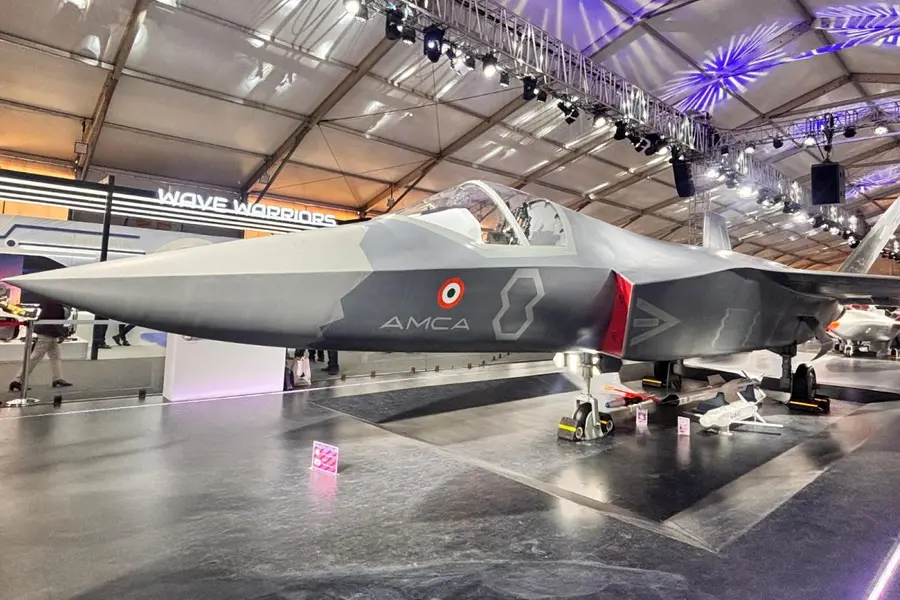
India’s quest for a robust, self-reliant defence ecosystem has taken a significant leap forward with the recent approval of the Advanced Medium Combat Aircraft (AMCA) programme. On Tuesday, the Ministry of Defence announced that Defence Minister Rajnath Singh has greenlit the execution model for this ambitious project, to be spearheaded by the Aeronautical Development Agency (ADA) under the Defence Research and Development Organisation (DRDO).
This decision, following the Cabinet Committee on Security’s nod in March 2024, marks a pivotal moment for India’s aerospace ambitions. The AMCA, envisioned as a fifth-generation stealth fighter jet, could reshape India’s defence capabilities, particularly in countering threats from Pakistan and China. But can it truly serve as a deterrent to these adversaries, and does building it indigenously offer a strategic edge over procuring off-the-shelf options like the American F-35 or Russia’s Su-57? Let’s explore.
Strategic Necessity Amid Regional Tensions
India faces a complex security landscape. Pakistan’s aggressive posturing and China’s growing assertiveness along the Line of Actual Control (LAC) demand a strong and modern air force. The Indian Air Force (IAF), however, is grappling with a worrying shortfall. Against a sanctioned strength of 41 squadrons, the IAF currently operates just 29.
This gap, coupled with delays in procurement and slow progress in indigenous projects, has raised concerns among defence experts. The AMCA, with its promised stealth capabilities, advanced avionics, and cutting-edge technology, could address this gap and bolster India’s air superiority.
The AMCA’s stealth features place it in the same league as global fifth-generation fighters like the F-35 and Su-57, developed by the United States and Russia, respectively. Stealth technology allows aircraft to evade radar detection, giving them a tactical advantage in modern warfare.
For India, facing adversaries equipped with advanced air defence systems, this capability is critical. Pakistan’s air force, while smaller, is modernising with Chinese support, including access to J-20 stealth fighters.
China, on the other hand, boasts a formidable air force with its own fifth-generation jets. The AMCA, if successfully developed, could level the playing field, offering India a credible deterrent against both neighbours.
Indigenous advantage: Why build over buy?
The decision to develop the AMCA domestically, rather than purchasing readily available options like the F-35 or Su-57, is a bold one. While the F-35 and Su-57 are proven platforms, they come with significant drawbacks for India.
First, procuring foreign jets involves high costs, complex logistics, and dependency on external suppliers for maintenance and spare parts. This reliance can be a strategic liability, especially during conflicts when supply chains may be disrupted.
Second, foreign platforms often come with restrictions on technology transfer, limiting India’s ability to customise or upgrade them to meet specific needs.
Building the AMCA indigenously, on the other hand, offers long-term advantages. It fosters self-reliance, a cornerstone of India’s defence policy under the ‘Aatmanirbhar Bharat’ initiative. By involving domestic industries, the AMCA programme will create jobs, build technical expertise, and strengthen India’s aerospace ecosystem.
The Ministry of Defence has emphasised that the ADA will collaborate with industry partners, with an expression of interest (EoI) for the development phase to be issued soon. This partnership model could accelerate innovation and ensure that the AMCA is tailored to India’s unique operational requirements, such as high-altitude combat in the Himalayas or maritime operations in the Indian Ocean.
Moreover, indigenous development allows India to retain full control over the aircraft’s technology. Unlike foreign platforms, which may come with “black box” systems or restricted access to critical components, the AMCA will be a fully Indian product. This ensures greater flexibility in integrating homegrown weapons, sensors, and electronic warfare systems, making the jet a perfect fit for the IAF’s needs.
Challenges and the road ahead
While the AMCA holds immense promise, its path is not without hurdles. India’s track record with indigenous defence projects, such as the Tejas Light Combat Aircraft, has been marred by delays and cost overruns.
The AMCA, being a far more complex fifth-generation platform, will test the capabilities of the DRDO, ADA, and their industry partners. Developing stealth technology, advanced engines, and cutting-edge avionics requires significant investment, technical expertise, and time.
Although earlier reports suggested a prototype could be ready within three years, with the first flight a year or two later, the ministry’s latest statement avoids committing to a timeline, hinting at the challenges ahead.
Another concern is the IAF’s immediate operational needs. With only 29 squadrons, the air force is stretched thin. The AMCA, even in the best-case scenario, is years away from entering service. In the interim, India must rely on existing platforms and expedite other procurements, such as the Rafale or additional Tejas jets, to maintain deterrence.
The AMCA’s success will also depend on sustained political will, adequate funding, and seamless coordination between the DRDO, ADA, and private industry.
A Deterrent in the making?
The AMCA’s potential as a deterrent against Pakistan and China cannot be overstated. Its stealth capabilities, combined with advanced sensors and weaponry, would give the IAF a significant edge in air-to-air and air-to-ground missions.
Against Pakistan, the AMCA could neutralise the threat posed by modernised aircraft and air defence systems. Against China, it could provide a credible counter to the J-20, enabling India to project power and protect its interests in contested regions like Ladakh or Arunachal Pradesh.
However, deterrence is not just about technology – it’s about numbers and readiness. Even with the AMCA, the IAF will need to address its squadron shortfall to project credible strength. The government’s decision to prioritise indigenous development over foreign purchases is a strategic bet on long-term self-reliance.
If successful, the AMCA could not only deter adversaries but also position India as a global player in aerospace technology, joining the elite club of nations with fifth-generation fighters.
The approval of the AMCA programme is a defining moment for India’s defence ambitions. By choosing to build its own fifth-generation fighter, India is investing in its strategic autonomy and technological prowess.
While challenges like delays and technical complexities remain, the AMCA has the potential to transform the IAF into a modern, self-reliant force capable of countering threats from Pakistan and China.
Unlike the F-35 or Su-57, which offer immediate solutions at the cost of dependency, the AMCA represents a vision of sovereignty and innovation. If India can navigate the challenges and deliver on this promise, the AMCA will not only be a deterrent but a symbol of a resurgent, self-confident nation.
As the ADA prepares to issue its EoI and industry partnerships take shape, all eyes will be on the AMCA’s progress. For now, it’s a bold step towards a stronger, more secure India – one that could reshape the regional balance of power for decades to come.
The author is a defence, aerospace & geopolitical analyst.
Published: 27 May 2025, 11:59 am IST
Related Topics
Disclaimer: Kindly avoid objectionable, derogatory, unlawful and lewd comments, while responding to reports. Such comments are punishable under cyber laws. Please keep away from personal attacks. The opinions expressed here are the personal opinions of readers and not that of Mathrubhumi.
