
A new radar in Assam is set to give India a sharper eye on the increasingly crowded skies. Here’s how ISRO’s Project NETRA will track space debris and protect satellites.
Picture a crowded highway with no traffic police, no signals and no headlights, where every vehicle races at 27,000 kilometres an hour. That is roughly what the space around our planet has become. Spent rocket stages, dead satellites and fragments of broken spacecraft hurtle through low Earth orbit, and at such speeds even a piece smaller than a cricket ball can shatter a satellite worth hundreds of crores.
India's answer to this invisible danger is taking shape at Chandrapur, near Guwahati. On Monday, 21 September, Assam Chief Minister Himanta Biswa Sarma laid the foundation stone of ISRO's Advanced Radar Research Centre, a facility being built under Project NETRA, short for Network for Space Object Tracking and Analysis.
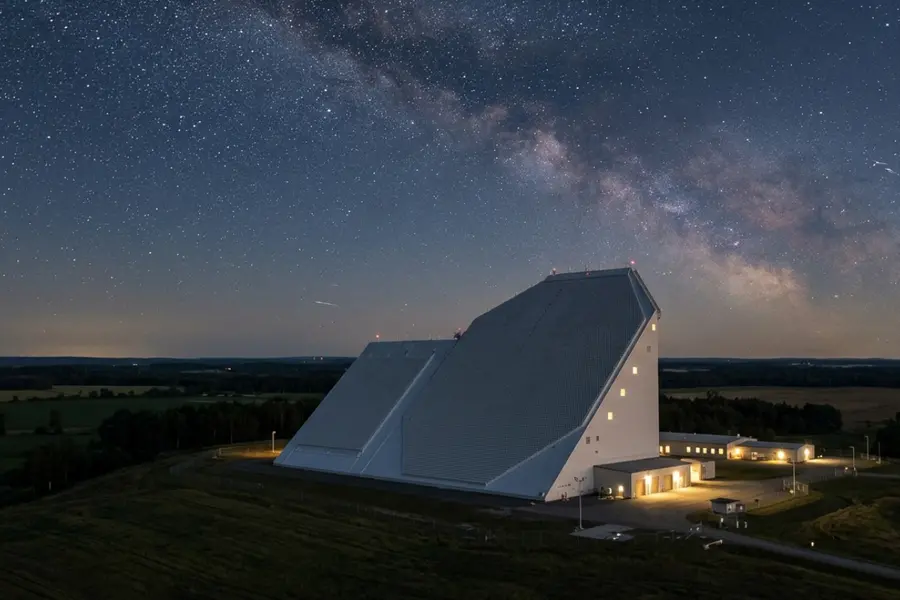
So what exactly will this radar do? Think of shouting in a valley and listening for the echo. A radar sends out radio waves, and when they strike an object, a faint echo bounces back. From that echo, engineers can calculate where the object is, how fast it is moving and which way it is heading. The Chandrapur system is described as India's first dedicated debris-tracking phased-array radar. Instead of one large dish that must physically swivel, a phased-array radar uses thousands of small antennas working together to steer its beam electronically, much like a torch whose beam can leap across the sky without the torch ever turning, hopping from one object to the next and back again in a split second. NETRA's radar is planned to reach 1,500 km and track objects 10 cm and above, and it will be indigenously designed and built.
Why should this matter to every Indian household? Our weather forecasts, navigation apps, television broadcasts, disaster warnings and banking networks all depend on satellites. In 2021 alone, ISRO had to perform 19 collision avoidance manoeuvres, nudging satellites out of harm's way. Until now, India has leaned on foreign eyes, depending on NORAD, which shares only selective debris data. A nation preparing to send its own astronauts into orbit cannot afford to borrow its vision. Space awareness also carries a security dimension, adding a new ring to the country's defence against threats from air, space or sea.
Chandrapur will not stand alone. NETRA is a web of watchtowers. It draws on the Multi-Object Tracking Radar at Sriharikota and telescopes at Ponmudi and Mount Abu, while another telescope is being developed at Hanle in Ladakh. All this information flows to ISRO's Space Situational Awareness Control Centre in Bengaluru, set up in 2020, which works out exactly where each object is flying, sends out collision-avoidance alerts and tracks satellites and rocket bodies falling back to Earth. The long-term dream is even bolder: to watch the high "parking orbit" about 36,000 kilometres up, where TV and communication satellites hover over one fixed spot on Earth.
Which brings us to the question many are asking: why Assam? The answer lies in geography. With sensors already stationed in the south, west and far north, the country's eastern flank remained the missing piece, and ISRO's planners had long envisioned a radar in the North-East to widen coverage across India. A watchtower at each corner of the house sees far more than several crowded into one room. ISRO earmarked around 67 acres at Chandrapur; the land was transferred in November 2023 and final registration was completed on 7 November 2025.
For Assam, the moment carries deep emotional weight. Sarma reflected that the state was once seen as distant from India's technology heartland, and said it was deeply satisfying to watch it now host such advanced national infrastructure. Thanking Prime Minister Narendra Modi for choosing Assam, he described the state as an emerging hub for major strategic technology projects.
The radar was not the weekend's only milestone. On Sunday, the Chief Minister laid the foundation stone of Adani Power Limited's 3,200 MW ultra-supercritical thermal power project at Chapar in Dhubri district. "Ultra-supercritical" simply means water is heated under such extreme pressure and temperature that it turns straight into steam without boiling, squeezing more electricity from every tonne of coal. Costing around Rs 48,000 crore, it ranks among the largest single investments in Assam's industrial sector, with roughly 25,000 jobs expected during construction and about 5,000 permanent ones afterwards. Sarma called it historic, a strong base for the state's power sector and a step towards energy self-reliance, promising dependable electricity for industries and fresh investment.
Together, these two foundation stones tell one story. A region once spoken of as India's periphery is now helping power the nation below and guard its satellites above, keeping a patient, unblinking watch over the sky we all share.
(Girish Linganna is an award-winning science communicator and a Defence, Aerospace & Geopolitical Analyst)
Published: 21 Sept 2026, 03:35 pm IST
ABOUT THE AUTHOR

Disclaimer: Kindly avoid objectionable, derogatory, unlawful and lewd comments, while responding to reports. Such comments are punishable under cyber laws. Please keep away from personal attacks. The opinions expressed here are the personal opinions of readers and not that of Mathrubhumi.