
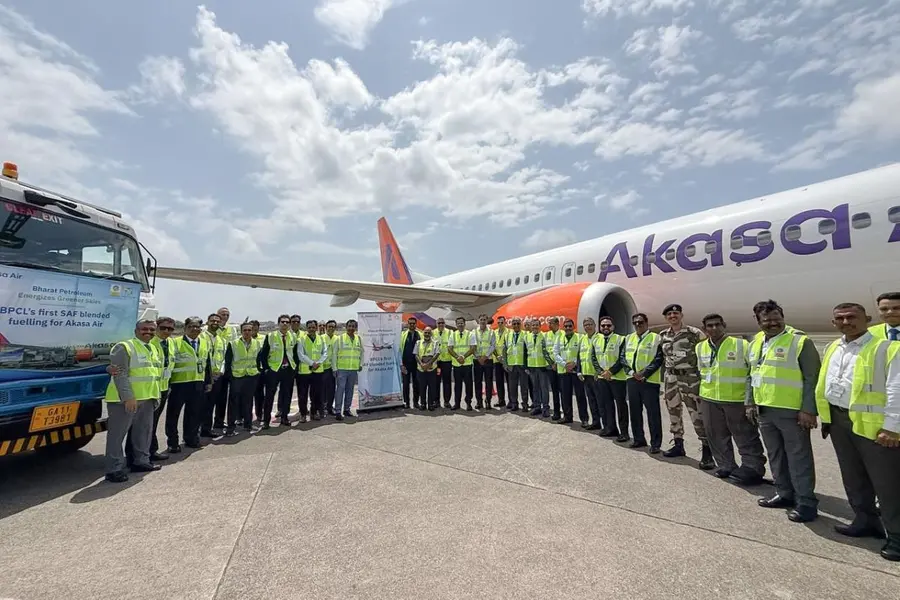
Akasa Air has taken another step towards greener aviation by operating a commercial flight using Sustainable Aviation Fuel (SAF), supplied by Bharat Petroleum Corporation Limited (BPCL). The flight marks an important move for India’s growing aviation sector as airlines explore cleaner alternatives to conventional jet fuel.
The Mumbai-based airline operated the commercial flight on September 8 using aviation turbine fuel blended with 1% SAF. The flight departed from Chhatrapati Shivaji Maharaj International Airport in Mumbai at 1:05 pm and arrived at Manohar International Airport in Goa at 2:30 pm.
Also Read

The SAF was supplied by BPCL as part of a partnership between the two companies to explore the use of sustainable fuels and other ways to reduce aviation emissions.
Step towards clean aviation
SAF is considered one of the most important tools available to the aviation industry to reduce carbon emissions. Unlike conventional jet fuel, SAF can be produced from renewable sources and waste-based feedstocks.
The fuel can be blended with conventional aviation fuel and used in existing aircraft and engines, making it an important option for reducing emissions without requiring airlines to replace their fleets.
For Akasa Air, the latest flight is more than a one-time demonstration. The airline said the operation will provide practical experience and useful information that can help both Akasa and BPCL understand the challenges and opportunities involved in increasing SAF use in India.
Akasa Air pushes sustainability agenda
Sustainability has been part of Akasa Air’s strategy since the airline began operations. Ankur Goel, Chief Financial Officer, Akasa Air, said the airline has focused on newer aircraft, technology and responsible operating practices to build a more efficient airline. He said the SAF-powered flight was an important step in turning the airline’s partnership with BPCL into practical action.
However, increasing SAF use across India will require cooperation between airlines, fuel suppliers, policymakers and other aviation stakeholders. Akasa said domestic SAF production, supportive government policies and commercially viable pricing will all be important if the fuel is to be adopted on a larger scale.
India targets 5% SAF blending by 2030
The development comes as India works towards its target of achieving 5% SAF blending by 2030. The country is looking at SAF as part of its wider efforts to reduce emissions from aviation, one of the fastest-growing transport sectors in India.
With passenger traffic and aircraft fleets expected to continue growing, the need for cleaner aviation fuels is also becoming more urgent. The successful Akasa-BPCL flight provides an example of how airlines and fuel companies can begin testing and gaining experience with SAF as India works towards building a larger domestic SAF ecosystem.
BPCL to build SAF ecosystem
BPCL said developing sustainable aviation fuel is both an environmental requirement and an important part of India's future energy strategy.
Subhankar Sen, Director (Marketing), BPCL, said the company is working across the value chain to address challenges such as the availability and collection of suitable feedstocks for SAF production.
He said developing sustainable and locally sourced energy solutions could also help improve India's energy security, given the country's dependence on imported crude oil.
BPCL also thanked the Ministry of Petroleum and Natural Gas, Ministry of Civil Aviation and Directorate General of Civil Aviation (DGCA) for their support in making the initiative possible.
Boeing 737 MAX supports Akasa's Green Strategy
Akasa Air's focus on sustainability also extends to its aircraft fleet.
The airline operates a fleet of Boeing 737 MAX aircraft, powered by CFM International LEAP-1B engines and equipped with advanced winglets. The aircraft use around 20% less fuel and produce lower emissions compared with the aircraft they replace.
Akasa has also partnered with OpenAirlines to use its SkyBreathe fuel-management system. The technology uses data and analytics to help airlines reduce fuel consumption and improve operational efficiency.
The airline has also taken steps to reduce water consumption during route inaugurations. It was the first Indian airline to voluntarily stop traditional water-cannon celebrations for new routes, saving more than 5.5 lakh litres of water so far.
SAF could shape India's aviation future
Akasa Air's latest SAF flight comes at a time when India's aviation industry is preparing for rapid growth while also facing increasing pressure to reduce its environmental impact.
While a 1% SAF blend is only an initial step, the significance lies in putting the fuel into actual commercial operation and gaining experience with its use.
As India works towards its 2030 SAF blending target, such initiatives could help airlines, fuel suppliers and regulators understand what is needed to move from pilot projects to wider adoption. For Akasa Air, the flight strengthens its position as an airline willing to test new technologies and operating practices as it builds its business.
All-in-all journey towards cleaner aviation will require small, practical steps today and SAF is likely to be one of the most important steps on that journey.
Published: 09 Sept 2026, 05:14 pm IST
ABOUT THE AUTHOR
Disclaimer: Kindly avoid objectionable, derogatory, unlawful and lewd comments, while responding to reports. Such comments are punishable under cyber laws. Please keep away from personal attacks. The opinions expressed here are the personal opinions of readers and not that of Mathrubhumi.