
A suspicious Wi-Fi network aboard Delta Flight 591 has raised fresh cybersecurity concerns. Here’s what happened and why fake in-flight Wi-Fi could be a growing risk.
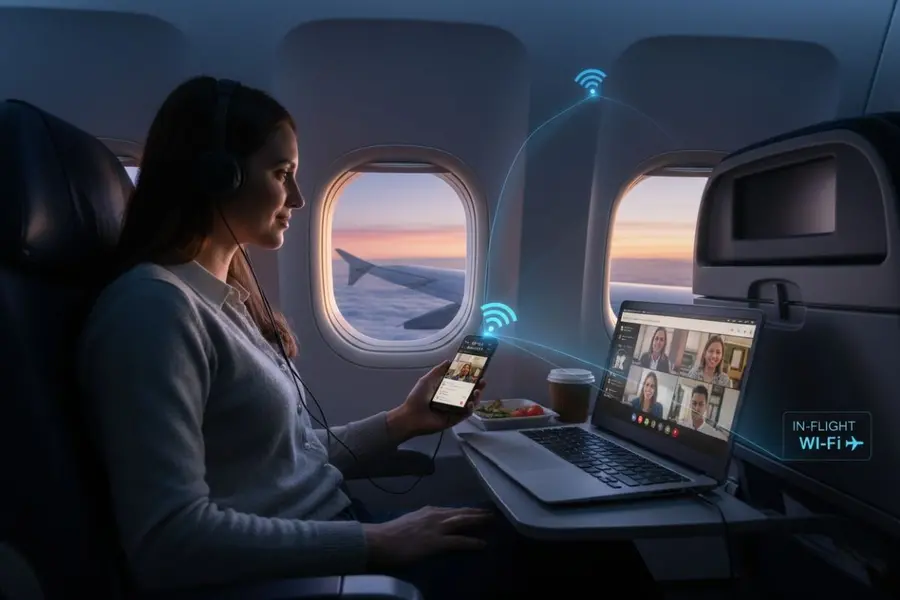
Imagine settling into your seat on a long flight, opening your laptop or phone and looking for the aircraft's Wi-Fi. You see a familiar network name and naturally you connect to kill the boredom. You start checking your email, browsing the internet or perhaps logging into your bank account. Now imagine finding out that the network you connected to was not the airline's Wi-Fi at all.
That unsettling possibility became a reality aboard a Delta Air Lines flight from Las Vegas to Atlanta earlier this month, when an unauthorised Wi-Fi network appeared inside the aircraft cabin. The incident forced the crew to temporarily switch off the aircraft's legitimate Wi-Fi service and has prompted an investigation involving Delta, federal law enforcement and aviation regulators.
The good news for the passengers is important. Delta says none of its systems were hacked, its legitimate in-flight Wi-Fi was not compromised, and flight safety was never affected.
But the incident raises an intriguing question for the modern connected aircraft. How easy is it for a passenger to mistake a fake network for the real thing?
A strange wi-fi appears
The incident occurred on Delta Flight 591, travelling from Las Vegas to Atlanta. The Boeing 757 was carrying 199 passengers and six crew members when an unauthorised Wi-Fi network was detected onboard. According to Delta, the network was not provided, operated or supplied by the airline.
ALSO READ: From Imphal to the skies: How two siblings found a shared journey as Air India cabin crew
The cabin crew responded by temporarily disabling the aircraft's Wi-Fi functionality for approximately 30 minutes. There was no emergency declaration and, importantly, the aircraft continued its flight normally. The concern, however, was not simply that another Wi-Fi signal was floating around inside the aircraft.
Messages attributed to the flight crew indicate that someone onboard may have created a network designed to look like the aircraft's legitimate Wi-Fi. One reported network name was "Delta WiFi Fast." That immediately raises a bigger concern, could passengers have connected to it believing it was the airline's network?
The fake network concern
For an ordinary passenger, the difference between a genuine and fake Wi-Fi network can be almost impossible to spot. Airlines typically provide passengers with a clearly identified wireless network that allows them to access onboard connectivity services. A malicious actor can potentially create another network with a similar or convincing name.
ALSO READ: US FAA orders Boeing 787 inspections over fatigue crack risk: What it means for passengers
The device being used does not necessarily have to be highly sophisticated.
Cybersecurity professionals have access to commercially available equipment that can be used to create simulated or spoofed wireless networks for legitimate security testing. Similar technology, however, can also be misused.
If a passenger unknowingly connects to a malicious network, the concern could shift from simply losing internet access to potentially exposing personal information, depending on how the network is configured and what the user does while connected. There is currently no evidence that passengers on Flight 591 had their information stolen or compromised.
It is also not yet known who created the unauthorised network or exactly what they intended to do. Those questions are now part of the investigation.
ALSO READ: DGCA considers testing every pilot yearly in push to strengthen flight safety
The crew took action
Once the crew became aware of the unauthorised network, they took the safest and simplest approach, they switched off the aircraft's legitimate Wi-Fi. Messages reportedly sent by the flight crew to air traffic control indicated concerns that the network could potentially be used to scam passengers.
For passengers, perhaps the most important part of the story is what didn't happen.
Delta has stressed that there was no hack of its systems, including the aircraft legitimate in-flight Wi-Fi system. The airline also said that no aircraft operating systems were affected and that the safety of the flight was never in question.
Modern commercial aircraft contain numerous interconnected digital systems, but passenger Wi-Fi is not the same thing as the systems responsible for safely operating the aircraft. The unauthorised network therefore did not mean that someone had gained control of the aircraft or accessed its flight-control systems.
The flight continued safely to Atlanta. The why is this incident so important?
Even without an aircraft systems breach, the incident highlights a growing challenge for the aviation industry. Aircraft are becoming increasingly connected. Passengers expect to remain online from the moment they board until they reach their destination. Airlines are investing heavily in faster Wi-Fi, digital services, connected cabins and increasingly sophisticated onboard technology. That connectivity brings benefits but it also creates new questions around cybersecurity.
ALSO READ: 15 engineers, 34 days: How Emirates turned aircraft parts into Arsenal’s giant crest
The biggest vulnerability may not always be the aircraft itself. It could be the passenger sitting in random seat, simply trying to connect to Wi-Fi. A convincing fake network could potentially trick an unsuspecting traveller into believing they are using the airline's service.
For airlines, that means cybersecurity is no longer only about protecting aircraft systems and corporate networks. It is also about protecting the increasingly connected passenger environment.
The Investigation Continues
Delta is working with federal law enforcement and aviation regulators to establish exactly what happened. The FBI has confirmed that it is aware of the incident and is working with local and corporate partners. The Federal Aviation Administration has also been contacted about the matter, although its initial response indicated it had not received a formal report.
At this stage, several questions remain unanswered like who created the network? Was it actually intended to impersonate the flight’s wi-fi, did anyone connect to it, was any passenger’s personal information compromised and most importantly, was it an elaborate attempt to scam passengers, a cybersecurity experiment, or something else entirely?
Those answers will have to wait for the investigation.
Reality check
The Flight 591 incident ended without an aircraft safety issue, but it offers passengers and airlines something valuable that a reminder that connectivity comes with responsibility. For passengers, the point to remember is when connecting to aircraft Wi-Fi, make sure you are using the official network identified by the airline, and be cautious about entering sensitive information on unfamiliar networks.
ALSO READ: Why pilots want DGCA to increase random drug tests from 10% to 25%
For airlines, the challenge is considerably larger.
As aircraft cabins become more connected, the industry must think not only about keeping aircraft systems secure, but also about ensuring that the digital environment surrounding passengers cannot easily be manipulated. The aircraft of the future will be more connected than ever and that means the question may no longer be simply: "Does this aircraft have Wi-Fi?" It may increasingly become: "Am I sure that I am connected to the aircraft's Wi-Fi?"
For Delta Flight 591, the crew acted quickly, the legitimate Wi-Fi was switched off and the aircraft completed its journey safely. But the incident is a timely reminder that in aviation, even something as ordinary as connecting your phone to Wi-Fi can become a cybersecurity story.
Published: 31 Aug 2026, 05:49 pm IST
ABOUT THE AUTHOR

Related Topics
Disclaimer: Kindly avoid objectionable, derogatory, unlawful and lewd comments, while responding to reports. Such comments are punishable under cyber laws. Please keep away from personal attacks. The opinions expressed here are the personal opinions of readers and not that of Mathrubhumi.