
The pilots' body wants investigators to examine possible electrical system anomalies, maintenance messages, and security footage as the Air India AI171 crash probe continues
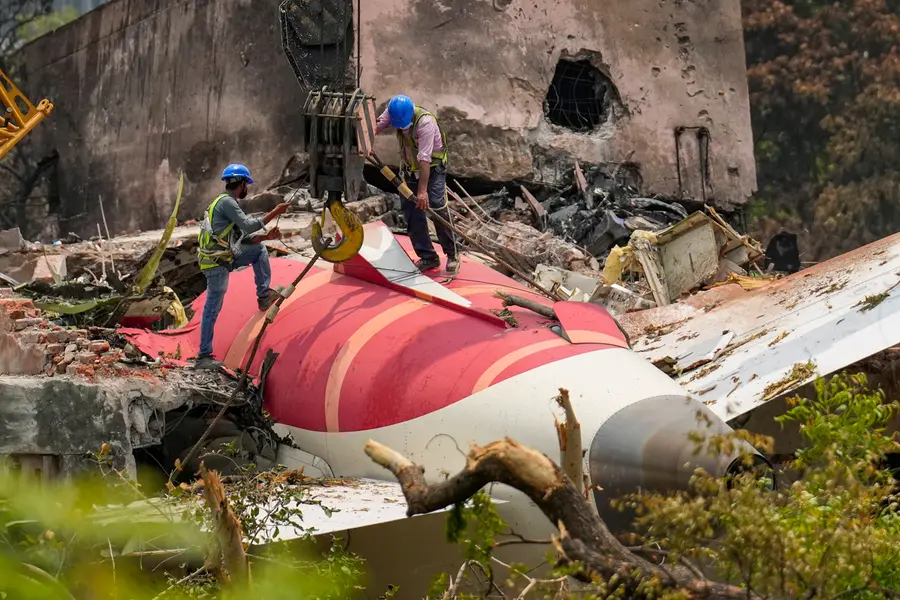
The Federation of Indian Pilots (FIP) has urged the Aircraft Accident Investigation Bureau (AAIB) to conduct a fresh series of Boeing 787 simulator tests as part of the ongoing investigation into the Air India Flight AI171 crash.
In a letter sent to the Director General of the AAIB, the pilots' body raised questions about certain findings contained in the bureau's preliminary report and called for a closer examination of the aircraft's Ram Air Turbine (RAT) deployment timeline.
Also Read

The request comes a year after the June 12, 2025 crash of Air India Flight AI171, a Boeing 787-8 operating from Ahmedabad to London Gatwick. The accident claimed the lives of 241 of the 242 people on board and 19 people on the ground, making it one of the deadliest aviation disasters in India's history.
Questions over RAT deployment timeline
The FIP's concerns are based on a submission made by US-based aviation lawyer D. Michael Andrews of Beasley Allen Law Firm, which represents more than 130 passengers and family members affected by the crash.
According to the AAIB's preliminary report, fuel system interruption occurred at 08:08:42 UTC, and hydraulic power generated by the aircraft's Ram Air Turbine became available approximately four to five seconds later.
However, simulator testing conducted in a certified Boeing 787 full-motion simulator reportedly produced different results. According to the findings submitted by Andrews, RAT-generated power was observed only around 18 seconds after fuel interruption.
The pilots' body said this difference in timing warrants further investigation. It argued that if the simulator results accurately reflect aircraft performance, the RAT may have deployed before the fuel interruption occurred rather than as a consequence of it.
Possibility of earlier system anomaly
The submission suggests that RAT deployment may have been linked to an earlier system or electrical fault rather than fuel system changes alone.
The letter also referred to images included in the preliminary report and still frames reportedly extracted from Ahmedabad Airport security camera footage. According to the submission, these images appear to show the RAT already deployed while the aircraft was still on the runway before rotation for take-off.
The FIP said these observations should be examined alongside other available evidence to establish a clear sequence of events.
Call for review of additional evidence
The pilots' association has requested investigators to review several factors together, including reports of a loud bang heard before the crash, dimming cabin lights, maintenance messages transmitted through the Aircraft Communications Addressing and Reporting System (ACARS), and damage visible in images of the aircraft's flight recorder.
According to the letter, analysing these elements collectively could help determine whether any electrical system anomalies contributed to the accident.
The FIP has also requested that fresh simulator tests be conducted in the presence of an observer nominated by the association. The organisation said the tests should independently verify the aircraft's acceleration profile as well as the relationship between RAT deployment, hydraulic power generation and fuel control switch movements.
Request to decode maintenance messages
The pilots' body further urged investigators to ask Air India Engineering and Boeing to decode fault and status information contained in ACARS maintenance messages transmitted between 07:53 UTC and 08:09 UTC on the day of the accident.
The messages reportedly referenced several aircraft systems, including flight controls, hydraulics, processing modules, electronic flight bag equipment and common core system functions.
The association has also sought access to Ahmedabad Airport security camera footage for independent analysis of the timing of RAT deployment.
Lawyer submits findings to US and UK authorities
In a separate letter dated June 11, Andrews said the simulator findings had also been shared with the US Department of Transportation, the Federal Aviation Administration (FAA) and the UK's Air Accidents Investigation Branch.
He argued that the simulator results may not fully align with the timeline outlined in the AAIB's preliminary report and suggested that further examination of the RAT deployment sequence may be necessary.
Investigation continues
The AAIB's preliminary report stated that shortly after take-off, both engine fuel control switches moved from the RUN position to CUTOFF one second apart, resulting in a loss of fuel supply to both engines.
The report noted that the switches were subsequently returned to RUN and engine relight attempts began, but the aircraft was unable to regain altitude.
Investigators have emphasised that the inquiry remains ongoing and that no final conclusions have been reached.
On the first anniversary of the crash, the AAIB said significant work had been completed on the analysis of flight data, engine examinations, maintenance records and operational documentation. However, no date has yet been announced for the publication of the final investigation report.
Published: 15 Jun 2026, 02:58 pm IST
Disclaimer: Kindly avoid objectionable, derogatory, unlawful and lewd comments, while responding to reports. Such comments are punishable under cyber laws. Please keep away from personal attacks. The opinions expressed here are the personal opinions of readers and not that of Mathrubhumi.