
Built under the ₹21,935 crore Airbus-Tata partnership, the programme strengthens the Make in India and Atmanirbhar Bharat initiatives while expanding private-sector participation in aerospace production
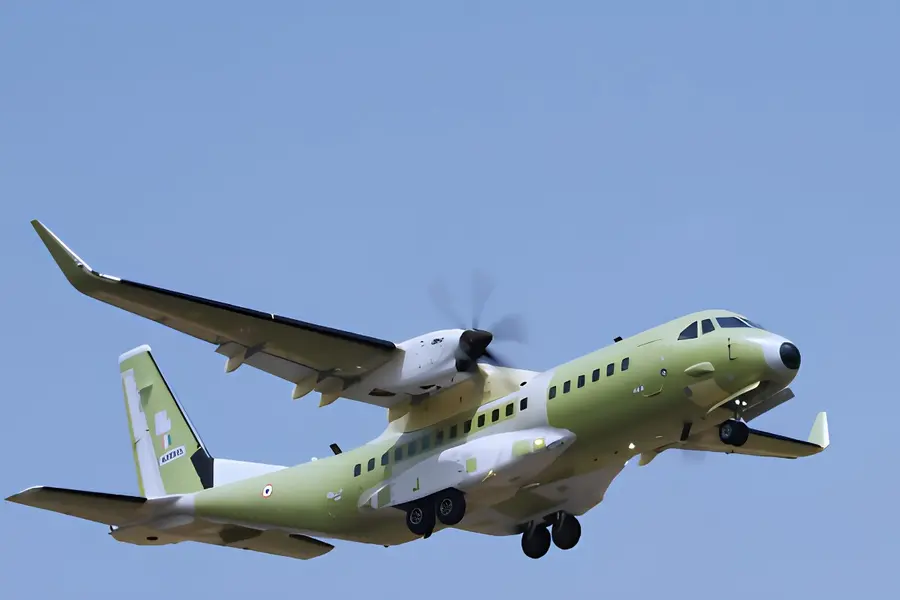
India has achieved a major milestone in its defence manufacturing journey with the successful maiden flight of the first Airbus C295 military transport aircraft built in the country. The aircraft, manufactured at the Tata-Airbus Final Assembly Line in Vadodara, Gujarat, completed its first test flight successfully, marking a significant step forward for the Government’s ‘Make in India’ and Atmanirbhar Bharat initiatives.
The achievement is being viewed as a landmark moment for India’s aerospace sector because it is the first time a military transport aircraft is being manufactured in the country by a private-sector company. The programme is being executed through a partnership between European aerospace giant Airbus and Tata Advanced Systems Limited (TASL).
From buyer to manufacturer
For many years, India has largely depended on imports or licensed production to meet its military aviation requirements. The C295 programme represents a shift in that approach. Instead of simply purchasing aircraft from overseas manufacturers, India is now developing the capability to build advanced military aircraft within the country.
The project is part of a ₹21,935 crore contract signed in 2021 between Airbus Defence and Space and the Ministry of Defence for the supply of 56 C295 transport aircraft to the Indian Air Force (IAF). Under the agreement, the first 16 aircraft are being delivered directly from Airbus facilities in Spain, while the remaining 40 aircraft are being manufactured in India.
The aircraft that completed its maiden flight this week is the first of those 40 aircraft to be produced domestically.
A new chapter for private sector
The successful test flight also highlights the growing role of private industry in India’s defence sector. Traditionally, military aircraft manufacturing in India has been dominated by public sector companies, particularly Hindustan Aeronautics Limited (HAL).
With the establishment of the Tata-Airbus production facility in Vadodara, Tata Advanced Systems has become the first private Indian company to set up a full-scale military aircraft manufacturing line in the country. Industry experts believe this could pave the way for greater private-sector participation in future defence and aerospace programmes.
The Final Assembly Line, inaugurated in 2024, is responsible for assembling, testing and delivering the aircraft to the Indian Air Force.
Strengthening the Make-in-India ecosystem
One of the key objectives of the programme is to develop a strong domestic aerospace manufacturing ecosystem. Airbus has repeatedly highlighted the involvement of Indian micro, small and medium enterprises (MSMEs) in the project. These companies are manufacturing a wide range of aircraft components and assemblies that are being integrated into the final aircraft.
The programme is creating opportunities for Indian suppliers, engineers, technicians and skilled workers while helping build expertise in advanced aerospace manufacturing. It is also expected to encourage further investments in the sector and strengthen India's position as a global aerospace manufacturing destination.
The development of local supply chains is considered crucial for reducing dependence on imports and supporting the country's long-term goal of becoming self-reliant in defence production.
Indian Air Force welcomes the achievement
The Indian Air Force congratulated all teams involved in the successful maiden flight and described the achievement as a reflection of India’s growing aerospace capabilities.
In a statement, the IAF said the successful flight reinforces the country’s expanding defence manufacturing capabilities and demonstrates its commitment to supporting indigenous development under the vision of Atmanirbhar Bharat.
The maiden flight marks the beginning of the next phase of testing and certification before the aircraft enters operational service with the Air Force.
Replacing the ageing Avro Fleet
The C295 aircraft will eventually replace the Indian Air Force’s ageing Avro-748 transport fleet, which has served the country for several decades.
The twin-engine turboprop aircraft is designed for a variety of military missions, including troop transportation, cargo movement, medical evacuation, humanitarian relief operations and special missions. It is capable of operating from short and unprepared runways, making it suitable for operations in remote and difficult terrains.
Its modern systems and operational flexibility are expected to significantly enhance the transport capabilities of the Indian Air Force.
More than an aircraft programme
Beyond the delivery of new aircraft, the C295 programme is being seen as an important industrial development initiative. It demonstrates how international partnerships can help build manufacturing capability within India while creating jobs, developing skills and strengthening domestic supply chains.
The project also serves as an example of how the Government’s Make in India policy is moving from concept to reality in high-technology sectors such as aerospace and defence.
Looking ahead
The successful maiden flight of the first Made-in-India C295 is an important moment for India's defence and aerospace sectors. While further testing and certification activities will continue before the aircraft is formally delivered to the Indian Air Force, the achievement clearly demonstrates the progress India has made in building its own aerospace manufacturing capabilities.
As production of the remaining aircraft gathers pace, the programme is expected to play a key role in strengthening India’s defence industrial base and advancing the country’s vision of becoming a global manufacturing hub for aerospace and defence equipment.
Published: 11 Jun 2026, 02:20 pm IST
Disclaimer: Kindly avoid objectionable, derogatory, unlawful and lewd comments, while responding to reports. Such comments are punishable under cyber laws. Please keep away from personal attacks. The opinions expressed here are the personal opinions of readers and not that of Mathrubhumi.
