
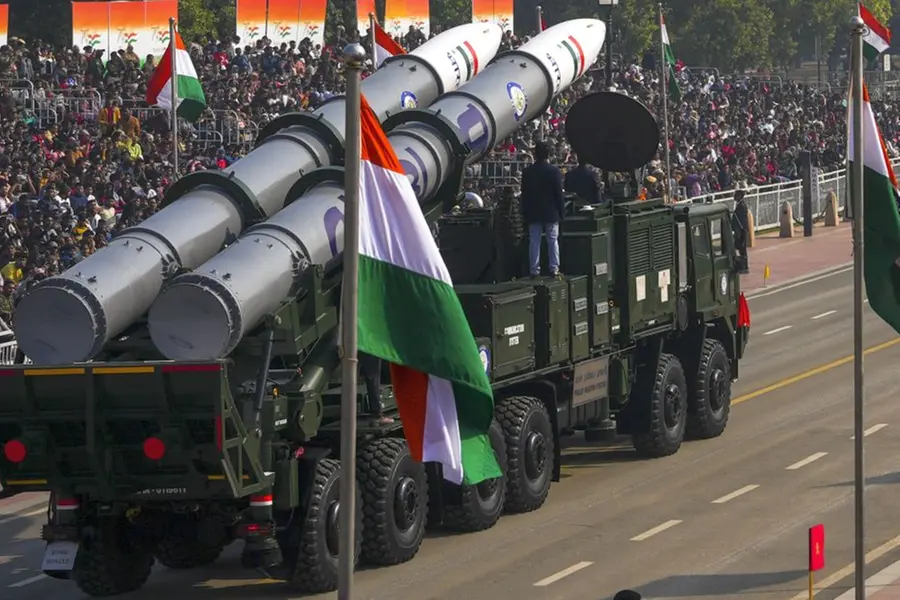
India will showcase the Pralay ballistic missile system for the first time during the Republic Day Parade on January 26, 2025. Developed by the Defence Research and Development Organisation (DRDO), the Pralay is a tactical quasi-ballistic surface-to-surface missile with a range of 150 to 500 kilometers.
It is designed to change its flight path during the mid-course phase, making it difficult for enemy defenses to detect and intercept. This advanced missile highlights India’s growing strength in military technology.
Also Read

The twin launcher design of the Pralay missile system allows it to fire two missiles one after the other. This launcher is mounted on an Ashok Leyland 12x12 high-mobility vehicle, which is an advanced truck with 12 wheels, all of which are powered for better traction and mobility on rough terrains.
This setup replaces the older launchers that were imported from the Czech Republic, making the system fully designed and manufactured in India. This change reflects the country’s focus on using more locally made equipment.
In the future, BEML will be involved in developing new Transporter Erector Launcher (TEL) systems. These systems are used to transport and launch missiles, and the collaboration highlights efforts to enhance India’s defense technology with more locally produced equipment.
Boosting India's defense at the border
The Indian Air Force ordered 120 Pralay missiles in December 2022, and in 2023, the Indian Army placed a larger order for 250 missiles. This shows the growing demand for the Pralay missile across India’s armed forces.
These missiles are being acquired to boost India’s defense along the Line of Actual Control (LAC) and the Line of Control (LoC). The Pralay missile is part of the Integrated Rocket Force (IRF), which also includes other advanced systems like BrahMos, Nirbhay, and Pinaka.
The mobile launcher for the Pralay missile is equipped with two missile canisters, making it capable of carrying and launching two missiles.
It also has an advanced communication system and a mast that can be extended to improve signal range. The launcher comes with a special arm that helps position the missiles for launch, and a jet deflector to safely manage the exhaust gases during firing. Together, these features meet the Army’s needs for a reliable and effective tactical ballistic missile system.
Tactical ballistic missiles are short-range missiles designed for use on the battlefield. They target enemy positions, equipment, or infrastructure quickly and precisely, supporting military operations in specific conflict areas.
India is placing missiles along the Line of Actual Control (LAC) and the Line of Control (LoC) as a strategic step to counter the military strength of neighboring countries, especially China and Pakistan.
Both Pakistan and China have strengthened their missile systems near their borders with India. Pakistan has deployed the Chinese-made HQ-9 surface-to-air missile system along the Line of Control (LoC), and China has positioned similar missile systems along the Line of Actual Control (LAC).
To respond to these developments, India has decided to acquire Pralay ballistic missiles. These missiles will be deployed near the borders to improve India's defense and ensure it is prepared to counter any threats.
The Pralay missile program started in 2015 with a budget of Rs 332.88 crore. It used technology from earlier Indian missile projects like the Prithvi Defense Vehicle (PDV) and the Prahaar missile. The Research Centre Imarat (RCI) handled the development, and aerodynamic testing was done at the National Aerospace Laboratories.
In the league of Iskander and Dongfeng 12
According to armyrecognition.com, the Pralay missile uses a special type of fuel called composite propellant, which is similar to the one used in the Sagarika missile. This fuel is more efficient, providing better energy compared to older systems. Composite propellant is a mix of solid chemicals that burn together to create the power needed to launch the missile.
The Pralay is a tactical surface-to-surface missile with advanced capabilities. It can be compared to other missiles like Russia's 9K720 Iskander, China's Dongfeng 12, the U.S.'s Precision Strike Missile (PrSM), and South Korea’s Hyunmoo 2. These are modern missiles designed for quick and precise strikes on enemy targets during combat.
The Pralay missile can carry a payload weighing between 350 and 700 kilograms. It is powered by a solid-fuel rocket engine, which makes it reliable and efficient. The missile also has advanced guidance systems, allowing it to hit targets with high accuracy, having an error margin of less than 10 meters.
Pralay's prowess
The Pralay missile can carry different types of warheads, depending on the mission:
1. High-Explosive Fragmentation : This warhead explodes into many small pieces, or fragments, which spread out to hit multiple targets nearby. It is effective for damaging enemy troops, vehicles, and equipment over a wide area.
2. Penetration-Cum-Blast (PCB) : This warhead is designed to penetrate tough structures like bunkers or buildings before exploding. It is useful for destroying heavily fortified enemy positions.
3. Runway Denial Submunitions (RDPS): This warhead releases smaller explosives over a wide area, specifically targeting enemy runways or airstrips. The goal is to make the runway unusable for aircraft operations.
Pralay missile features
The Pralay missile can reach very high speeds, up to Mach 6.1 (about 7,500 km per hour). This makes it extremely fast and capable of hitting important enemy targets like radar stations, command centers, and airstrips with precision.
The Pralay missile is between 7.5 to 11 meters long and has a diameter ranging from 420 mm to 750 mm.
The Pralay missile has a special nose cone, called a radome, made from fused silica, which protects its advanced targeting system. It uses a millimeter-wave seeker to lock onto targets. Efforts are being made to make the missile even more accurate, aiming to reduce its error margin to less than 4 meters.
A millimeter-wave seeker is a high-tech sensor that uses tiny radio waves to detect and lock onto targets with great accuracy, even in poor weather or challenging conditions.
Tests conducted in December 2021 and November 2023 confirmed that the missile performs well within its range, can carry its intended payload, and has reliable guidance systems.
The missile is designed using advanced technologies from the Prahaar missile program and the K-series missiles, which are launched from submarines. The missile uses a solid-fuel engine and a maneuverable re-entry system to perform better against missile defense systems. Tests in 2021 and 2023 confirmed its range, ability to carry different payloads, and readiness for use in combat.The missile can carry different types of warheads, allowing it to hit a variety of targets like radar stations and runways.
Foreign Interest in Pralay missile
Other countries have shown interest in the Pralay missile. India’s Ministry of Defense has approved its export, and there are reports of advanced talks to sell it to Armenia.
Export versions of the Pralay missile are being designed to meet international rules, which restrict the range to 300 kilometers and the payload to 500 kilograms. These limits ensure the missile complies with global agreements. This version suits Armenia’s defense needs, especially since its neighbor, Azerbaijan, has acquired the Israeli LORA missile system, creating a need for Armenia to strengthen its own defenses.
India and Armenia have worked together on defense deals in the past. India has sold Swathi radars and Excalibur precision artillery shells to Armenia. Armenia is also interested in buying India’s Pinaka rocket system and ATAGS howitzers. These weapons could work well alongside the Pralay missile if Armenia decides to purchase it, helping to strengthen its overall defense system.
(The author of this article is an award-winning Science Writer and a Defence, Aerospace & Political Analyst based in Bengaluru.
Published: 23 Jan 2025, 04:30 pm IST
Related Topics
Subscribe to our Newsletter
Disclaimer: Kindly avoid objectionable, derogatory, unlawful and lewd comments, while responding to reports. Such comments are punishable under cyber laws. Please keep away from personal attacks. The opinions expressed here are the personal opinions of readers and not that of Mathrubhumi.