
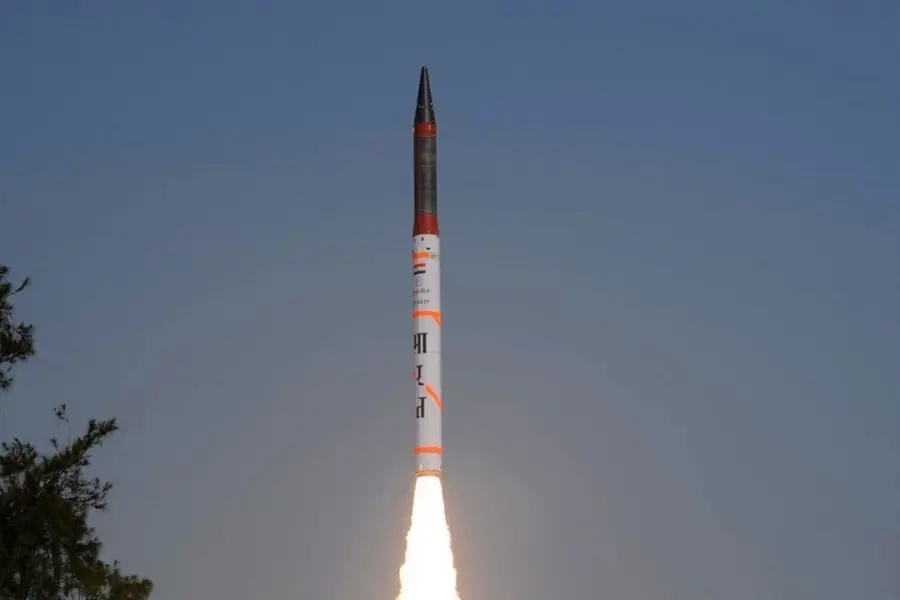
India has successfully tested the Agni-4 intermediate-range ballistic missile (IRBM), officials announced on Friday (September 6). The missile was launched from the Integrated Test Range in Chandipur, Odisha.
They confirmed that all operational and technical aspects were successful. The launch was carried out by the Strategic Forces Command (SFC), a part of India’s Nuclear Command Authority (NCA).
Also Read

The successful launch of the Agni-4 missile adds to the accomplishments of its earlier versions, such as the Agni-1, Agni-2 and Agni-3, all of which have enhanced India’s strategic defence capabilities.
Agni-4 can strike targets up to 4000 km away
The Agni missile has been designed as a long-range, nuclear-capable ballistic missile designed for surface-to-surface attack.
The Agni-4 missile has an extended range of up to 4,000 kilometres. The projectile is 20 metres long and is capable of carrying up to a 1,000 kg payload. It can be launched from a mobile launcher on the road and has the ability to transport either conventional or nuclear warheads, including a payload of a single warhead or multiple independently targetable re-entry vehicles (MIRVs).
The solid rocket propellant-fuelled Agni-4 missile uses a dual-stage propulsion system. This enables a faster launch and simpler logistics compared to rockets fuelled by liquid propellants.
Tailored for use on mobile platforms, the Agni-4 can be launched from different sites, making it challenging for enemies to identify and attack.
India's Agni Arsenal
The SFC in India has units for various Agni missiles, including the Prithvi-II (350 km), Agni-1 (700 km), Agni-2 (2,000 km), Agni-3 (3,000 km) and Agni-4.
In March this year, India had successfully tested its first intercontinental ballistic missile (ICBM), the Agni-5, which has a range of more than 5,000 km.
The road-mobile Agni-4 and Agni-5 are primarily aimed at deterring China, as the Agni-5 can target even the northernmost regions of the country.
Meanwhile, the shorter-range Agni missiles are designed for use against Pakistan. In April this year, India successfully tested the Agni-Prime ballistic missile, which has nuclear warhead carrying capability and a range of 1,000-2,000 km. The test took place at Abdul Kalam Island, located off the coast of Odisha.
In 2012, the Agni-4 missile was tested by the DRDO and flew over 3,000 km in just 20 minutes, making it their longest-range mission at the time. The missile was originally known as Agni-2 Prime.
The DRDO is responsible for creating the Agni missiles. The development of the Agni-5 signifies a significant advancement in India’s indigenous missile technology.
Published: 07 Sept 2024, 12:44 pm IST
Related Topics
Disclaimer: Kindly avoid objectionable, derogatory, unlawful and lewd comments, while responding to reports. Such comments are punishable under cyber laws. Please keep away from personal attacks. The opinions expressed here are the personal opinions of readers and not that of Mathrubhumi.