
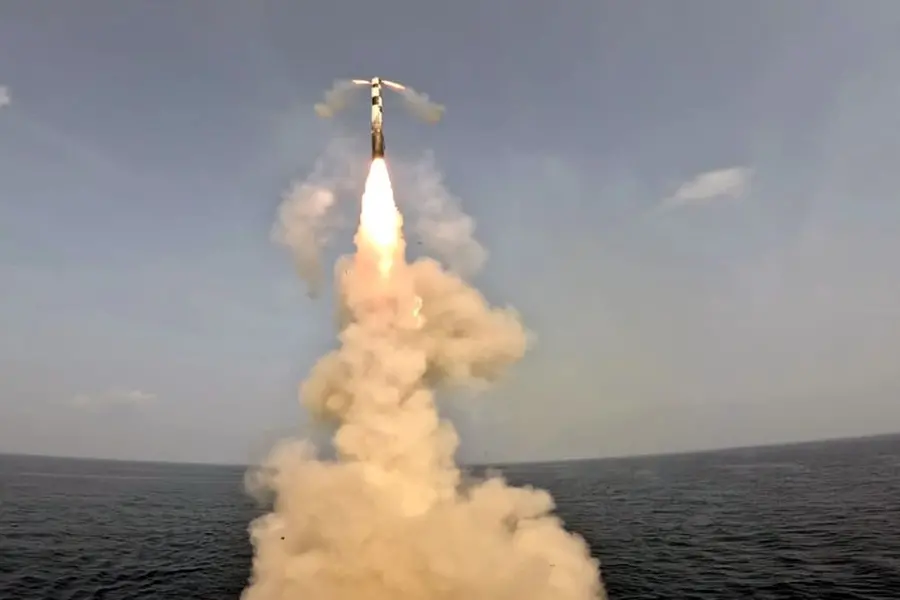
India has tested its K-4 submarine-launched ballistic missile (SLBM), which is capable of carrying nuclear warheads. The test was conducted from the newly-commissioned nuclear-powered submarine, INS Arighaat on the morning of Wednesday, November 27, in the Bay of Bengal, near the coast of Visakhapatnam.
The K-4 missile, powered by solid fuel and capable of hitting targets up to 3,500 km away, was launched from the 6,000-ton submarine.
Also Read

INS Arighaat is India's second nuclear-powered submarine, adding considerable strength to the country's ability to deter nuclear threats. This submarine is designed to carry nuclear-armed ballistic missiles, referred to as SSBNs (Ship Submersible Ballistic Nuclear) in naval terminology.
Unlike India's first nuclear submarine, INS Arihant, which is equipped with K-15 missiles that have a range of 750 km, INS Arighaat is designed to carry the more advanced K-4 missiles, capable of striking targets up to 3,500 km away.
The addition of INS Arighaat is a major boost to India's naval nuclear strength. It allows the country to launch missiles from a nuclear-powered submarine hidden underwater, making its defense strategy more reliable and harder to counter. This greatly improves India’s ability to deter threats.
India is getting ready to add its third nuclear-powered submarine, INS Aridhaman, to its fleet by early 2025. Weighing 7,000 tonnes, INS Aridhaman will further enhance the country's sea-based nuclear defense capabilities.
Key Features of the K-4 SLBM
The K-4, or Kalam-4, is a state-of-the-art nuclear-capable submarine-launched ballistic missile developed by India's Defence Research and Development Organisation (DRDO) for the Arihant-class submarines.
This advanced missile boasts a range of up to 4,000 km, offering significantly greater operational reach compared to the K-15, which is limited to shorter, coastal ranges.
Weighing 17 tonnes and measuring 12 meters in length with a diameter of 1.3 meters, the K-4 is equipped with a 2,500 kg strategic nuclear warhead. It is powered by a two-stage solid rocket motor, ensuring reliable propulsion and high performance.
Designed for deployment on Arihant-class submarines, the K-4 strengthens India’s sea-based nuclear deterrence and adds a vital layer of security to its strategic defense system.
Secret Testing of the K-4 Missile
In January 2010, India conducted a secret test of the K-4 missile near Visakhapatnam. This 10-meter-long and 1.3-meter-wide missile, recognized by its black-and-white design, was launched from a pontoon (a floating structure used as a platform) submerged 50 meters underwater. It successfully surfaced, showcasing its underwater launch capability.
A second test followed in the same region, reaffirming the missile's ability to handle high water pressure of 50 kilograms per square centimeter. The 20-tonne missile proved it could eject from a submerged platform, ignite its rocket booster, and continue its flight path effectively, validating its performance under challenging underwater conditions.
Published: 28 Nov 2024, 12:54 pm IST
Related Topics
Disclaimer: Kindly avoid objectionable, derogatory, unlawful and lewd comments, while responding to reports. Such comments are punishable under cyber laws. Please keep away from personal attacks. The opinions expressed here are the personal opinions of readers and not that of Mathrubhumi.