

Contemporary fiction explores how cities, culture, and cuisine shape stories that resonate universally. Discover the ways authors bring place and identity to life in modern literature.
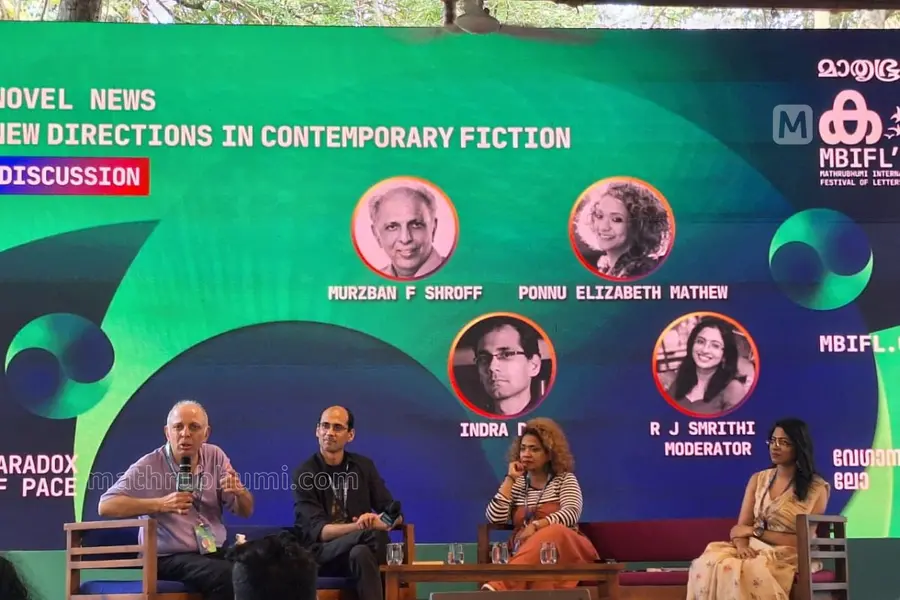
Thiruvananthapuram: At the Mathrubhumi International Festival of Letters (MBIFL 2026), a vibrant panel discussion on 'Novel News: New Directions in Contemporary Fiction' brought together authors Murzban F Shroff, Ponnu Elizabeth Mathew, and Indra Das, moderated by R J Smrithi. The session examined how location, culture, and food shape modern storytelling, alongside the influence of emerging technologies like AI on contemporary literature.
Indra Das, whose novel 'The Last Dragoners of Bowbazaar' was conceived during the pandemic, described how a personal sense of nostalgia for Kolkata shaped his narrative. “I wrote it during lockdown, and I felt a profound loss for the city I grew up in. The streets, the cafés, the Chinatown neighbourhoods—these weren’t just settings, they were characters themselves,” he said. His story features a family of refugees living in Kolkata, blending the real cityscape with fantastical elements inspired by a dream involving a tiny dragon. Das explained how the Chinese-Indian community, its cuisine, and the historical multicultural fabric of Kolkata became central to her storytelling. “Kolkata’s syncretic culture—Armenian, Jewish, Chinese, Anglo-Indian—shapes every interaction, every meal, every corner of the city. Capturing that was vital.”
Ponnu Elizabeth Mathew emphasised the cultural and social role of food in fiction, drawing on experiences in Kerala. “In Kerala, cuisine is inseparable from identity and social norms,” she noted. Her novel explores a seemingly simple dispute in a housing society over vegetarian versus non-vegetarian meals, highlighting how small cultural differences can escalate into larger social conflicts. “Food is not merely sustenance. It carries memory, hierarchy, and history. Even the vessels and plates we eat from can signify status and caste. That subtlety is what fiction can explore.” Ponnu, as in her book, 'The Remnants of Rebellion: A Novel,' also connected these ideas to her Kerala setting, illustrating how the estate towns, local cuisine, and family histories offer a lens to examine community and continuity in changing times.
Murzban F Shroff spoke about how cities themselves act as living entities in literature. Drawing from his works such as 'Breathless in Bombay' and 'Muses over Mumbai: Stories', he described his journey to capture Mumbai’s diverse social landscape. “I realised early on that to truly understand the city, I had to understand all its inhabitants—from migrants and street vendors to public sector employees,” he said. “Writing about the city meant capturing its rhythm, its inequalities, and its evolving skyline, which includes everything from historic buildings to modern high-rises.” Shroff highlighted how his fiction seeks to portray both visible and invisible communities, offering readers a holistic understanding of urban life.
The session also explored contemporary influences on fiction, including AI and digital tools. Authors reflected on how technology can assist research, world-building, and idea generation, yet underscored the irreplaceable role of lived experience and sensory observation. “Technology can provide data, but it cannot provide the smell of a street kitchen, the heat of a sunlit terrace, or the texture of local food and architecture. Those remain central to immersive storytelling,” Ponnu added.
Throughout the discussion, the authors demonstrated that contemporary fiction increasingly bridges the personal and the political, the local and the global. By weaving together cityscapes, culinary traditions, and social dynamics, writers are producing narratives that are both imaginative and grounded in lived experience. Das concluded, “Place is not a backdrop; it informs identity, memory, and emotion. Whether it’s a Kolkata street, a Kerala estate, or the simple act of sharing a meal, these details are what bring fiction alive.”
The session emphasised that while technology and new publishing trends are reshaping literature, the essence of storytelling remains rooted in observation, cultural understanding, and a deep connection to place. Authors are increasingly using novels not just to tell stories but to capture the very soul of cities, communities, and traditions for future generations.
Published: 01 Feb 2026, 06:06 pm IST
ABOUT THE AUTHOR
Related Topics
Disclaimer: Kindly avoid objectionable, derogatory, unlawful and lewd comments, while responding to reports. Such comments are punishable under cyber laws. Please keep away from personal attacks. The opinions expressed here are the personal opinions of readers and not that of Mathrubhumi.