

The discussion also drew in recent controversies and court-linked disputes around Waqf properties, minority rights and Centre–state tensions
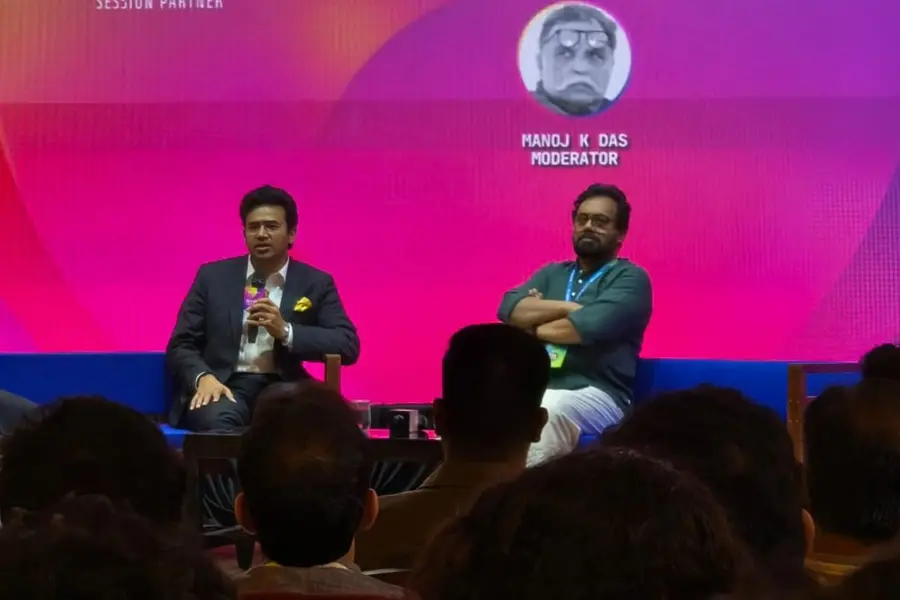
Questions around secularism, reform and ideological consistency took centre stage at MBIFL 2026 during the session titled “Left, Right and Centre: The Paradox of Positions,” where BJP MP Tejasvi Surya and CPI(M) MP John Brittas engaged in a pointed debate on Waqf reforms and the uniform application of constitutional principles.
Tejasvi Surya opened by resisting the “right-wing” label often attached to him. “I prefer to call myself a nationalist or a constitutionalist,” he said, arguing that the Constitution must be applied uniformly across regions and communities. Positioning his critique primarily against Left politics, he accused Left parties of selective liberalism, especially in matters of reform and religious law. Targeting their opposition to Waqf-related reforms and past positions on special provisions such as Article 370, Tejasvi said ideological contradictions were visible. “This endangered species called leftist is the paragon of paradox,” he remarked during the exchange.
Brittas rejected the framing of the debate as Left versus Right, and instead recast it as a question of constitutional commitment. “The real divide is whether you stand with the Constitution or against it,” he said, warning that reform narratives built around religious institutions can become instruments of polarisation. He invoked B.R. Ambedkar’s warning that even a good Constitution can suffer if implemented by those with poor intent, and argued that unity depends on three anchors — democracy, federalism and secularism.
The discussion also drew in recent controversies and court-linked disputes around Waqf properties, minority rights and Centre–state tensions. Tejasvi described the Communist position on Waqf reforms as an example of double standards, while Brittas maintained that minority protection and due process cannot be reduced to vote-bank politics.
Adding another layer to the debate, both speakers touched on Kerala’s Christian voter patterns in the context of Waqf and minority outreach. Tejasvi argued that sections of the Christian community are showing greater openness toward the BJP, citing issue-based alignment and reform conversations. Brittas countered with local body election data, saying vote-share trends do not support claims of a significant shift, and cautioned against drawing sweeping conclusions without statistical backing.
He linked the discussion to broader concerns about polarisation, warning that institutional reform debates risk being weaponised. Referring to recent incidents of vigilante action and communal targeting, he argued that selective outrage and enforcement distort the secular promise of the Constitution.
“Unity can be secured only through democracy, federalism and secularism,” Brittas said, invoking B.R. Ambedkar’s warning that even a well-written Constitution can fail if those implementing it act in bad faith.
Published: 31 Jan 2026, 11:55 am IST
ABOUT THE AUTHOR
Related Topics
Disclaimer: Kindly avoid objectionable, derogatory, unlawful and lewd comments, while responding to reports. Such comments are punishable under cyber laws. Please keep away from personal attacks. The opinions expressed here are the personal opinions of readers and not that of Mathrubhumi.