

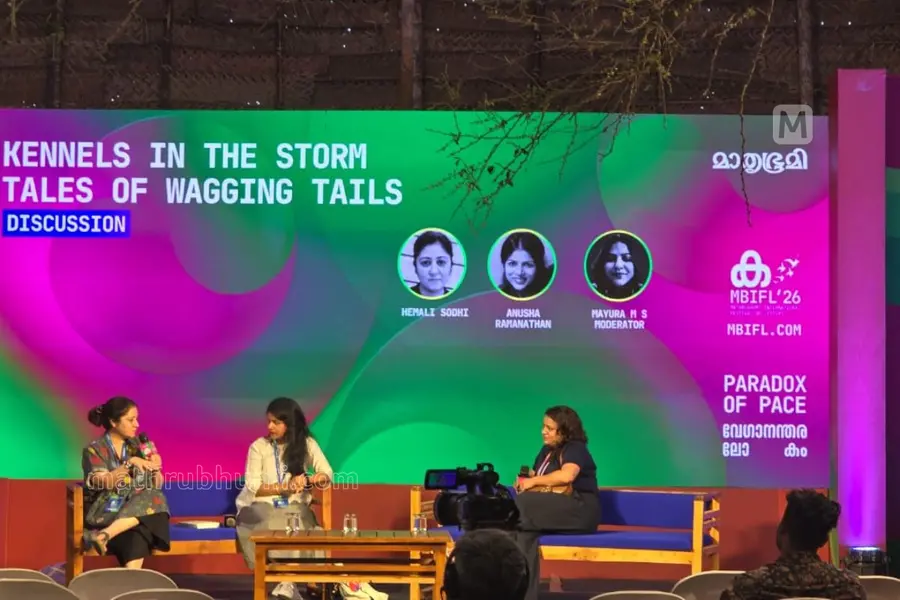
For some, love for dogs begins in childhood. For others, it arrives unexpectedly — sometimes as an eight-week-old golden bundle placed gently into unsure hands.
The conversation at MBIFL 2026 featured writers Hemali Sodhi and Anusha Ramanathan in dialogue with Festival Director Mayura MS.
Writer Hemali Sodhi laughs that she didn’t grow up as a “dog person.” “I was actually afraid of dogs. I didn’t dislike them — I just had no connection,” she says. That changed after marriage into what she calls a “dog-crazy family,” and the day she first held their puppy, Simba. “Life changed,” she says simply.
That transformation — from distance to deep emotional kinship — sits at the heart of a new set of dog-centric books and conversations led by Sodhi and writer-advocate Anusha Ramanathan, who write and speak about life with pet and indie dogs. Their shared theme: dogs don’t just live with humans — they emotionally steady them.
“Every other relationship comes with parameters,” Sodhi says. “With a dog, you can absolutely be yourself because the dog is absolutely being itself. It’s stripped of artificiality. That’s why it feels like the purest bond.”
Empathy on Four Legs
For Anusha Ramanathan, the learning runs deeper than companionship.
“Dogs have empathy,” she says. “They know what you’re feeling sometimes before you do. Like children — but often more perceptive.” Her boarding school years and later experiences with community dogs shaped her understanding of how animals read emotional cues and respond without judgment.
Indie dogs, she notes, live with daily uncertainty — dependent on shifting human behaviour. “We call dogs unpredictable. But humans are far more unpredictable. A dog doesn’t know who will feed it and who will throw a stone.”
What helps, she says, is consistency — predictable pockets of kindness, food and water within communities.
Street Dogs, Fear and Polarisation
The conversation also turned to rising conflict around street dogs, including reported mass culling drives linked to civic and electoral pressures. Both writers warned against what they called a dangerous polarisation — between “dog lovers” and those who see dogs only as a threat.
“You can’t turn around and just blame dogs,” Sodhi says. “If animals are unfed, unvaccinated and unmanaged, of course behaviour issues rise. The solutions being proposed are often grossly unfair.”
The alternative, they argue, is already known: sterilisation, vaccination, and public education on how to interact safely with dogs. Animal Birth Control (ABC) programmes, when implemented properly, work — but require funding and local execution.
“Pity never helps — not for anybody,” Ramanathan adds. “Respect and systems help.”
No Bad Dogs, Only Failed Upbringing
Both stress responsibility in pet parenting as much as compassion toward community animals. Bringing a dog home, they say, is not a lifestyle accessory but a long commitment.
“There is no bad dog — only bad upbringing,” Sodhi says. “Dogs are reactive. If a dog isn’t responding well, the first place to look is human behaviour and socialisation.”
Preparation matters, Ramanathan adds. “Learn before you adopt. Don’t impulse-bring a dog home and then complain.”
Their shared closing message is simple and direct: adopt, don’t shop — and make space for dogs in shared public life too. Parks and community spaces, they argue, should not automatically exclude pets.
Living in the Moment
If there is one enduring lesson dogs offer humans, Sodhi says, it is emotional reset. “What amazes me is their ability to live in the moment. They don’t carry baggage. Every day is a new day.”
Published: 30 Jan 2026, 10:09 pm IST
ABOUT THE AUTHOR
Related Topics
Disclaimer: Kindly avoid objectionable, derogatory, unlawful and lewd comments, while responding to reports. Such comments are punishable under cyber laws. Please keep away from personal attacks. The opinions expressed here are the personal opinions of readers and not that of Mathrubhumi.