
It is official now. The Union Home Minister Amit Shah was lying through his teeth in the Parliament when he said that Kerala was issued necessary warnings about the excessive rains that caused the killer landslide of June 30. It's even more abominable that the Union Minister tried to score political brownies even after such a horrendous human tragedy.
The central agencies with the prime responsibility to issue disaster warnings failed, and hundreds of poor people paid the price with their lives and lifetime savings.
However, can the central agencies’ criminal fault absolve the Kerala government’s abject failure to protect people even after the state has suffered recurrent disasters year after year? Haven't our governments - both UDF and LDF- crassly neglected the several stern warnings issued for over a decade by scientists and environmentalists like Prof Madhav Gadgil? Haven't they let wanton destruction of the ecologically sensitive region’s fragile environment to go on for years by unscrupulous lobbies with money and muscle? Worst of all, isn't the present government still going ahead with disastrous projects, which are a sure recipe for even more devastating tragedies? Can we be more stupidly self-destructive?
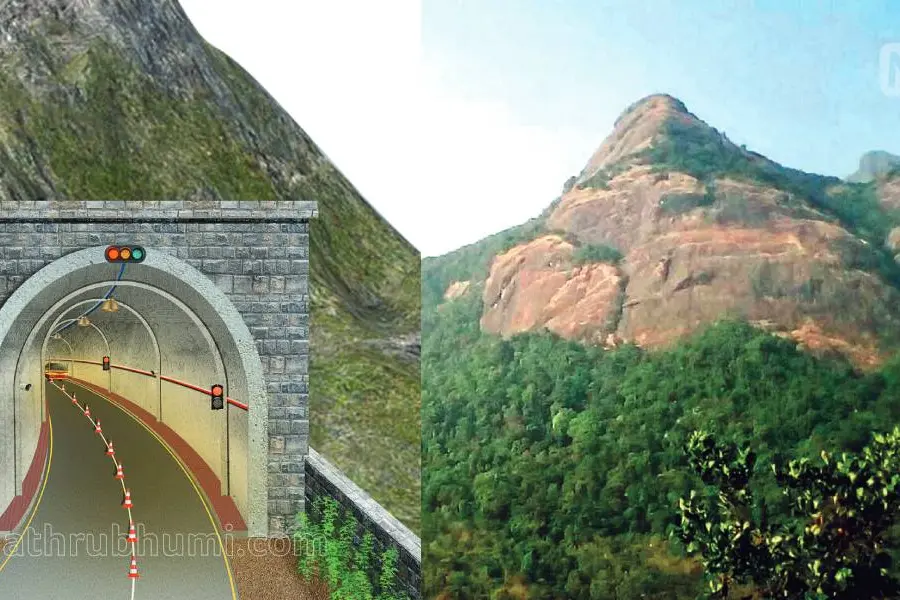
What can justify the state government’s much-trumpeted Kozhikode-Wayanad Tunnel (KWT), the 8.75 kilometre-long, twin-tube underpass connecting the two districts, which is to pierce right through the same region, ravaged now by the killer landslide that killed so many? If any humanity or wisdom is left with the state government, it should immediately halt its construction, at least until more comprehensive and authoritative environmental impact studies are done, considering the suffering that just took place. More so, since the Central Government-constituted State Environment Impact Assessment Authority- Kerala (SEIAA) raised serious reservations over KWT in May this year. This is even after the project won in April 2023 the preliminary clearance from the Union Ministry of Environment, Forests and Climate Change.

The SEIAA’s Environment Appraisal Committee has warned that the KWT would aggravate the already escalated human-animal conflicts and other severe environmental issues. It has specifically cited the project’s alignment passes near Puthumala, where the 2019 massive landslide occurred. Only Puthumala was mentioned probably because the report was submitted before the latest landslide took place just a few kilometres away. SEIAA Kerala is authorised to deal with environmental clearance for projects under Category “B” of Schedule in EIA notifications, 2006.
The need to halt KWT has assumed extreme urgency as the construction of the Rs 2044 crore project entrusted with the Konkan Railway Corporation is scheduled to begin this month. Or will the Pinarayi government stick to its false prestige and refuse to retract as in the case of K-Rail?
More on KWT later. One hears a loudening view that what caused the latest disaster was only natural factors and not human interventions. They cite the excessive rains caused by the warming of the Arabian Sea and global climate change. The entire political class, religious heads and some experts also belong to this camp. Clearly, they also happen to be people who derided Prof. Gandgil’s Report on the Western Ghats of 2011, which called for the immediate halting of the excessive human intervention in the Ghats in the form of indiscriminate construction, quarrying and mining, unsustainable tourism, etc. Gadgil’s warnings have been coming true every year in the past decade, recurrently, with floods, droughts, heatwave conditions, or landslides. The argument heard post-landslide that rescue and rehabilitation require more urgent attention and not a debate over Gadgil’s recommendations could also be a tactic to block the report from being recovered from under the carpet.
Indeed, global and natural factors were the landslide’s immediate causes. But who can absolve the land use pattern in the Western Ghats from being its underlying trigger? Moreover, isn’t it only elementary that the “natural” disaster” would not have caused deaths and devastation of such magnitude without human assaults on the region’s sensitive ecology? Haven’t Prof. Gadgil and institutions like the Indian Space Research Organisation and Thiruvananthapuram’s Centre for Earth Science Studies (CESS) listed this specific region of Vellarimala -Camel Hump Hills- where the catastrophe took place as a highly sensitive region, unsuitable for human habitation? Shouldn’t the state government be held accountable for failing to heed these alerts given over a decade ago?
Look at the price we paid for not heeding the alerts. Below is Wayanad’s shocking list of major landslides in the last four decades, making it a red spot of extreme ecological vulnerability.
Date | Place | Toll |
June 15,1984 | Puthuppadi | 8 |
July 2, 1984 | Meppadi | 18 |
Oct 9, 1984 | Kozhikode-Wayanad | 17 |
June 19, 1992 | Padinjarethara | 11 |
Aug 8, 2019 | Puthumala | 19 |
July 30, 2024 | Mundakkai | 340 (still counting) |
Now, look at the mind-boggling damage inflicted on Wayanad by human interventions over the last two decades. (Sources in brackets)
Deforestation
- 15% decline in forest cover between 2001 and 2019 (India State of Forest Report 2019)
- 22,000 hectares of forest land diverted for non-forest purposes between 2001 and 2018 (Kerala Forest Department-KFD)
Water pollution
- 60% of water sources are contaminated with pesticides and heavy metals (Kerala State Pollution Control Board, 2019-SPCB)
- 80% of river stretches in Wayanad have high levels of bacterial contamination (Central Pollution Control Board, 2020)
Climate change
- 1.5°C rise in average temperature between 2000 and 2020 (India Meteorological Department-IMD)
- 15% decline in rainfall between 2001 and 2019 (IMD)
Mining and quarrying
- 1500 hectares of land affected by mining activities between 2001 and 2018 (SPCB)
- 30% increase in mining-related environmental complaints between 2015 and 2020 (SPCB)
Human-wildlife conflict
- 200% increase in human-wildlife conflict cases between 2010 and 2020 (KFD)
- 150 human deaths and 500 crop damage cases due to human-wildlife conflict between 2015 and 2020 (KFD)
Biodiversity loss
- 20% decline in endemic species population between 2001 and 2019 (KFD)
- 15% decline in bird species population between 2001 and 2019 (KFD)
The proposed KWT is passing precisely through the epicentre of the latest killer landslide. According to experts, Wayanad’s geology poses several challenges for tunnel construction, such as rock instability, water ingress, and hazards like faults, shear zones, etc. Like the other disastrous and doomed K-Rail project, KWT has also been tipped as the Pinarayi government’s “prestigious project” and to be the third longest underpass in India. It is among the 30 “dream projects” that Chief Minister Vijayan personally monitors. Proposed by the state Public Works Department, it's funded by Kerala Infrastructure Investment Fund Board (KIIFBI). The project's survey began in 2020, and the construction was originally announced to begin in January and completed in five years. It received stage-1 clearance from the Union Ministry of Environment, Forests and Climate Change for acquiring 17.26 hectares of forest land in early 2023. The Central Ministry’s condition is that the state should initiate afforestation on the same extent of land elsewhere. Having completed the Environmental Impact Assessment done by the state-run KITCO, only SEIAA Kerala raised serious reservations about the project. The Committee pointed out that any barrier at the proposed tunnel mouth in the Meppadi area would force the elephants to utilise the alternate route through the Kalladi tribal colony and nearby settlements, which are more populated. It also questioned the tunnel’s sustainability in a landslide-prone region. It also dwelt upon its impacts on the nearby tribal colonies, and the endangered bird species were pointed out.
In June, PA Mohammed Riyas told the state assembly that 92% of the required land was acquired for the KWT on the Anakkampoyil-Kalladi-Meppadi route connecting Marippuzha in Tiruvambadi and Meppadi. While all the required land in Wayanad was acquired, 9.3 hectares of the required 11.16 hectares in Kozhikode was yet to be taken over. According to a report, Rs 36.5 crore was allocated as compensation to 45 private landholders, with Rs 30.4 crore already disbursed to 43 of them. Uralunkal Labour Contract Cooperative Society was awarded Rs 108 crore to construct a 17.5 km-long four-lane-approach road from Tiruvambadi to Maripuzha.
In 2023, it was said that the tunnel would be built with Norwegian technology, for which Chief Minister Vijayan signed a memorandum with Norway’s authorities during his visit in 2022. Norwegian experts were to study the region's rock and soil details as Norway is known for designing and constructing tunnels through hills or fjords (Sindre tunnel). A Norwegian team visited the site in November 2022 and was endorsed as appropriate by its leader, Dr Dominik Lang, Director, Natural Hazards at the Norwegian Geotechnical Institute. However, nothing has been heard about Norwegian assistance since then. Not just the construction but the tunnel's lifelong management and monitoring for unexpected geological events is also exceptionally challenging.
KWT expects to accrue several commercial and other benefits to the region. It is an alternative to the busy Thamarassery Ghat road (NH 766), the only road link connecting Kozhikode and Wayanad through which 14000-20000 vehicles pass daily. It often suffers from accidents and traffic snarls. Even a minor accident or a landslip would block traffic for hours on the road, Wayanad’s key link to rail and air transports and major hospitals. KWT is said to reduce the distance between Kozhikode and Wayanad from 85 to 54 km. It will also shorten the proposed “commercial corridor” from Kochi to Bengaluru. The tourist potential of the KWT, which passes through the hills and jungles of the Western Ghats, is cited as another attraction.
However, the question is, can all these claimed benefits, even put together, ever compensate for the hundreds of poor lives lost after midnight on that ill-fated July 30?
Published: 03 Aug 2024, 08:25 am IST
Related Topics
Disclaimer: Kindly avoid objectionable, derogatory, unlawful and lewd comments, while responding to reports. Such comments are punishable under cyber laws. Please keep away from personal attacks. The opinions expressed here are the personal opinions of readers and not that of Mathrubhumi.