
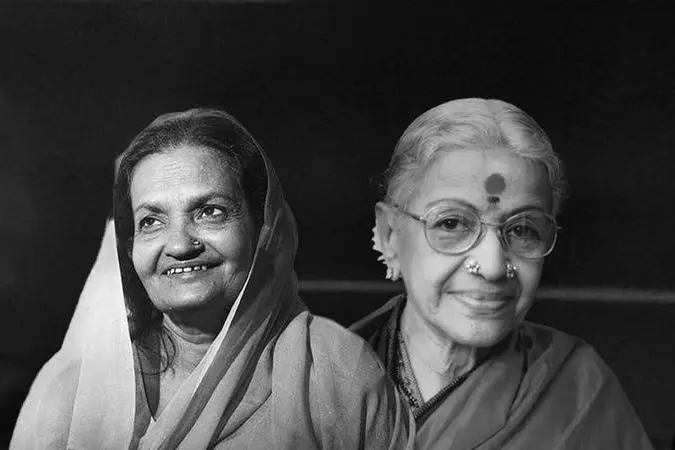
Standing before the modest marble tomb of the Mallika-e-Ghazal, the immortal Begum Akhtar, nestled in a narrow galli flanked by countless lower-middle-class apartment blocks in Pasand Bagh of old Lucknow on a cold February morning, this I was reminded of my visit, some time ago, to a rickety bylane in Madurai—the birthplace of another divine nightingale, MS.Subbulakshmi.
According to the caretaker at the Begum’s mazaar built beside her mother's within a small brick enclosure, it was restored only a decade ago by her admirers complete with its Italian Pietra dura inlay design, from an even more obscure state. The area, now chock-a-block with shanties, was originally a sprawling mango orchard that belonged to the great singer.
Also Read
Reflecting on these two singing queens, who embodied India's two major classical traditions, I was struck by the remarkable parallels in these remarkable women’s lives and careers in a patriarchal world. Born just two years apart—1914 and 1916—the Carnatic singer was only slightly younger. Though their families followed different faiths, both were born in ancient towns steeped in Hindu traditions, located in the north and south regions of the country: Begum near Ayodhya and MS in Madurai. In their gifted voices, pain and prayer, love and longing resonated with equal intensity. However, Akthar’s music was soaked in pain most, perhaps her share of personal agonies were unparalleled.
Their parentage, too, reveals striking parallels. Both were raised in single-parent households by artistic mothers who shared similar social backgrounds as professional entertainers to the elite—women who, in later times, bore the weight of social stigma. If Bibbi’s (young Akhtar’s) mother, Mushtari, was a tawaif (courtesan), Kunjamma’s (Subbulakshmi’s) veena-playing mother, Shanmughavadivu, was a Devadasi.
Both singers’ fathers came from more privileged backgrounds but were largely absent from their lives. Akhtar’s father, Asghar Hussain, a lawyer from an aristocratic family of Lucknow, disowned her mother—his second wife—and their twin daughters. Subbulakshmi’s father, Subramania Iyer, a Brahmin lawyer, remained a distant figure. (However, several of MS’s biographers, including T.J.S. George, suggests that her real father was the renowned Carnatic musician Madurai Pushpavanam Iyer.).

Akthar's tormented childhood experiences were extremely traumatic which scarred her forever. Her twin sister Zohra died in childhood by accidentally consuming poison. According to Begum Akhtar's biography by her disciple Rita Ganguly, the singer suffered abusive music teachers during her childhood. Akthar had the most excruciating experience at 13 when she was raped by a raja while she went to perform in his palace. Ganguly says the singer even bore a child from this tragedy whom her mother Mushtari brought up as Akthar's younger sister!
Akhtar's and MS’s mothers discovered their daughters' talent early in life, became their first teachers and propelled them to the public stage. Akhtar sang with her mother when she was thirteen and gave her solo public performance at 15.
Subbulakshmi’s first public performance was when she was 11. The nascent gramophone companies were captivated by both the prodigies. The HMV head who was at the 15-year-old Akhtar’s first public performance, persuaded her to cut her first disc. MS had her first vinyl recording when she was barely ten. Blessed with good looks and sensitive voices, they were among the few young women to perform in public.
Unlike most women of the day, Akhtar and MS were not prepared to confine themselves to their small worlds. Pushed by circumstances and their determination, they dared to venture out to claim their rightful place. After training under the prominent sarangi exponent Ustad Imdad Khan and Ata Mohammed Khan of Patiala, Akhtar moved to the big city of Calcutta with her mother. Becoming the disciple of Ustad Jhande Khan, the young musician soon started making a name. Meanwhile, around the same time in the far south, MS, after training under a few masters in Madurai, moved to Madras city also to escape a marriage arranged by her mother. The twenty-year old became a disciple of the doyen of Carnatic music, Semmangudi Srinivasa Iyer.
Indian cinema entered the talkies era with Alam Ara (1931). Playback singing was yet to arrive and singers with good looks were much sought after to act in films. The 19-year-old Akthar acted in her first Hindi film -King For A Day- as a singing star, made by Calcutta’s East India Film Company in 1933. Subbulakshmi’s life in cinema began in Madras at the age of 22 in K Subramanyam’s Tamil film, Sevasadanam, in 1938 as an abused wife. Though never too keen about acting, Akhtar did eight more films including Mehboob Khan’s Roti. Her swansong -Jalsaghar- (1958) was of the maestro, Satyajit Ray in which she played a thumri singer. MS’s filmography included only six films that featured her famed roles as Shakuntala, Savitri and Meera. Both Akhtar and MS were favourites among the nationalist leaders of the period like Sarojini Naidu as the rising India's cultural icons. After their brief careers in cinema, both returned to where they belonged - music. Both excelled in the lighter streams of their respective Classical music traditions.
It was a time when women performers, especially those from tawaif or Devadasi backgrounds, were viewed with disdain by society, regardless of their success or prosperity. Even opportunities like singing on All India Radio were often reserved for “respectable” married women. For both Akhtar and MS, marriage seemed like the gateway to what they lacked—“respectability.” Ideally, a husband from an elite background would provide the social acceptance they sought.
So, when they found seemingly suitable partners, they did not hesitate. Little did they realise then just how profoundly their husbands would reshape their lives.
Both their husbands shared similar backgrounds and, on some points, similar views. Both came from elite families, were middle aged widowers and had domineering personalities. Each sought to shape and mold his wife into the ideal of a "respectable lady." However, their approaches to achieving this goal were fundamentally different. The wives' responses to their husbands’ expectations also diverged, marking the first major point at which Akhtar's and MS’s lives took separate paths. While Akhtar’s marriage ended in disaster, MS completely surrendered to her husband's will.
Akthar married Istiyaq Ahmed Abbasi, a London-educated and Lucknow-based barrister who was the Nawab of Kakoli. The 32-year-old Akthar at that time was at the height of her singing career and the cynosure of being the elite of Lucknow. Her house, Akthar Manzil, was the favourite haunt of nawabs and princes. And among her admirers was the dashing barrister. Though it was a love marriage, the conservative Abbasi wanted Akhtar to be a chaste, orthodox Muslim wife and abandon her public life of singing and acting and habits like smoking. He changed her name from Akhtar Bai Faizabadi to Begum Akhtar and insisted that she be confined to home.
Akthar tried for some time to submit to her husband’s dictates and stopped her public performances. However, gradually she found life suffocating and sank into depression. Unable to bear any longer, Akthar returned after some time to the world of music with all glory. Abbasi also accepted Begum's return to her music partly owing to his declining financial status.
At 26, at the height of her stardom, Subbulakshmi fell in love with the 38-year-old “Kalki” Sadasivam, a married person with two children. A prominent figure in Madras’s Brahmin society, he was a freedom fighter, journalist, and film producer. They married only after Sadasivam’s wife died.
Subbulakshmi took care of her husband's two children and became the ideal housewife. Under Sadasivam's influence, she underwent a striking transformation—from a popular singer-actor to a revered, Brahminised, Kanchipuram silk-clad devotional musician. This metamorphosis was Sadasivam’s carefully orchestrated project.
Unlike Abbasi, who compelled Akhtar to abandon her public life, Sadasivam encouraged MS to remain active in music and cinema albeit strictly under his supervision. The free-spirited teenager who walked out of her home to escape a marriage and once seen in playful photographs with her friend, the legendary dancer Balasaraswati—both clad in Western nightdresses, cigarettes dangling from their lips—became a distant memory. Instead, she was permanently draped in Kanchipuram silk, adorned with a diamond nose stud and a large sindoor bindi.
Her film roles, carefully chosen by Sadasivam—whether as Savitri or Meera—further reinforced the image of the "respectable lady." Yet, unlike Akhtar, who struggled against marital constraints, MS embraced her husband's vision wholeheartedly, appearing content in her new identity.
Thanks to her determination, Begum Akhtar’s second innings in music was as successful as her first. She won the Padma Shri in 1968 and the Sangeet Natak Akademi award later. She could also realise her dream- to sing until her last. She passed away immediately after a performance in Ahmedabad in 1974. Akthar was granted Padma Bhushan posthumously.
Subbulakshmi scaled every height in the music world and toured the world as India's cultural ambassador. She was the first Indian to perform at the UN (1966), first Indian musician to win the Magsaysay award and the first musician to win Bharat Ratna (1997), India's highest civilian honour. After Sadasivam’s demise in 1997 at the age of 95, Subbulakshmi never gave public performances until she passed away in 2004.
Though Akhtar gave birth to a child, she was never able to embrace motherhood. MS, on the other hand, found fulfillment as a mother to her two stepdaughters.
Beyond their shared experiences—both joyful and painful—what truly united these two icons of our rich cultural traditions was their extraordinary artistry, their broad and humanistic values, and their deeply pluralistic worldviews and above all, their unwavering resolve. Let us bow in respect to both these legends.
Published: 11 Mar 2025, 10:08 am IST
Related Topics
Disclaimer: Kindly avoid objectionable, derogatory, unlawful and lewd comments, while responding to reports. Such comments are punishable under cyber laws. Please keep away from personal attacks. The opinions expressed here are the personal opinions of readers and not that of Mathrubhumi.