
A petty debate rages on some sections of social media. Who drew more crowds at their respective funerals. VS or OC (Oommen Chandy) ? More absurd are the attempts to compare them.
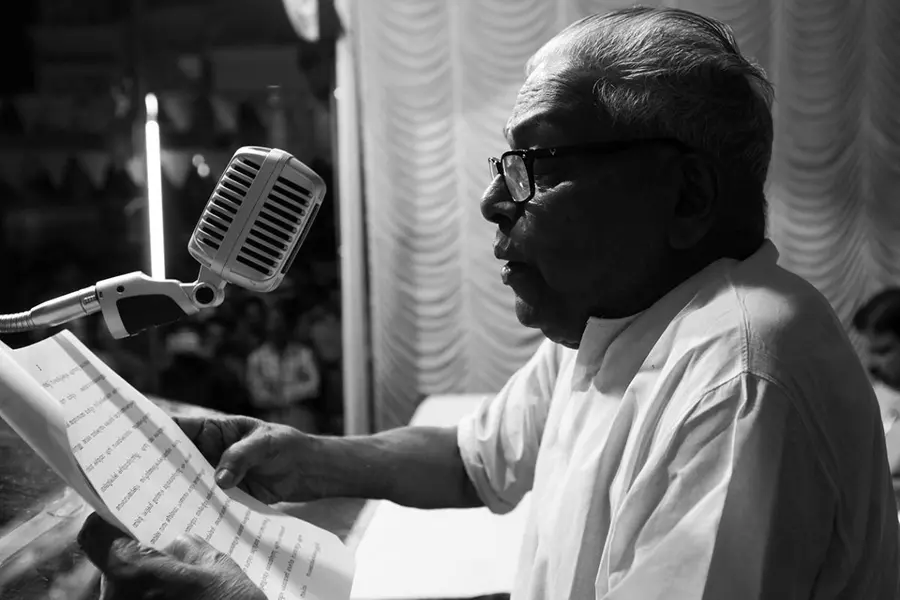
The massive turnout at V S Achuthanandan’s funeral and the emotional outpouring from thousands across age, gender and faith who braved the rain to line the streets of Kerala was a sight to behold. The cortege's slow passage was not merely a procession—it was a people’s tribute to a man who had come to embody their struggles, values and memories of a disappearing political ethic.
A petty debate rages on some sections of social media. Who drew more crowds at their respective funerals. VS or OC (Oommen Chandy) ? More absurd are the attempts to compare them. Apart from both being immensely popular and former Chief Ministers, their lives bore little resemblance. That both evoked such mammoth public affection at the end is proof that they were two of the most beloved political leaders this country has seen. But VS’s story stands apart. His subaltern origins, lifelong struggles and rise against all odds to the top echelons of the CPM, and the moral courage he showed even while being marginalised —are unparalleled in contemporary Indian politics including his own party.
The politics of funerals
Massive funeral processions are not new in Indian public life. In fact, the Guinness record for the largest funeral gathering is held by C N Annadurai, Tamil Nadu’s first Chief Minister, whose funeral in 1969 drew over 15 million people. Mahatma Gandhi’s procession in 1948 was joined by 2 million mourners and took six hours to travel six km. The minute by minute commentary by All India Radio’s legendary broadcaster Melville De Mellow by traveling along the funeral procession too was historic. Nehru’s in 1964 was equally phenomenal. I recall as a child being part of Nehru’s cortege with my father.
The largest crowds of mourners I witnessed in Thiruvananthapuram during my student days were those that gathered at VJT Hall (now Ayyankali Hall) to pay their last respects to two towering cultural figures—the legendary actor Sathyan in 1971 and the revolutionary poet Vayalar Ramavarma in 1975.
The era of live television has changed how we experience the passing of public figures. Since the funeral of E K Nayanar, the first to be broadcast in full, these processions have become collective spectacles of mourning. There was no live coverage when EMS Namboodiripad passed away in 1998, but as a reporter I walked with the large crowds who matched solemnly from the Durbar Hall to the public electric crematorium at Thycaud. In 2005, PK Vasudevan Nair was given a warm farewell. In 2011, it took 18 hours for K Karunakaran’s cortege to reach Thrissur from Thiruvananthapuram. But none matched the farewell to Oommen Chandy in 2023—his cortege took nearly 30 hours to travel the 150 km to Kottayam.
Yet, the scale of public grief for VS—who had disappeared from public view for six years and lived past 100—was astounding. One wonders: would any Communist leader in the democratic world today receive such a tearful and passionate send-off?
Why was VS so special?
VS was no EMS Namboodiripad in terms of intellectual stature, nor an AK Gopalan in mass appeal. What made him exceptional was that he was the last surviving link to a generation that saw politics as an act of faith and sacrifice. He became a symbol of a vanishing ethos—when public life meant struggle, moral clarity and self-denial. In a darkening political sky, such a star inevitably shines brighter.
But VS’s legacy is also entangled in conflict. He was at the heart of the CPM’s most bitter internal wars. In the first round, he stood alone against formidable veterans like EMS, Nayanar, Balanandan and Susheela Gopalan—and won. In the second, he was pitted against Pinarayi Vijayan, his former ally, and lost. Ironically, even as the party sidelined him, his popularity soared outside it. He became a people’s leader—transcending partisanship. In the age of 24x7 television, he became the first Communist to force the CPM to reverse its decision—twice—and make him Chief Minister at the age of 83.
What fuelled this late-life transformation was not just age, but survival. He remade himself—from a doctrinaire Stalinist into a moral crusader. He railed against corruption, environmental degradation and atrocities on women—earning admirers beyond the Left fold.
His unique place in history
So, what was so special about VS? The struggles and sufferings in his life were common to most Left leaders of his generation. To me, VS deserves a special place in India’s political history for three key reasons—all emerging from his post-prime years:
1. He steadfastly upheld moral values in politics—at a time when political cynicism had become the norm.
2. He mainstreamed micro-political issues—like gender justice, free software and environmental activism—long before others saw them as electoral assets.
3. He was the first Indian Communist Chief Minister who was a true son of the economically and socially deprived class the Left proclaimed to champion but only had the “adopted sons of the working class” at its helm.
Of course, VS was not above ambition or vengefulness. His transformation, while admirable, was also tactical. After all, he had good reason to feel denied and discriminated against by the party he helped found. He joined the CPI at 17, became a district secretary at 33, and a member of the CPI National Council before 40. He was among the youngest of the 32 who walked out to form the CPM in 1964. He became the party’s state secretary in 1980 and was elevated to the Politburo later.
Yet, top parliamentary positions eluded him. Despite being an MLA for 35 years, he never became a Minister until 2006. He did, however, become the longest-serving—and arguably the most effective—Leader of Opposition in Kerala’s history.
Three times, the Chief Ministership slipped from his grasp. In 1991, the LDF unexpectedly lost after the assassination of Rajiv Gandhi. In 1996, he was defeated in Mararikkulam, allegedly due to sabotage from within. It took a monumental inner-party battle in 2006 for him to finally occupy the CM’s chair. That wasn’t ambition; it was justice.
VS’s farewell was not just to a leader, but to an era. He was the last of the first generation—a political orphanage now left behind, clutching at memories of conviction-led politics. No leader is without contradictions. But in a time of transactional politics, his flaws too were deeply human—making his legacy even more enduring.
VS didn’t just live a political life; he embodied one. In his death too, VS shows the way forward to us in general and to the Left in particular.
Published: 27 Jul 2025, 02:43 pm IST
Related Topics
Disclaimer: Kindly avoid objectionable, derogatory, unlawful and lewd comments, while responding to reports. Such comments are punishable under cyber laws. Please keep away from personal attacks. The opinions expressed here are the personal opinions of readers and not that of Mathrubhumi.
