

A deeply personal tribute to Potteth Narayanan Unny—childhood friend, pioneering organic farmer and the man who brought Navara rice back from the brink of extinction.
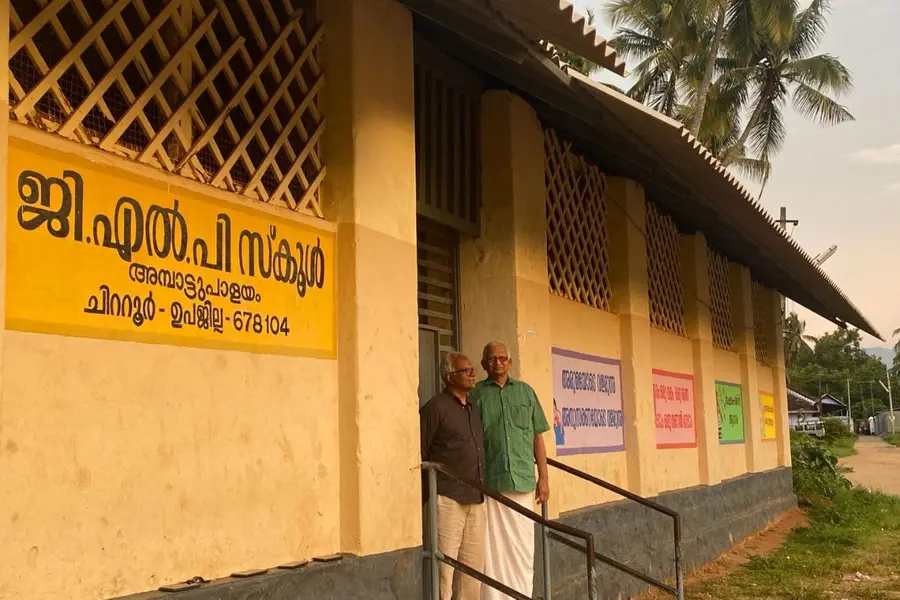
It is not often that someone from our childhood reenters our lives after half a century and leaves an imprint deeper than ever. Potteth Narayanan Unny was such a person for me.
We grew up together—but only briefly—in the mid-1960s, when my mother, a young college lecturer, was posted to Chittur Government College in Palakkad. I was seven years old then, my sister barely two. My father was in prison at the time, jailed with his comrades for his political activities. Because of his absence, my grandmother came from Pandalam to stay with us.
The years we spent in Chittur unfolded against a backdrop of political storms that swept through our family. After the Vimochanasamaram, the Congress-led government—rabidly hostile to the Left—had thrown my mother out of her teaching job solely because my father and uncle were active in the Communist movement. The Communist Party itself had split, cleaving friendships and families, ours included. My father, who had been an editor with the People’s Publishing House run by the CPI in Delhi, lost his position after choosing to join the newly formed CPM. With no work and no home to anchor us, we returned to Kerala. Then came the India–China war, and with it the mass arrests of CPM leaders including my father.
Amid this churn, Bharatappuzha, which takes the name Sokanashini as it winds through Chittur, offered us a breather. My mother was reinstated after three difficult years, and her first posting was this quiet corner of Palakkad. For her, it was a second chance; for the rest of us, a temporary shelter. But to the child I was—bewildered, fearful and unable to fully grasp why his father had vanished behind prison walls—Chittur might as well have been an unfamiliar planet.
I joined Class IV in the Ambattupalayam Government Lower Primary School. Everything about me must have appeared strange to my classmates and even to my teachers. Since I had been in Delhi’s Kerala school in the previous, I continued in the Delhi student’s sartorial style in Chittur too; tucked-in shirt, shoes and socks, etc. My Malayalam tinted with a southern accent. In that rustic 1960s Chittur, all of this made me an outsider instantly.
Most children kept their distance. Except for one boy. A fair, lean, soft-spoken child with an easy smile introduced himself to me without hesitation. He was Narayanan Unny.
He became my anchor in those bewildering months. Our homes stood not far apart. My family occupied a modest rented cottage called Lekshmi Nivas, set right by the roadside. Unny, meanwhile, grew up in Karukamanikkalam, his ancestral house that sat deep inside their land—an old, generous building surrounded by trees and opening out to wide stretches of paddy fields.
We walked to school together every morning and returned home by the same familiar paths in the afternoons. We explored the dusty lanes, chased each other through paddy bunds and coconut groves, listening to the Shokanasini whispering somewhere in the background. Some more boys joined our gang later. Thachukkutty who came everyday on a bullock cart to the school and Velayudhan, amazingly skilled to spot the sweetest mangoes around the village.
And then, abruptly, it ended. My mother was transferred to Thiruvananthapuram, and we left Chittur. The friendship dissolved into memory, as childhood friendships often do.
We lost touch for nearly fifty years. And then, in a moment that felt almost scripted by fate, we found ourselves face to face again on the Nelliyampathi hills—at a conference on organic farming. I was there as a journalist, and Unny as an organic farmer. Though I couldn’t recognise him, he came to me after asking some other journalists he knew, and it turned out to be an unforgettable reunion after half a century. That meeting caused by ‘Navara’ changed the trajectory of our bond and, in a small way, my understanding of various things, including Kerala’s agricultural heritage itself.
From that day onward, Unny and I reknit our friendship with the ease of people who had never truly drifted apart. And I became a witness to his astonishing journey with Navara, the ancient rice variety that he revived with the ferocity of a man entrusted with a sacred task. We visited each other in Chittur and Thiruvananthapuram; our families too became friends. We travelled together to hills and forests; he took me to Manila’s International Rice Research Institute, and we jointly organised programmes in Kerala to promote Navara, attended by celebrities like M S Swaminathan and Shashi Throor.
When we met again after decades, Unny told me the story of how he had returned to farming. I still remember his quiet humour when he said this shift was never part of his plan. As a young man, he had thrown himself into the futuristic world that Rajiv Gandhi’s India promised during the 1980s. Computers, software, hardware—he had embraced it all. While many in our generation sought government jobs or the Gulf, Unny opened one of the earliest computer franchises, selling HCL machines when a desktop itself was an object of wonder.
Then came the year that reordered his life: 1994. The passing of his father, Ramachandra Menon, left a hole not only in his family but in the hundred-year-old farm that depended on him. With a sense of duty more than ambition, he shut down his thriving computer venture and returned to the land.
Most people saw this as a step backwards. But it was the beginning of the most remarkable chapter of his life. When he spoke to me about Navara for the first time, I remember being struck by the emotion in his voice. It wasn’t nostalgia; it was something more profound—a combination of reverence, urgency and an almost childlike curiosity. Navara, the legendary medicinal rice once grown extensively in our region, had nearly disappeared. Ayurveda valued it for its healing properties, yet no one seemed to be cultivating it properly anymore.
Unny, with characteristic stubbornness, decided that this grain deserved a second life.
The obstacles were immense. Pure seeds were scarce. Agricultural universities could not help. Farmers who once grew Navara had moved on to more profitable crops. But the rarity of the variety only strengthened his resolve.
For five painstaking years, he maintained a purification plot isolated from all other rice varieties. He told me about the daily rituals—brushing the plants with his own hands to fend off pests, sitting late into the night studying ancient references, ignoring those who dismissed his efforts as eccentric or impractical.
Every time he spoke about it, I felt immense pride—and worry. He was draining his savings, fighting isolation, confronting the possibility of failure. But giving up simply wasn’t in his nature.
The first harvest was both triumph and trauma. He had real Navara in his hands, but no real market for it. Even leading Ayurveda companies, the very institutions Navara historically served, preferred cheaper imitations sold under its name.
During those difficult years, we spoke often. I tried to offer encouragement, though I knew my words could not soften the crushing financial strain he endured. Yet each time, Unny would reassure me—with gentleness, almost mischievousness—that things would turn around.
The turning point came when the legendary agriculture scientist, Dr M S Swaminathan, whom fate also placed in Unny’s path, recognised the significance of his work. Swaminathan spoke publicly about Navara’s nutritional depth and visited the farm himself. That validation gave Unny credibility, courage and new visibility. He laughed heartily when I said he was not Narayanan Unny but, “Navarayanan” Unny.
Which he then put to use—not for himself, but for his community. Unny began organising the farmers of Chittur. He helped create a growers’ society, reached out to the Agricultural University, and tirelessly pushed for Geographical Indication (GI) status for Navara. His determination was contagious; people who had doubted him now stood beside him.
When Navara received the GI tag in 2004—India’s first rice variety to be granted this recognition—I remember feeling that something historic had happened. He had not only revived a crop; he had restored a chapter of Kerala’s cultural memory.
Later, under his leadership, Palakkad Matta too earned its GI tag. And with the recognition of Palakkad Maddalam, the little region of Peruvamba became home to three GI-protected treasures. Unny’s missionary zeal gradually won recognition. Awards began to flow including the prestigious Gene Saviour title from the Central Government. He was invited to several conferences and exhibitions worldwide.
Through all this, Unny remained grounded. Even when his organic farm, UNF, -the world's largest organic Navara farm- gained national attention and demand outpaced supply, his heart remained in the soil, in heritage, in authenticity. He was never a salesman—only a steward.
Now, as I write these words, I realise that Kerala has lost more than an organic farmer. It has lost a guardian of memory, a quiet revolutionary and a man whose achievements will grow even more luminous with time. Even as he was battling an advanced stage of prostate cancer, diagnosed only two years ago, Unny proudly told me last week about the invitation he received to attend BIOFACH, the world’s leading trade fair of organic products in Numberg, Germany next February where India is chosen as the Country of the Year. But the night before I had planned to travel to Chittur to visit him, Unny’s sister Dr Indira called me to say he was gone forever.
For me, the loss is personal. The boy who ran beside me in Chittur, the man I rediscovered after half a century, and the friend whose mission I tried in my own small way to support—he is gone.
Yet his presence lingers.
In every bag of genuine Navara that reaches a hospital.
In every talk on biodiversity that mentions his name.
In every farmer who dreams a little bigger because Unny once did.
Published: 14 Dec 2025, 09:57 am IST
ABOUT THE AUTHOR
Disclaimer: Kindly avoid objectionable, derogatory, unlawful and lewd comments, while responding to reports. Such comments are punishable under cyber laws. Please keep away from personal attacks. The opinions expressed here are the personal opinions of readers and not that of Mathrubhumi.