
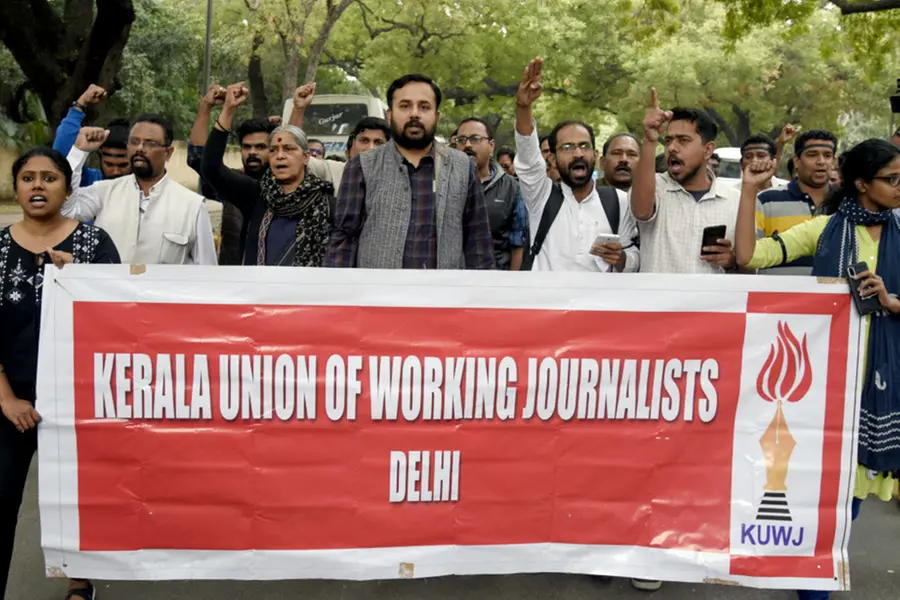
February 11 marks the 46th anniversary of Indira Gandhi’s Emergency government passing independent India’s three blackest anti-press laws. The Prevention of Publication of Objectionable Matter Act, 1976, the Parliamentary Proceedings Repeal Act, 1976 and the Press Council (Repeal) Act, 1976.
All the laws were repealed immediately after L.K.Advani took over as I&B Minister in the Janata regime next year. Since then, much water has flown through the Yamuna, as Advani’s successors show in their arbitrary order against the Media One TV channel.
Renowned writer and former US Ambassador to India, JK Galbraith, called India a "functioning anarchy.” He referred to the thriving of India's democracy despite its gross faultlines. India is the world’s largest democracy, and except during the Emergency, it has had an unbroken record of holding free elections every five years. A feat very few countries that became free from colonialism along with India can claim. Indian elections have often witnessed seemingly unshakable ruling dispensations -like Indira Gandhi’s iron-fisted Emergency regime- being thrown out by the country's poor and illiterate millions. A record 62 crore people voted in India’s last general election, which was four times more than those who did in the presidential election in USA, the world's oldest democracy. The durability of India's democratic system, notwithstanding the size and diversity of its population, high levels of poverty, unemployment, illiteracy, etc, has indeed made the Indian story unparalleled in democracy’s more than 2000 years-long history.
Indian democracy bears another major irony too. Despite all the above, India has one of the world’s poorest records in maintaining a cornerstone of democracy. Media freedom. According to the annual World Freedom of Press Index, India’s latest rank (2021) is 142 out of 180 countries. India’s position in the World Freedom Index, which rates political liberties and civil rights, and the Transparency Index, is also unenviable. It could be because of the absence of a robust constitutional safeguard like the First Amendment of the USA to permanently insulate media freedom from assault by any government. (It's a different story whether the mainstream Indian media is making the proper use of whatever freedom it has!)
The central government’s recent decision not to renew the Media One news channel’s license has yet again brought to the fore the unconstitutional, undemocratic and arbitrary nature of India's television broadcasting laws. Contained in the Cable TV Networks (Regulation) Act of 1995, they fly in the face of the fundamental right to freedom of expression enshrined in Article 19 of the Constitution. Besides, they are also grossly unfair and discriminatory compared to the laws that govern print media which faces no content-specific restrictions. Every democratic society would seriously debate such arbitrary rules. But in India, it is done only when they are used to deprive channels of the right to function. Hence these black laws stay coiled down inside statute books like a sleeping snake to be woken up to bite and silence those with whom the authorities are not happy. And organizations like the Editors Guild, which loudly protest when there is repression against English or Hindi media, just ignore when it is the regional media at the receiving end.
On January 31, 2022, the Union Ministry of Information and Broadcasting (MIB) revoked permission to Media One channel to uplink and downlink. This followed the Union Ministry of Home Affairs (MHA) decision not to renew the channel’s security clearance. The MHA clearance is a prerequisite for the company and directors of every channel as per MIB’s Guidelines on uplinking and downlinking for private satellite channels and teleports. Media One, owned by Madhyamam Broadcasting Limited (MBL), which has connections to Kerala’s Jamaat-e- Islami, started operations in 2013 after receiving MHA’s security clearance in September 2011. As the MIB permission’s validity was to expire in September 2021, MBL applied for renewal on June 2. In response, the MIB sent a show cause notice to MBL on January 5, 2022, asking why it should not revoke its permission because MHA has refused to renew the clearance. MBL replied that it was unaware of the grounds for denial of renewal. MIB replied that the response was unsatisfactory and denied permission granted to MBL with immediate effect, and the channel’s name was removed from the list of permitted channels. It also requested Planetcast Media Services of Noida, the teleport operator, to stop uplinking services to MBL with immediate effect and send a compliance report to MIB within 24 hours.
Consequently, the channel went off air on January 31. But thanks to the two-day stay granted by the Kerala High Court, the channel was back on air by night. On February 2, Justice N Nagaresh extended the stay for five more days as he found unconvincing the MIB’s explanation that it could not divulge the security issues that had led to its decision.
The action's arbitrariness is self-explanatory. Without explaining why the security clearance was denied, MIB accused the channel of not complying with MHA’s security parameters. Even the CrPC 1973 grants every accused the right to know the details of the offense and charges filed against him/her. A throwback to the Emergency days?
Things were slightly better on past occasions. The MIB had cited specific instances of “wrongdoings” by the channels when it initiated similar action. MIB has banned many channels (like Fashion TV) for showing explicit visuals under both Congress and BJP governments. But the first channel banned on “security considerations” was NDTV India’s Hindi channel when MIB ordered it to stop telecast for one day on November 6, 2016. The reason cited was the channel’s coverage of the terrorist attack on the Indian Air Force base at Pathankot in January 2016. MIB accused the channel of revealing strategic and sensitive information that was helpful for terrorists and had put Indian lives at risk. The ban was initiated under Section 6 (1) (p) of the Programme Code of the Cable TV Act, which proscribed showing anti-terrorist activities. However, NDTV and various journalist bodies immediately pointed out that the channel’s reports contained what was already available on the public realm, which most media organizations had carried. The singling out of NDTV smacked political vendetta as the channel was often very critical of BJP. NDTV moved the Supreme court the next day against the ban, and immediately, the government suspended the ban. Consequently, the case lost urgency and wasn’t pursued further.

The next action occurred when MIB took off air Asianet News and Media One on March 6, 2020 for two days. The reason cited was the way the channels’ covered the Delhi riots. MIB accused the channels of violating the Programme Code’s Rule 6 (1) (e) and (1) (f). These rules essentially proscribed programmes attacking religions or communities, encouraging and inciting violence, or promoting anti-national attitudes. The ban attracted wide criticism from media bodies, legal experts, and civil rights activists. “The ban is vitiated with apparent legal errors...it reeks of arbitrariness and vagueness and are glaringly disproportionate,” wrote Manu Sebastian in livelaw.in. He pointed out that MIB never charged that the reports carried by the channels were false or fake.
At the time of the ban on NDTV, Gautam Bhatia, lawyer and columnist, wrote that the Programme Code constituted a serious infringement of fundamental rights to freedom of expression and was unconstitutional. “The Programme Code contains a bouquet of blissfully vague, boundlessly manipulable and entirely subjective terms,” he wrote in The Hindu.
It may also be recalled that the Supreme Court held in October 2021 in the Pegasus spyware case that the government could not get “a free pass every time” by raising the spectre of “national security” when the issues concern the “potential chilling effect” on the right to privacy and freedom of speech.
Published: 05 Feb 2022, 11:08 am IST
Related Topics
Subscribe to our Newsletter
Disclaimer: Kindly avoid objectionable, derogatory, unlawful and lewd comments, while responding to reports. Such comments are punishable under cyber laws. Please keep away from personal attacks. The opinions expressed here are the personal opinions of readers and not that of Mathrubhumi.