
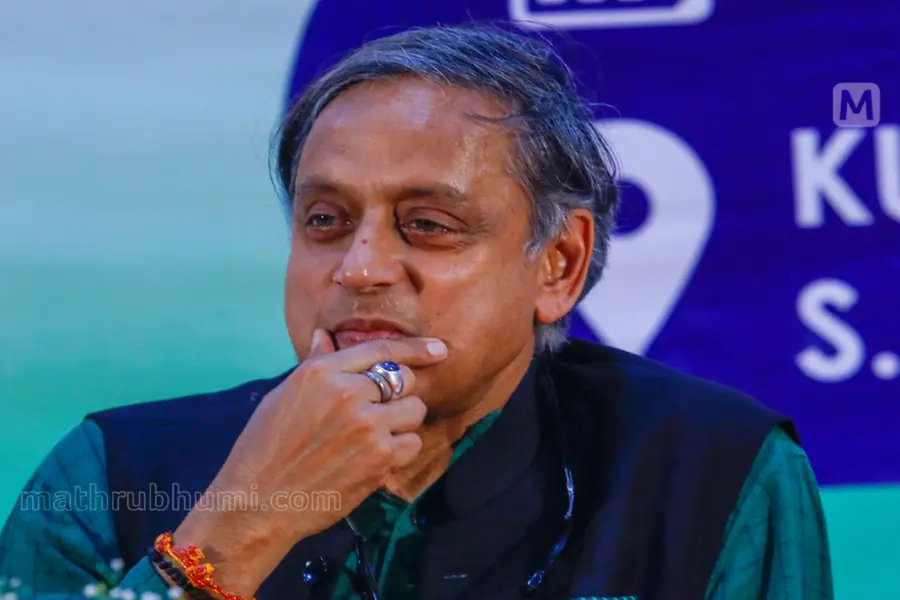
The "wizard of words" has stirred the hornet’s nest again—how else but with words? Language, both spoken and written, has been Shashi Tharoor’s greatest strength and, at times, his undoing. From childhood to his many avatars—writer, orator, diplomat and politician—words have shaped his journey. So deep is his passion that he has chronicled it in a book, “Tharoorosaurus” and continues to explore it in his column, “World of Words”. The logophile’s flair has won him millions of hearts, yet it has also landed him in trouble. Who can forget the shockwaves of his “floccinaucinihilipilification” or the backlash over his infamous "Cattle Class" remark?
This time, the uproar is over his praise for Kerala’s vibrant start-up ecosystem and the Modi-Trump meeting in the USA. The Congress is in turmoil, scandalised by its Working Committee member’s “political incorrectness” in applauding the adversary. Meanwhile, the Left and the BJP are jubilant, seizing upon his words as unexpected validation from a high-profile rival.
One may disagree with Tharoor’s stance, but there is no denying that his willingness to acknowledge merit beyond party lines only enhances his stature. His political appeal has always transcended divisions—political, religious, caste, gender and class. His four repeated electoral victories in Thiruvananthapuram since 2009 attest to that broad support. By refusing to conform to the rigid sectarianism of conventional politics, Tharoor strengthens his image as a statesman—one who dares to see virtue even in his opponents, while others remain blinded by partisanship. Does anyone other than Congress leaders or their supporters on television debates, bad-mouth Tharoor for what he said? He has also enhanced his credibility as a person who is frank and fair when most politicians appear to the public as rank opportunists. Unfortunately, Tharoor’s critics in Congress do not see that the attack he may launch against the CPM tomorrow could carry far more conviction as one who appreciated them when he thought the Marxists were right.

More than just a personal conviction, Tharoor’s stance is also politically smart. Conventional political parties and many TV pundits often overlook the changing perceptions and values of large sections of the public, particularly the younger generation—for better or worse. While such a constituency has always existed, it has expanded significantly with the exponential growth of the Indian middle class by the turn of the century. This segment seeks a constructive and forward-looking development agenda, rejecting political and ideological divisions that hinder progress. It also abhors relentless negativity. A key factor in the UDF’s successive defeats in the 2021 assembly elections was its leaders’ persistent—albeit often well-founded—negative portrayal of LDF governance, particularly in the absence of a compelling alternative vision. The current UDF leadership except Tharoor seems yet to grasp this attitudinal shift among voters. However, V D Satheesan deserves appreciation for being ingenuous, despite his bitter criticism, to attend the upcoming Global Business Meet being held by the state government.
During the 1990s, the world witnessed some cataclysmic events of the past century. The collapse of the Socialist bloc which prompted many to announce the “end of history”, the “final triumph” of the Western liberal democracy and the hegemony of neoliberalism, transformed the world. India also was launched into the path of “LPG” (Liberalisation, Privatisation, Globalisation) by the Congress governments under Narasimha Rao and Manmohan Singh during the same period.
These tectonic events led the Indian Left to a quandary. But unlike the Communist parties elsewhere in the world which disappeared or were dismantled, the Indian Communists swore to go ahead, come what may. One of those Communists who set out thinking of new ways of political survival was EMS Namboodiripad, notwithstanding his virtual retirement from active politics and advancing age. He began campaigning for a consensus among people and political parties for the development of the state. The veteran consistently warned against sectarian and divisive party politics as harmful to democracy and public interest. The product of this new thinking, spearheaded by EMS and backed by his young comrade and economist Dr Thomas Isaac, was the 1996 LDF government’s decentralisation project, the People’s Planning Programme (PPP). Ironically, though PPP was also envisaged as the common people's only alternative to the neoliberal agenda, it owed much to the neoliberal Rao government. The 73rd and 74th amendments of the Constitution brought by the Rao government in 1992 which substantially strengthened the local self-governments had made the PPP possible. However, PPP emerged as the country's most successful non-partisan model for local development and grassroots democracy, driven by empowered local self-governments and mass participation.
To escape from the crippling economic stagnation of the state, the CPM’s Bengal comrades too had embarked during the same period on an offbeat path. But what they chose was the one launched by the Congress governments under Rao and Singh and not of their comrades in Kerala. The Left Front government in West Bengal, under Buddhadeb Bhattacharya, hastily embraced neoliberalism and corporate capital — an overdrive that ultimately contributed to its downfall.
(Ironically, Kerala’s CPM too abandoned the PPP when it came to power again in 2006. To many critics, the last and current Pinarayi governments seem to be leaning more toward Buddha’s corporate path than EMS’s people-centric approach. An interesting comment from Bishop Mar Coorilos, the Leftist cleric on Tharoor’s praise for the LDF government; “Has the Left turned so Right to win Tharoor's compliments?”)
Interestingly, even as neoliberalism was hammering out the political consensus for markets, several prominent Leftist scholars from Europe like Chantal Mouffe, Slavoj Zizek and Jacques Ranciere, began issuing warnings. They pointed to this neoliberal consensus as depoliticisation and a “retreat of the political” or the advent of an era of "post-politics". They warned that it was highly detrimental to true democracy and the interests of ordinary citizens. Post-politics also tends to create a consensus among political parties with diverse ideologies for pro-market policies which its critics call “party cartel”. Look at the close similarities in the views on economic policies of Republicans and Democrats of the US, Labour and Conservatives of the UK or India’s Congress and BJP. Many would argue the same about the UDF and LDF in Kerala.
Post-liberalisation, a new generation in India too has become staunch votaries of post-politics. Regardless of its long-term desirability, the "post-political generation" is guided more by what it perceives as pragmatism than by ideology. It may support any party, leader, or even a non-political technocrat with a "credible agenda untainted by party interests”. Advocating the “depoliticisation of development,” they champion the slogan: “development above politics.” As exemplified by Tharoor’s bipartisan stance, post-politics also seeks to move away from adversarial political practices toward policy consensus among different parties. One critic describes post-politics as a counterrevolutionary force aimed at creating a society devoid of conflict, struggle and radical systemic change. Nonetheless, though post-politics presents significant challenges to democracy, its rise is largely a response to the deep-seated decay of democratic institutions.
Despite Kerala’s reputation as a deeply politicised state, it is also one of India’s most “middle-classised” societies, where post-political thinking has gained significant traction—whether one welcomes it or not. The previous and present LDF governments have consistently championed the idea of “development above politics.” In this landscape, Tharoor appears to be the ideal candidate to emerge as the darling of this new post-political mindset and its adherents.
If he follows up—though he is not usually known for such groundwork—his vision with a comprehensive development agenda addressing Kerala’s chronic issues like unemployment, lack of investment and the crisis in higher education, he could easily become the state’s most beloved politician, transcending political and ideological divides. For the UDF, retaining him within its fold would be a strategic advantage in the 2026 assembly elections, given that no other Congress or UDF leader matches his popularity, despite his perceived drawbacks. Yet, paradoxically, he does not even figure among the top five contenders within Congress for the Chief Minister’s post. From the moment he joined the party, his strongest adversaries have come from within, a reality that persists even today.
However, a pertinent question remains: Can Tharoor, as a member of the Congress Working Committee, publicly take positions that contradict the party’s official stance? Ultimately, though, this is an internal matter for Congress and holds little relevance for the larger public. More importantly, Congress arguably needs Tharoor more than he needs the party—he remains one of its few respected national figures. It has often surprised many that, after a distinguished career in global intellectual and diplomatic circles, Tharoor has allowed himself to be drawn into the petty power squabbles of small men driven by crass ambitions.
Published: 19 Feb 2025, 10:26 am IST
Disclaimer: Kindly avoid objectionable, derogatory, unlawful and lewd comments, while responding to reports. Such comments are punishable under cyber laws. Please keep away from personal attacks. The opinions expressed here are the personal opinions of readers and not that of Mathrubhumi.