
When a much bigger star walks into a film for five minutes, the cameo can take over the film itself. Instead of talking about the story, we end up talking about the star
There was a time when seeing a superstar suddenly walk into a film was enough to make you sit up. The surprise was part of the fun. But somewhere along the way, the cameo itself became an event — teased, marketed, dissected and sometimes even used to prop up a film. And perhaps the more interesting question now is not who makes the cameo, but whether the story actually needed them there.
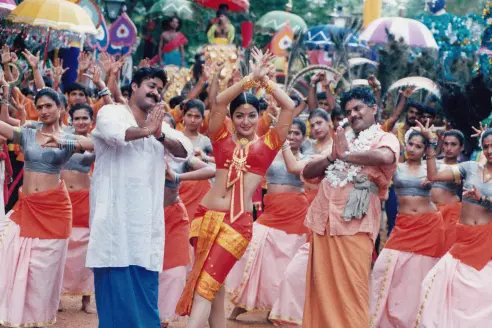
In Shaji Kailas’ Narasimham, released in 2000 and headlined by Mohanlal as Induchoodan, we get the quintessential larger-than-life alpha male hero. Induchoodan is the prodigal son who returns after being wrongly imprisoned for a crime he did not commit, ready to wreak vengeance on those who wronged him. But beneath all that swagger and bravado is a deep bitterness towards his father (Thilakan), who never believed in his innocence.
Also Read

The narrative is careful to build Induchoodan as this indomitable hero, flexing his muscles, his attitude and his power at will. He seems to need nobody. And then comes the crucial point when even this seemingly invincible hero needs a saviour, someone who can bail out his father. That is when the film gives us one of its biggest surprises: Mammootty walks in as Nandagopal Marar, a pricey Supreme Court lawyer and Induchoodan’s best friend.
What makes the cameo work isn't merely the shock of seeing Mammootty appear in a Mohanlal film. It is when he appears and what he does. Nandagopal Marar isn't there to rescue Induchoodan or to steal his thunder. He arrives because Induchoodan has reached the limits of what his own power can accomplish. The man who appears to need nobody needs his friend to save his father.
And Mammootty brings an entirely different kind of authority into the film. Nandagopal doesn't need to establish his dominance through physical power. He walks in with the effortless confidence of a man who knows exactly what he is capable of, and the film trusts that presence. More importantly, his arrival tells us something about Induchoodan. For all that self-sufficiency and bravado, here is a man who has a friend he trusts enough to call when he cannot solve something himself. The cameo therefore does more than solve a problem in the plot. It adds another layer to the hero we have been watching.
That is what made cameos like this so effective back then. They had a purpose. They entered the narrative at a crucial moment and added something to the story or to the characters. They weren't simply there to salvage a film, manufacture a surprise or add another layer of stardom to the hero's arc. In fact, the irony of Narasimham is rather wonderful.
The film spends so much time constructing Induchoodan as the ultimate self-sufficient alpha male. And then, at the moment when it matters, it quietly reminds us that even Induchoodan needs somebody. And that somebody is Mammootty.
There is also something particularly interesting about superstar cameos because Mammootty and Mohanlal don't enter a film merely as actors. They carry decades of stardom with them. When either of them walks into a film, the audience is inevitably aware of the star as much as the character. Which is why a filmmaker has to know what to do with that star power. Otherwise, the character can very easily disappear behind the actor.
In Vysakh’s Khalifa, Aamir Ali (Prithviraj Sukumaran) is already established as the larger-than-life inheritor of his grandfather's legacy. The film spends considerable time glorifying the grandfather's exploits while simultaneously building up Ali's own reputation. When he is arrested for murder and thrown into jail, he once again proves that he can take care of himself, single-handedly fighting and defeating his opponents.
So, by the time we reach the final five minutes, the film hasn't really established a problem that the grandfather needs to solve. And yet, that is when Mohanlal appears as the grandfather, returning from years of imprisonment in Nepal with his own gang of men. Of course, the reveal is designed as a moment. And that is precisely where the problem lies.
Unlike Mammootty's appearance in Narasimham, Mohanlal's cameo doesn't emerge from a narrative necessity. It is the event the film has been building towards as a fan-service moment. The marketing leaned heavily on his presence too, making the cameo itself part of the selling point. Which means the star's arrival becomes bigger than what the character actually contributes to the story.
For some viewers, that five-minute appearance became the film's high point, even the thing that appeared to salvage it. For others, it felt like a spectacular but ultimately empty flourish because the grandfather arrives, makes an impact and leaves without fundamentally altering the story. And that's where the comparison with Narasimham becomes fascinating. In Narasimham, Mammootty's star power serves the narrative. In Khalifa, Mohanlal's star power becomes the narrative event.
There is another difference too. In Narasimham, the audience gets the pleasure of discovering Mammootty when he walks in. In Khalifa, the audience had already been told to wait for Mohanlal. The cameo had become something to anticipate rather than something to discover.
Today, cameos are increasingly part of the marketing machinery. The star is announced. The appearance is teased. Social media speculates. Fan pages look for clues. The cameo becomes something audiences are actively waiting for.
By the time the character arrives, you aren't necessarily discovering someone. You are waiting for the celebrity you were promised. And once the cameo becomes a marketing tool, the distinction between the actor and the character can become rather blurry. The star arrives, the audience cheers and the film gets its social media moment. Whether the character actually adds anything to the story almost becomes secondary.
And then there are cameos that are just plain embarrassing.
Take Chatha Pacha, which featured Mammootty as a mentor to a bunch of young wrestlers. By the time he entered the film, the buzz around his appearance was already strong on social media, so there was hardly any element of surprise left. But what made it particularly underwhelming was that this was Mammootty’s immediate film after a hiatus, and the performance was spot dubbed. The cameo simply never had the punch it was expected to have.
Similarly, Mohanlal’s special appearance in his daughter’s debut Thudakkam held no real surprise, but what it did leave us with was a fair amount of squirming at the meta-dialogues. At one point, Mohanlal who plays the lead’s mentor tells her to “make your father proud.” It is the sort of moment where the film seems almost too conscious of the star sitting in front of us.
Of course, there is no denying that it is always comforting to see Mammootty and Mohanlal on screen, particularly when they turn up unexpectedly. That thrill is part of what makes a great cameo work in the first place. But the old saying about too much of a good thing rings true here as well. Because once the cameo becomes a tool to milk a superstar’s stardom, rather than something the story genuinely needs, the distinction between a narrative choice and a marketing strategy begins to disappear.
And there is another problem. When a much bigger star walks into a film for five minutes, the cameo can take over the film itself. Instead of talking about the story, we end up talking about the star. Perhaps that is the simplest test of a cameo: when the actor leaves, are we thinking about the character who walked into the story, or merely the star who walked onto the screen?
Published: 29 Aug 2026, 10:26 am IST
ABOUT THE AUTHOR
Related Topics
Disclaimer: Kindly avoid objectionable, derogatory, unlawful and lewd comments, while responding to reports. Such comments are punishable under cyber laws. Please keep away from personal attacks. The opinions expressed here are the personal opinions of readers and not that of Mathrubhumi.