
An actor may arrive to promote a film, but the interview often comes with a set of expectations about who that actor is supposed to be
Are actors promoting films, or are films increasingly becoming vehicles for promoting the actor’s public persona?
Promotional interviews were once largely ancillary to a film’s publicity campaign. Today, they have acquired an entertainment value of their own. That also means, the actor’s personality, their politics, eccentricities, candour, humour, opinions and even their awkwardness can sometimes become more clickable than the film they have come to promote.
Also Read

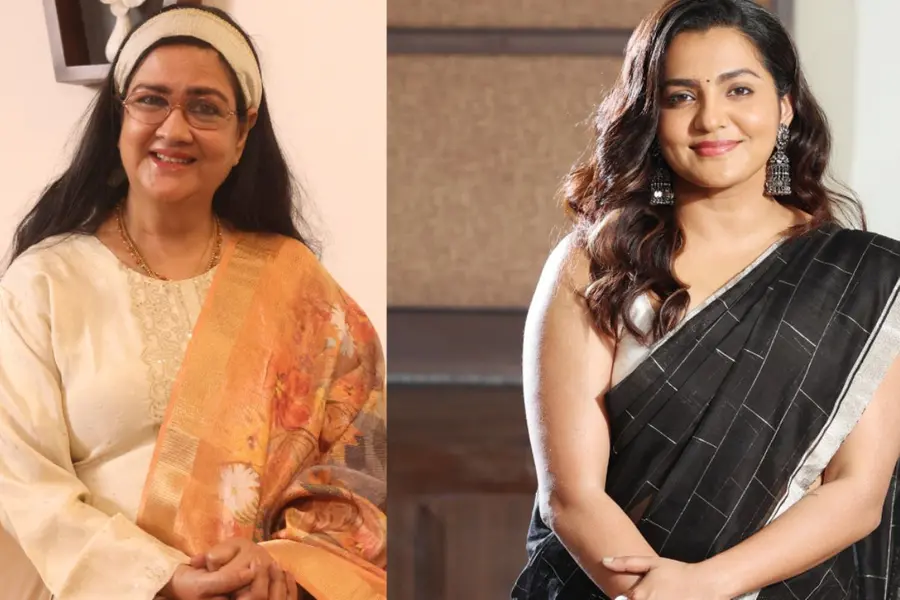
During the promotional interview for Aasha, Urvashi took exception to the anchor slipping into English and mocked her in full public view at a mall in Kerala. Her reasoning that the audience was predominantly Malayalee felt less like a principled defence of Malayalam than an appeal to the gallery, particularly given an audience that already displays a baffling derision towards the English language. Predictably, the reel went viral, and the promotion soon spiralled into a larger social media conversation about language, cultural bias and all the attendant shenanigans.
What was perhaps more revealing was how most of these interviews eventually became Urvashi spectacles, with anchors fawning over the actor, revisiting her filmography and inviting anecdotes from a long and celebrated career. Perhaps that is also the point. When audiences already know and respond to an “Urvashi”, reproducing that recognizable persona is itself part of the publicity. At some point, the promotion stops being about selling the film and starts selling the star.
The same thing happens, albeit differently, with Parvathy Thiruvothu. Even when she sat for promotional interviews for Pradhama Drishtiyal Kuttakkaran, the focus was often less on the film and more on her politics, her positions on various issues and the public persona that has come to define her off screen. It almost seems mandatory for Parvathy to sit there and speak about everything that feeds into that public image.
Perhaps the actor is aware of this dynamic, but a video interview leaves little room to simply opt out of questions that have come to be expected of her. I remember interviewing her over the phone for an online portal, when she gently asked me to skip questions related to WCC. She felt that the onus had somehow fallen disproportionately on her to keep speaking on behalf of the collective.
It is an interesting predicament. An actor may arrive to promote a film, but the interview often comes with a set of expectations about who that actor is supposed to be.
Look at what happened with Vismaya Mohanlal, who was accompanied by her parents for the promotional interviews of her debut. Suddenly, the conversation was no longer about the film or even about the young actor’s first experience of making one. It became about her body language, her gait, her gestures and her awkwardness — every little deviation from the polished ease we have come to expect from celebrity interviews.
Soon enough, social media was dissecting her behaviour, debating celebrity culture and the ways in which we audit public figures, while others celebrated Vismaya for being “real”. There is something revealing about that response. We have become so accustomed to celebrities performing a version of themselves for public consumption that even awkwardness gets turned into content. The absence of polish becomes another kind of spectacle.
And then there are actors like Shine Tom Chacko and Dhyan Sreenivasan, the latter even being dubbed an “interview star”. If Shine’s interviews are more about his eccentricities and melodrama, Dhyan sits and talks about everything else except the cinema he promotes. That includes mocking his family, friends, the anchor and the world around him.
The promotion is essentially about Dhyan being Dhyan. And the format rewards this. A provocative remark, an irreverent anecdote or an outrageous joke can be clipped, circulated and consumed without the viewer having any interest in the film itself. The resulting attention benefits the actor, the interviewer, the platform and the social media ecosystem alike.
In fact, the interview itself has become a content factory. One 30 minute Urvashi, Parvathy or Prithviraj interview can generate a viral clip, several reels, reaction posts, memes, headlines, fan edits, controversy and follow-up interviews. There is an entire ecosystem that benefits from the actor becoming the story.
If you take Prithviraj Sukumaran’s interviews, despite a whiff of self-regard, even bragging, we are somehow buying into his confidence, the fluency, and that almost effortless articulation. He can talk about Malayalam cinema, filmmaking or his favourite films and make the conversation as much about the person speaking as what he is saying.
His recent interviews for Daayra were a good example. His observations on Malayalam cinema, the importance of screenwriters and the differences between Bollywood and Malayalam production were widely consumed, with one answer even turning into a fan edit. And let’s face it, this is what travels. A sharp observation or an amusing anecdote has far more afterlife on social media than an earnest promotional pitch for a film. Before long, we are consuming Prithviraj as much as the film he has come to promote.
And we have this obsession with being “authentic”. Anything slightly polished can become another set of cryptic social media content, while an awkward pause, an indiscreet remark or an unexpected reaction is celebrated as proof that someone is being “real”. We demand authenticity from our actors, but we also seem to have very fixed ideas about what that authenticity should look like.
A Parvathy has to be political and not necessarily fun. Dhyan has to be irreverent. Prithviraj has to be a “movie encyclopedia”. Urvashi has to be blunt. We have, in effect, assigned each of them a version of themselves that we expect to encounter every time they sit before a camera.
So, the media and the audience themselves participate in constructing these personas. Not every interview needs to be solemn or film-school-ish. Entertainment is perfectly legitimate. An actor being funny, irreverent or candid isn’t inherently a problem. The question is whether the promotional apparatus has become so personality-driven that the film itself gets pushed to the margins. Because when the interview generates more conversation than the film it is meant to sell, what exactly are we promoting anymore — the film, or the actor?
Published: 29 Sept 2026, 11:34 am IST
ABOUT THE AUTHOR
Disclaimer: Kindly avoid objectionable, derogatory, unlawful and lewd comments, while responding to reports. Such comments are punishable under cyber laws. Please keep away from personal attacks. The opinions expressed here are the personal opinions of readers and not that of Mathrubhumi.