

Revisiting the on-screen collaborations between these two acting giants—moments where character and charisma found a way to coexist
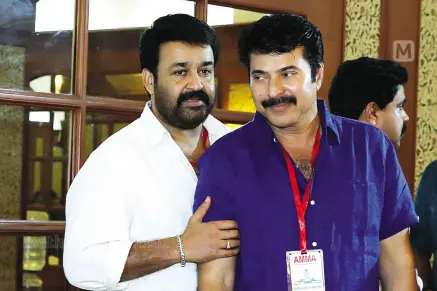
Patriot (directed and written by Mahesh Narayanan) arrives at a moment when both Mammootty and Mohanlal stand magnificently at the peak of their stardom. While Mammootty continues to experiment, often subverting his own image, Mohanlal operates within a more familiar space, his box office command remaining virtually unshaken. Perhaps that is why their rare on-screen reunions feel inherently eventful. Stardom, after all, comes with its own negotiations—the need to satisfy fans, sustain image, and still deliver to the box office. In that sense, every shared frame carries a certain weight, a careful calibration. And it felt only fitting to revisit four of my favourite on-screen collaborations between these two acting giants—moments where character and charisma found a way to coexist.
Also Read
Narasimham: But when they reunited a decade later in Narasimham (and let’s be honest, Harikrishnans in between felt more like a detour) the dynamic had clearly evolved. Mohanlal’s Induchoodan is a pure alpha spectacle, the one who effortlessly dismantles goons, and operates as the go-to fixer. In short, a man who is fully in command of his world. But then when his father is unjustly jailed, he turns to his college senior and friend, Nandagopal Marar (Mammootty in a sharp cameo) who is now a Supreme Court lawyer. Unlike Tony Kurishingal, Induchoodan doesn’t come from a place of vulnerability. He is assured, almost immovable. So even though Marar steps in as the rescuer, the equation this time carries an unmistakable parity. There’s no sense of leaning, only a meeting of equals. Of course, the easy camaraderie still remains, but it now exists within a carefully balanced space, where both star images are fully formed, fully aware, and deliberately held in equilibrium.
Gandhinagar Second Street (1986): Much before Tony Kurishingal’s cheekiness or Induchoodan’s swagger, there existed a Mohanlal who thrived on vulnerability, on the quiet desperation of men trying to get by. In this Sathyan Anthikad film, written by Sreenivasan, he plays Sethu, an unemployed youth who impersonates a Nepali Gurkha, speaking broken Hindi just to survive in a middle-class residential colony. Sethu is fragile, constantly on the verge of being found out, his confidence wavering, and his life further unsettled by the re-entry of an old lover. Soon he finds a quiet anchor in Seema’s Nirmala, who runs a nursery and chooses to look past his deception. But then their tender and fraternal bond is inevitably misconstrued by the gossip-ridden neighbourhood. And it is within this space that Mammootty’s Balachandran (Nirmala’s husband) enters. Briefly, but decisively. In under fifteen minutes, his presence carries a quiet authority as he silences the insinuations (echoing that familiar gravitas). But more importantly, he steps in as the “brother” Sethu never had, offering him not just a job, but dignity, and the courage to reclaim his life and love. Today, such an interplay would have been unimaginable, given their towering statures. But during a time, untouched by the burdens of stardom, this fleeting intersection remains one of the film’s most affecting high points, where character, not image, took centre stage.
Published: 30 Apr 2026, 10:23 am IST
ABOUT THE AUTHOR
Related Topics
Disclaimer: Kindly avoid objectionable, derogatory, unlawful and lewd comments, while responding to reports. Such comments are punishable under cyber laws. Please keep away from personal attacks. The opinions expressed here are the personal opinions of readers and not that of Mathrubhumi.