
Once young people stop fearing power, power usually discovers that it has far more to fear from them than they ever had from it, says Harikrishnan S
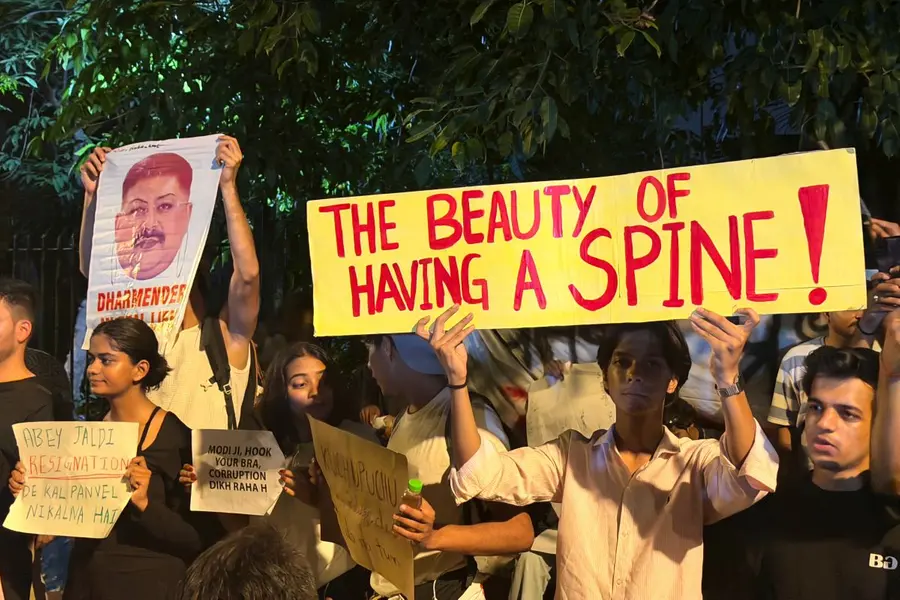
For the better part of almost a decade and a half, the BJP has operated on an assumption that would have made even Louis XIV blush with embarrassment. The State was Narendra Modi and Narendra Modi was the State. The distinction between the government, the party and the man gradually became so blurred that questioning one was construed as blasphemy against all three. That arrangement worked spectacularly well all this while. Until a bunch of children refused to cooperate.
History has an incurable habit of mocking power. The Bastille was not demolished by constitutional lawyers. Rosa Parks did not possess a television network, nor did Gandhi have an IT Cell. The Berlin Wall did not collapse because television propagandists finally ran out of adjectives while screaming themselves hoarse every evening. Power almost always collapses first in the imagination of ordinary people before it collapses anywhere else.
That is why the CJP movement deserves to be examined far more seriously than the government would like and, ironically, far more seriously than some of its own supporters have managed to do. I have my reservations about some of the personalities who first emerged as its public faces. Charisma is not character and public adulation is no substitute for political wisdom. Every movement eventually discovers that heroes are frequently the weakest link in history.
Also Read: The rise of politics beyond political parties
Fortunately, history has another delightful habit. Sometimes it simply discards its heroes and keeps the movement. And that, I suspect, is precisely what has happened here. The establishment, I feel, made a fatal miscalculation by assuming that if a few faces could be discredited, the movement would quietly dissolve into the digital ether from which it emerged. Instead, it has behaved like mercury. Strike it with a hammer and it merely becomes a hundred smaller droplets.
The BJP has spent years perfecting political centralisation. Every campaign had one face, every achievement one author, and every election became one man’s plebiscite. It is a remarkably efficient model until the day one discovers that decentralised dissent is immune to centralised authority. Who exactly does one arrest when outrage itself becomes the leader?
Whom does one threaten when every smartphone has become a newsroom? How does one negotiate with thousands of people who have never appointed a negotiating committee? Governments are accustomed to political parties, but they are utterly bewildered by swarms. That explains the visible panic far better than any television debate ever could.
One almost felt sorry watching the government’s communication machinery. There were the familiar accusations: foreign hand, urban naxals, hidden conspiracies, and anti-national elements. One waited patiently for George Soros to make his contractual appearance because no BJP political thriller seems complete without him making a cameo somewhere between the second act and the climax.
Also Read: The Dawn in Jantar Mantar
The script, however, refused to cooperate this time around, and the movement simply kept growing. Then came what must surely rank among the more extraordinary spectacles in contemporary Indian politics. The Prime Minister publicly demanding apologies from children. Children!
One searched in vain for satire because reality had already outperformed it. And, having extracted these confessions worthy of a Victorian boarding school, he then proceeded to announce with magnificent generosity that he had forgiven them. One half expected the Rashtrapati Bhavan to issue certificates of absolution embossed with the national emblem (and hopefully with the correct spelling!)
Absolute power has many characteristics, but needing validation from fifteen-year-olds is rarely one of them. Political psychology teaches us something rather elementary; confident authority seldom advertises itself. It certainly does not seek emotional satisfaction from children acknowledging its greatness.
The tragedy for Narendra Modi is that he has spent years constructing perhaps the most personalised political brand independent India has ever witnessed. Every road became Modi’s road, every vaccine became Modi’s vaccine, and even every diplomatic handshake became Modi’s triumph.
Also Read: The new burden of being a public figure
When politics becomes theatre, criticism ceases to be administrative and becomes personal instead. Every balloon will eventually encounter a pin. The CJP movement did not puncture the government. It punctured the Prime Minister's carefully cultivated aura of invincibility and personal ego. And that distinction matters far more than the immediate political consequences.
Equally revealing has been the opposition's behaviour. Everyone suddenly speaks fluent Gen Z. Narendra Modi has discovered informal conversations, the RSS has discovered youthful curiosity, and Rahul Gandhi appears to have discovered that listening occasionally produces better optics than lecturing.
Every political party now wishes to be photographed with people whom many of them, until recently, regarded as politically inconsequential. Nobody courts voters they consider irrelevant as political instinct is rarely sentimental. It is forensic.
Rahul Gandhi appears, for the moment, to have established the strongest emotional connection with politically engaged young citizens. Whether that translates to votes is another matter altogether. Young people are notoriously promiscuous with hope and deeply conservative with trust. They may cheer you today and abandon you tomorrow. That uncertainty is precisely what terrifies every established political formation.
The BJP's greatest strategic advantage has never merely been its organisation. It has been its ability to dominate narrative. Television studios became extensions of party headquarters. Large sections of digital media willingly transformed themselves into public relations consultancies masquerading as journalism.
Also Read: When corruption becomes the only politics
Prime time became less an exercise in information than an evening ritual of political incense. Yet technology has altered one uncomfortable reality. Editors no longer possess exclusive custody over public memory. A student carrying a mobile phone today can produce evidence before the first newsroom has even decided whether an event deserves coverage. And that changes everything. Not in the least because truth automatically prevails. The internet manufactures lies with astonishing efficiency. But because monopoly has died. That is why the extraordinary frenzy within the BJP’s communication ecosystem deserves attention.
Political parties do not mobilise every available resource because they enjoy exercise. They do so because somewhere, behind closed doors, professional strategists have concluded that something is worth containing before it acquires a life of its own.
Well, does that mean the government is electorally doomed? Not at all. The BJP remains perhaps the most formidable electoral machine India has ever seen. It possesses organisation, resources, discipline and a leadership structure that most rivals can only envy. Nor should anyone imagine that Gen Z is marching uniformly behind one political banner.
Generations do not possess ideologies; they possess anxieties. Employment, education, opportunity, dignity, and institutional fairness. The party that understands these anxieties first will inherit the future. The party that mistakes social media marketing for emotional legitimacy may discover that algorithms can amplify popularity but cannot manufacture authenticity.
The government’s gravest mistake may not have been its political response. It could very well be its moral response. Every parent watching images of children confronting armed authority asks precisely one question before asking any political question. What if that had been my son or my daughter? That question has altered governments throughout history, has toppled empires, and has even ended wars and rewritten elections. One should therefore resist the temptation to predict immediate political earthquakes.
History hardly ever moves with cinematic punctuality. It accumulates, drop by drop, insult by insult, image by image, and generation by generation. The CJP movement may yet disappear, and most movements do. Some fragment, some are co-opted, and some become footnotes. But occasionally a movement succeeds in doing something infinitely more important than winning an election. It changes what a generation believes is possible. And once young people stop fearing power, power usually discovers that it has far more to fear from them than they ever had from it.
The author is a National Award winner for Best Narration and an independent political analyst. Views expressed are personal.
Published: 08 Aug 2026, 03:45 pm IST
Related Topics
Disclaimer: Kindly avoid objectionable, derogatory, unlawful and lewd comments, while responding to reports. Such comments are punishable under cyber laws. Please keep away from personal attacks. The opinions expressed here are the personal opinions of readers and not that of Mathrubhumi.
