
Weeks after the Modi-Xi meeting, ITBP chief Shatrujeet Kapur has confirmed ongoing India-China face-offs in Arunachal Pradesh. The revelation raises bigger questions: Is China probing the LAC, and is India’s border-management framework keeping pace with PLA technology?
Just 40 days after the September 12 meeting between Prime Minister Narendera Modi and China’s President Xi Jinping comes the alarming revealation about regular face-offs between Indian and Chinese troops along the Arunachal Pradesh border. The revelations made by Indo-Tibetan Border Police (ITBP) chief Shatrujeet Kapur has raised some disturbing questions.
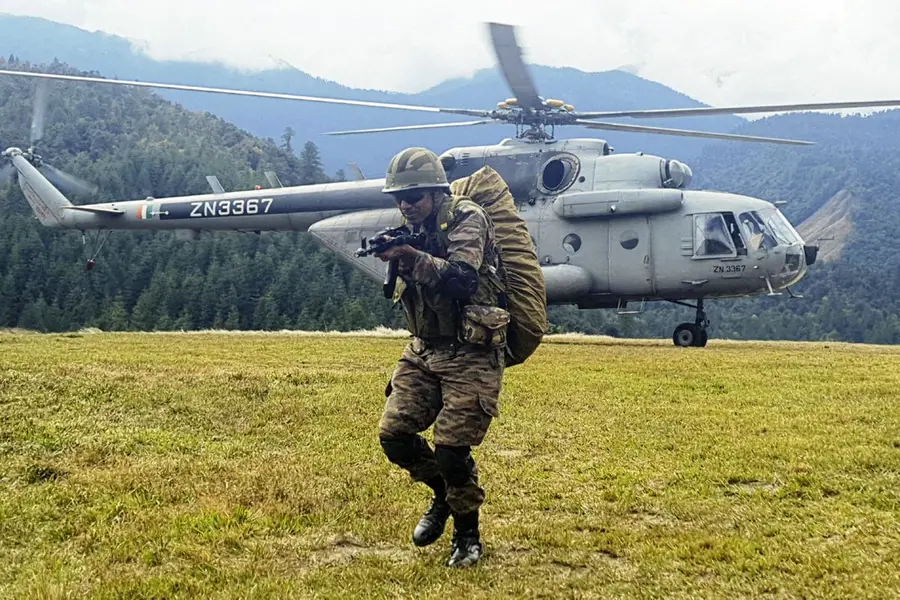
"Recently, a situation arose in Arunachal Pradesh where face-offs took place and are still ongoing," Kapur, the ITBP Director General said while praising the "exemplary role" of ITBP's Shaurya Commando teams in dealing with the challenge in the mountain ranges dividing the two countries.
China regards Arunachal Pradesh as a part of its Tibetan region. Troops of its People's Liberation Army have attacked India's military lines along the Arunachal border on seven occasions since Xi Jinping took over as president in 2013. This is why any border disturbance needs to be taken seriously and examined to verify if there is a sinister design.
The public relations department released a few video clips of the speech. This put at rest initial concern that the speech, made to the uniformed forces, had been leaked to the media. Kapur’s statement provided fodder to the Congress and other opposition parties bent on proving that the Modi government is inefficient. But the ground situation is a lot more complex than what political discourse would suggest.
One would assume that Kapur did not deliberately provoke a controversy when he made the observations ahead of his scheduled retirement on October 31. He would have served a short term since he took charge as DG in January this year. The statement caused some surprise because the government usually avoids discussing day to day developments along the border.
There were reports of disturbances in Taksing–Asaphila and adjoining areas of Arunachal Pradesh in July this year though Kapur did not cite any specific location. The last major incursion by PLA troops was in the Tawang region of Arunachal Pradesh in December 2022.
Defence Minister Rajnath Singh told Parliament that Chinese troops attempted to cross the LAC and change the status quo. Indian troops stopped them; a physical clash caused injuries on both sides. India reported no fatalities or serious casualties on its side.
India and China have developed an elaborate mechanism to cool down passions along the border and avoid confrontations. One of the rules established by them is that soldiers of either side patrolling within two kilometers from their perceived boundary line would not carry weapons of any kind. The main purpose is to make sure that confrontations don’t turn violent.
Confrontations and face-offs are usually shouting matches, each side protesting in their own language. Videos are recorded as anxious soldiers let off steam in Hindi and Chinese after high-tension patrolling. The recordings are later examined to verify if the rules established at commander level meetings are abided.
Deliberate moves?
Two questions emerge. Are these face-offs a natural offshoot of the tense job of guarding the border or deliberate instigation by Chinese commanders determined to create disturbance? An equally important query is why the two sides have not yet formulated a reliable border management protocol after years of deliberations?
The obvious reason for confrontations is that India and China perceive their border differently. Patrolling parties get different orders, and occasionally come close to each other, often crossing paths. This is why commanders of both sides have established a set of routines to overcome the possibility of face off. The problem is that the protocol is not working efficiently.
Three important meetings including the one involving the Prime Minister has taken place prior to Kapur’s October 22 speech. The National Security Adviser Ajit Doval and Chinese Foreign Minister Wang Yi discussed the boundary in Beijing on August 25. There was a Corps Commander-level talks between the two forces at Wacha–Damai on September 6. But there appears to be no reduction in the ongoing friction along the border.
After the controversy surfaced, Randhir Jaiswal, spokesperson of the Ministry of External Affairs, made a statement blaming the border movements of Chinese troops. “We have noted in the past, the situation in the India-China border areas gets disturbed from time to time when Chinese forces diverge from established patrolling patterns,” he said.
“Both sides continue to use existing diplomatic and military mechanisms to resolve outstanding issues and avoid misunderstanding and miscalculation along the Line of Actual Control,” he added.
The two countries had agreed to discuss ways to improve their understanding of the Line of Actual Control in appropriate areas to strengthen border management. “The maintenance of peace and tranquillity in the border areas is essential for the overall development of bilateral relations,” he said.
In his speech, Kapur stressed the need to further develop drone and anti-drone capabilities to deal with the border situation. The speech has put the government in a situation where it may have to explain what steps it is taking to enhance the capcility of Indian troops facing PLA soldiers with advances fighting machines.
Whether he intended it or not, Kapur has brought the issue out in the public gaze. It is time the government explained whether agreed patrolling has resumed, which disputes remain active, or whether an understanding is temporary.
The government also needs to look beyond the political controversy and find ways to tackle PLA’s technological advancement along both the Arunachal and Ladakh borders.
As the Middle East and Ukraine wars have shown, it is now possible to counter a formidable energy with abundant resources with low-cost drones, sophisticated satellite imagery and strategic game play. China’s superior wealth need not be a cause for worry if India is able to make the necessary technological advances.
Published: 26 Oct 2026, 03:32 pm IST
Related Topics
Disclaimer: Kindly avoid objectionable, derogatory, unlawful and lewd comments, while responding to reports. Such comments are punishable under cyber laws. Please keep away from personal attacks. The opinions expressed here are the personal opinions of readers and not that of Mathrubhumi.
