
A controversy over arrangements made for a BAPS delegation at the Eiffel Tower has triggered a wider debate in France about gender equality, religious accommodation and the limits of institutional flexibility.
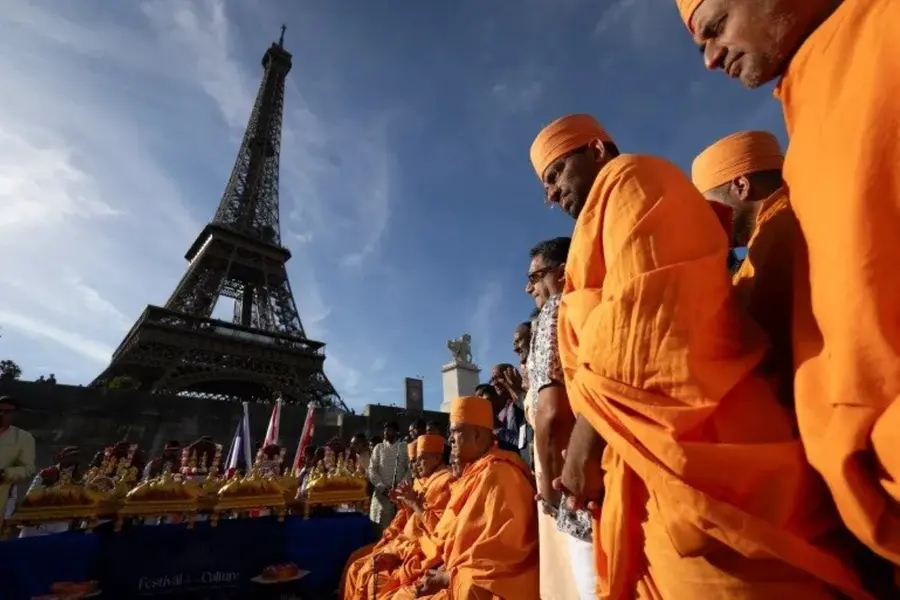
There are few places in the world more recognisably French than the Eiffel Tower. And few principles are more deeply embedded in the French Republic than equality. Which is why the spectacle of female employees being moved out of sight because a visiting religious delegation apparently wanted to limit its interaction with women is not merely an odd little diplomatic embarrassment, but a rather revealing episode in the continuing struggle between religious accommodation and secular democracy.
The delegation belonged to the Bochasanwasi Akshar Purushottam Swaminarayan Sanstha (BAPS), whose first traditionally designed Hindu temple in France had just been inaugurated at Bussy-Saint-Georges, in the eastern suburbs of Paris. The temple is a substantial enterprise, reportedly costing more than €21 million, and BAPS celebrated its opening with a 13-day cultural festival. There is, of course, nothing remotely objectionable about building a Hindu temple in France. Religious freedom is precisely that. Hindus have every right to build temples, Christians to build churches, Muslims to build mosques and atheists to build absolutely nothing at all. The trouble began when a delegation of around 100 BAPS members visited the Eiffel Tower.
Also Read

According to the employees’ union, female workers were instructed to leave their stations, avoid certain areas and, in some cases, were replaced by male colleagues. The Eiffel Tower’s operating company, SETE, subsequently acknowledged that the delegation had requested arrangements intended to limit “interactions with women”.
The company conceded that the conditions “were not in line with SETE’s values, nor with the principles of equality between men and women” and said it would “accept the consequences”. Employees subsequently walked out, forcing the Eiffel Tower to close for a day. BAPS has denied seeking to exclude women, saying the visit “was coordinated in advance to minimise disruption,” and apologised for any pain or inconvenience caused. The investigation will have to establish precisely what was requested, what management understood and what instructions were actually given.
But even allowing for every possible ambiguity, one fact is already beyond dispute. The management of the Eiffel Tower accepted an arrangement under which female employees were treated differently because of the gender of the people they might encounter. And that is not a minor administrative lapse, but an astonishing failure of judgment.
BAPS is a deeply conservative religious organisation, and its own literature explains the stringent rules governing its sadhus, including restrictions on contact and interaction with women. There is hardly anything particularly mysterious about that. Religious communities have always imposed disciplines upon their clergy. A monk can decide that he will not speak to women, a nun can decide that she will not speak to men, and the state is perfectly capable of protecting their right to do so.
But there is a rather important difference between choosing whom you will interact with and deciding whom other people are permitted to employ, approach, or interact with. A BAPS sadhu may avert his gaze from a woman if his religious discipline requires it. A female employee of the Eiffel Tower should not therefore have to vanish from her workplace. This should not require an advanced course in French republicanism. France has spent generations arguing about laïcité, the separation of religion from public life and the principle that citizens are equal before the state irrespective of their religious beliefs.
Yet for a brief and rather extraordinary period, the management of one of France’s most recognisable public institutions appears to have behaved as though the religious sensitivities of a visiting group were more important than the equality of its own employees. The French workers were having none of it, and quite rightly so.
But the episode becomes impossible to separate from politics because BAPS today is not merely a religious denomination. It is one of the most influential Hindu organisations in the world, with substantial financial resources, an extraordinarily disciplined global volunteer network and considerable access to political power in India. Narendra Modi has maintained a long public association with BAPS and its leadership.
As Chief Minister of Gujarat and subsequently as Prime Minister, he has repeatedly appeared at BAPS events and celebrated its temples as symbols of India’s cultural and civilisational influence abroad. His participation in the Paris inauguration was hardly a routine diplomatic courtesy. Modi described the temple as a “new milestone” in India-France cultural relations and praised BAPS for taking India’s spiritual and cultural traditions to the world. The Indian state was not a distant observer of BAPS’s achievement in France, but an enthusiastic participant.
That does not make the Indian government responsible for what happened at the Eiffel Tower. No evidence suggests Modi knew anything about the arrangements for the delegation’s visit, let alone approved them. But political influence is precisely what makes this story worth examining. When a religious organisation enjoys immense wealth, international reach, political access and the enthusiastic patronage of a national government, the question of how institutions respond to it becomes rather more consequential than a quarrel over visitor arrangements.
Religious freedom is indispensable, but religious privilege is something else entirely. The first means that a believer is free to practise his faith. The second begins when everyone else is expected to rearrange public life around the believer’s requirements. A wonderfully simple test distinguishes the two. If a religious visitor does not wish to interact with women, he is free to avoid them. If a public institution is asked to make its female employees disappear so that he need not encounter them, the institution should say no. It is not complicated, nor does it require a theological debate. What it requires is a backbone.
And the irony is too stark to ignore. France has spent decades arguing about religious accommodation, particularly in relation to Islam, and has often been accused of allowing laïcité to become a pretext for restricting religious expression. Yet here was the French system doing something rather different, accommodating a religious demand at the expense of women. The defenders of such accommodation have an oddly elastic and rather convenient understanding of secularism. They insist that France must respect religious freedom, but only in one direction. The women employed by the Eiffel Tower were apparently expected to exercise their freedom by disappearing.
The political reaction in France was swift and strikingly broad. Yaël Braun-Pivet, President of the National Assembly, said she refused to allow women to be “compelled to step aside in order to meet the demands of foreign visitors”. Marine Le Pen, leader of the hard right, declared that “in France, we will never accept that the presence of women be ‘limited.” Gabriel Attal, the former centre-right Prime Minister who has announced his intention to run for the presidency next year, put it even more bluntly, “In France, no culture, no belief, no worship, nothing nor anyone can come to dictate to women their place.”
It is difficult to imagine a more emphatic reminder that, whatever their political differences, there remains at least one matter on which much of the French political establishment appears to agree. Religious sensibilities do not confer the right to decide where French women may stand. And the Eiffel Tower workers eventually supplied the one thing their management appeared temporarily to have misplaced. They reminded France that tolerance is not the same thing as surrender.
The question, then, is not whether BAPS has the right to build temples, nor is it whether France should welcome Hindu institutions. The question is whether wealth, religious authority and political patronage together can persuade democratic institutions to suspend their own principles, even briefly. That is why this controversy travels far beyond Paris. It asks whether India’s increasingly muscular religious nationalism now arrives abroad wrapped in the language of culture and diplomacy, expecting accommodation rather than coexistence. It asks whether governments begin mistaking influential religious organisations for ambassadors of the republic itself.
The Eiffel Tower reopened the next day, but the episode left behind something more troubling than a temporary disruption to tourism. For a few hours, an institution that stands as one of France’s most recognisable symbols appeared willing to compromise the equality of its own female employees in order to accommodate the sensitivities of a visiting religious delegation. France did not embarrass BAPS that day, but the Eiffel Tower embarrassed France. And the lesson should be that equality is not a courtesy extended when circumstances permit, nor a principle that becomes negotiable in the presence of wealth, influence, or religious authority. In a republic, it should apply to everyone.
(The author is a National Award winner for Best Narration and an independent political analyst. Views expressed are personal.)
Published: 10 Sept 2026, 10:23 am IST
ABOUT THE AUTHOR
Related Topics
Disclaimer: Kindly avoid objectionable, derogatory, unlawful and lewd comments, while responding to reports. Such comments are punishable under cyber laws. Please keep away from personal attacks. The opinions expressed here are the personal opinions of readers and not that of Mathrubhumi.