
Switzerland is building one of the world's largest underground batteries, a massive energy storage project designed to support renewable power, strengthen grid stability and help meet growing AI-driven electricity demand.
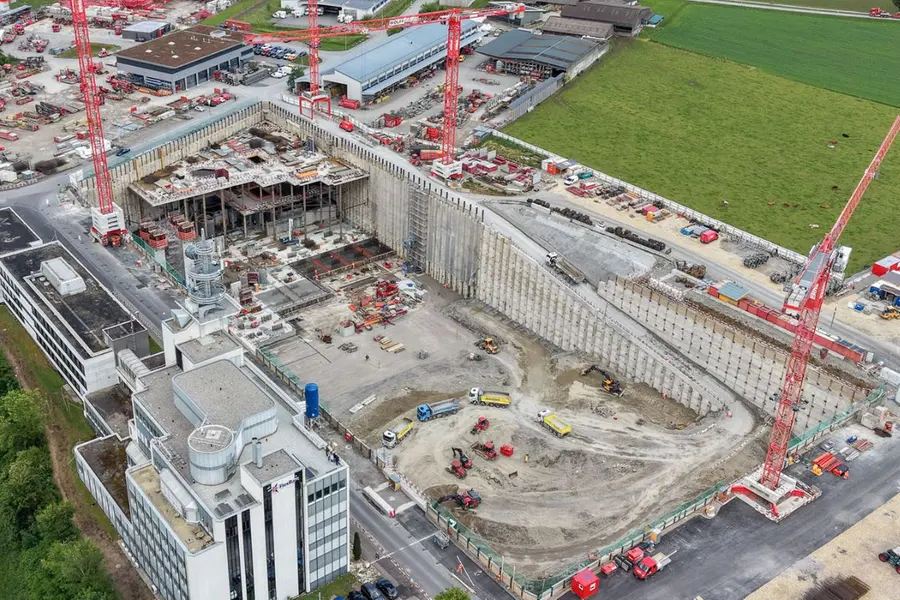
Switzerland is betting big on the future of renewable energy with plans for a massive underground battery capable of powering around 210,000 homes for a day. The project reflects a growing global challenge: not generating clean electricity, but storing it when the sun isn't shining and the wind isn't blowing.
As countries add record amounts of solar and wind capacity, a new challenge has emerged: storing electricity when production exceeds demand and delivering it back to the grid exactly when it is needed. Switzerland's latest energy project aims to tackle that problem at an unprecedented scale.
The facility, being developed by Flexbase in partnership with Invinity Energy Systems, is expected to be operational by 2029. Once completed, it will be capable of storing approximately 2.1 gigawatt-hours (GWh) of electricity while delivering up to 1.2 gigawatts (GW) of power during periods of peak demand.
Industry estimates suggest the storage system could provide enough electricity to meet the daily needs of nearly 210,000 households, making it one of the most ambitious long-duration energy storage projects currently under development in Europe.
A different kind of battery
Despite being described as a battery, the Swiss project bears little resemblance to the lithium-ion systems commonly used in smartphones, electric vehicles or conventional grid storage facilities.
Instead, the installation will rely on vanadium redox flow battery technology, a system that stores energy inside liquid electrolytes housed in large reservoirs. Electricity is generated when these liquids circulate through electrochemical cells, allowing stored energy to be released back into the grid.
The approach offers several advantages for large-scale energy storage.
Unlike lithium-ion batteries, which gradually lose capacity with repeated charging cycles, flow batteries are designed for long operational lifespans and can maintain performance over decades. They are also considered safer for large installations because they do not carry the same thermal runaway risks associated with conventional battery systems.
Why Europe's power grids need storage more than ever
The importance of projects like this extends far beyond their headline storage figures.
Renewable energy production rarely aligns perfectly with consumption patterns. Solar farms generate most of their electricity during daylight hours, while demand often peaks in the early morning and evening. Wind generation can fluctuate dramatically depending on weather conditions.
As renewable energy's share of electricity generation grows, grid operators increasingly need systems capable of storing excess power and releasing it within seconds when demand spikes.
The Swiss facility is expected to serve exactly that purpose, acting as a large-scale balancing mechanism that can stabilise electricity supplies during periods of volatility.
The project is being developed near the Star of Laufenburg, one of Europe's most important electricity interconnection points.
The substation links power networks across Switzerland, Germany and France, making it a critical gateway for cross-border electricity flows. Positioning a major storage facility at this location could help improve regional energy flexibility and support greater integration of renewable power across multiple European markets.
Energy analysts view strategic storage near major transmission hubs as increasingly important as nations work toward decarbonising their electricity systems.
And there is an AI connection to it:
What makes the project even more notable is its link to a planned 500-MW AI data centre campus, highlighting how the rise of artificial intelligence is becoming intertwined with the future of energy infrastructure.
Large-scale data centres require continuous, reliable power to support advanced computing workloads and AI model training operations.
By pairing a high-capacity storage facility with energy-intensive digital infrastructure, developers hope to reduce dependence on fossil-fuel backup generation while improving grid reliability during periods of elevated demand.
The combination reflects a broader trend in which energy storage is becoming a critical component of next-generation technology infrastructure.
As countries race to build more renewable energy capacity, projects like Switzerland's underground battery suggest the next energy revolution may not be about producing more electricity, but about storing it at the right place and delivering it at the right time.
Published: 05 Jun 2026, 03:40 pm IST
Related Topics
Disclaimer: Kindly avoid objectionable, derogatory, unlawful and lewd comments, while responding to reports. Such comments are punishable under cyber laws. Please keep away from personal attacks. The opinions expressed here are the personal opinions of readers and not that of Mathrubhumi.
