
Why does Venus have no moon? New research suggests a hypothetical moon may have spiralled into Venus because of its slow rotation and gravity.
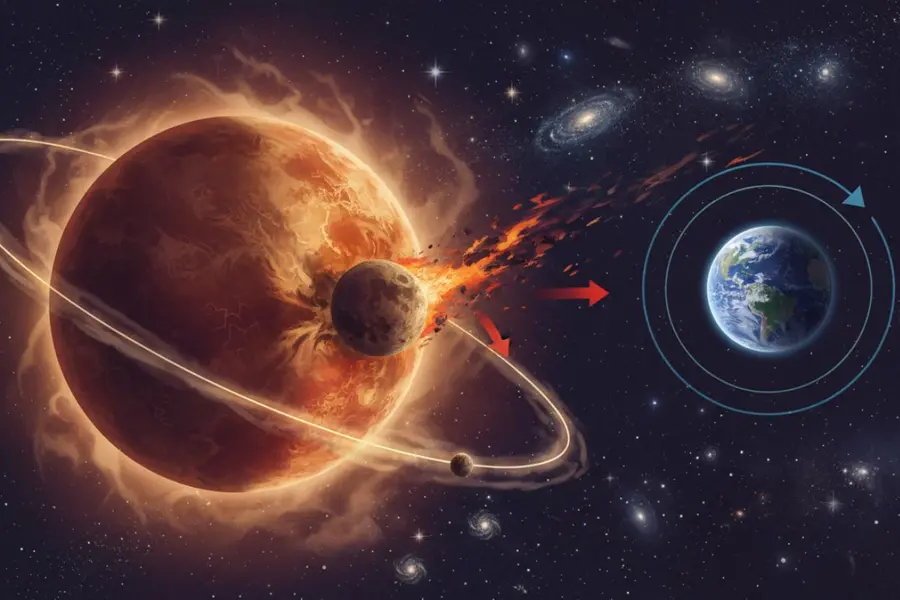
Earth has a large natural satellite that lights up the night sky. Venus, despite being similar to Earth in size and often called our planetary twin, has none. A new study offers a possible explanation: if Venus once had a moon, the planet's slow rotation and powerful gravitational interaction may have eventually pulled it back towards the surface.
The research, published in The Astrophysical Journal, suggests that Venus may not have needed a giant cosmic collision to lose a moon. Instead, the planet's own rotation and gravity could have set its satellite on a slow path towards destruction.
The finding does not prove that Venus once had a moon. But it offers a new explanation for why a large satellite could not have remained around the planet indefinitely.
Why Venus could not keep a moon
The key difference between Earth and Venus is their rotation.
Earth completes one rotation in roughly 24 hours. Venus, by comparison, takes about 243 Earth days to rotate once, making it the slowest-spinning planet in the Solar System.
That difference can affect the long-term relationship between a planet and its moon.
On Earth, energy associated with the planet's rotation is transferred to the Moon, gradually pushing it farther away from us.
Venus could experience the opposite effect. Its extremely slow rotation, combined with its gravitational interaction with a moon, could cause the satellite to gradually lose orbital distance and spiral towards the planet.
Eventually, that process could end with the moon colliding with Venus.
What the Venus moon study found
Astrophysicist Stephen Kane of the University of California, Riverside, tested the possibility using computer models designed to simulate how planetary bodies interact through gravity.
Before examining Venus, Kane first modelled the Earth-Moon system to check whether the model could reproduce the behaviour of a known planetary system.
He then changed Venus' rotation speed and tested hypothetical moons of different sizes, ranging from half the mass of Earth's Moon to ten times its mass.
In most of the simulations, the outcome was similar: the moon eventually crashed into Venus.
The simulations also showed that a more massive moon would collide with Venus more quickly.
That provides a possible answer to a long-standing question about Earth's planetary neighbour: if Venus once had a moon, why isn't it there today?
Did Venus actually have a moon?
That remains unanswered.
Scientists have previously considered different possibilities for Venus' lack of a natural satellite. One idea is that Venus once had a moon that was destroyed following a massive collision. Another possibility is that Venus never experienced the kind of event required to create a moon in the first place.
Kane's research presents another scenario — that a moon could have formed around Venus but eventually spiralled inward because of the planet's slow rotation and gravitational dynamics.
The study therefore does not establish that Venus definitely had a moon. Instead, it shows that the moon could have been unable to survive permanently under certain conditions.
What this could mean for planets beyond our Solar System
The research could also have implications for the search for Earth-like planets around other stars.
Scientists often consider the presence of a moon when studying potentially Earth-like worlds. Earth's Moon plays a role in the long-term behaviour of our planet, including its rotational orientation.
But the Venus study suggests that simply forming a moon may not be enough. A planet's rotation rate could determine whether its satellite survives over extremely long periods.
The researchers concluded that slowly rotating rocky planets in the inner regions of planetary systems may struggle to retain large moons, with possible consequences for their long-term rotational stability and habitability.
For Kane, the finding raises a broader question about planets that resemble Earth.
If an Earth-like planet rotates too slowly, its moon might not remain in orbit forever — it could eventually fall back onto the planet itself.
With PTI inputs
Published: 16 Sept 2026, 12:41 pm IST
ABOUT THE AUTHOR

Disclaimer: Kindly avoid objectionable, derogatory, unlawful and lewd comments, while responding to reports. Such comments are punishable under cyber laws. Please keep away from personal attacks. The opinions expressed here are the personal opinions of readers and not that of Mathrubhumi.